

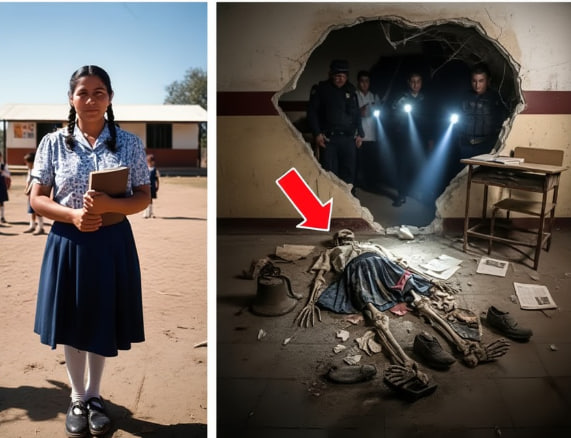
Rain fell softly over the town of San Merido the night the workers reopened Classroom 214.
For decades, the old building had stood quietly at the far edge of the city, hidden behind rows of aging pine trees and rusted iron fences. Most people barely noticed it anymore. The school had closed long ago after newer campuses were built closer to the city center, leaving the original structure abandoned to dust, silence, and rumor.
Children avoided the place after sunset.
Older residents rarely spoke about it at all.
And on the third floor, behind a faded wooden door wrapped in chains and old warning tape, Classroom 214 remained sealed for twenty-five years.
No one seemed to know exactly why.
The official records were strangely incomplete. Some documents claimed the room had suffered structural damage during a storm in 1999. Others suggested there had once been plans to renovate the entire floor before funding disappeared unexpectedly.
But none of the explanations truly satisfied the people of San Merido.
Because everybody remembered the teacher.

Claudia Venegas.
Even after twenty-five years, older residents still lowered their voices whenever they mentioned her name.
She had been one of the most beloved teachers in the school. Students described her as kind, intelligent, and unusually curious about local history. She often encouraged her class to question old stories rather than blindly accept them.
“Every town hides memories,” she once told her students.
“Sometimes the past waits patiently for someone willing to listen.”
Then one autumn morning in October 1999, Claudia simply stopped appearing at school.
No farewell.
No explanation.
According to local rumor, Classroom 214 was locked only days later and never reopened again.
Until now.
The construction workers assigned to restore the abandoned school initially assumed the room would be empty like the others. Most classrooms contained little more than broken chairs, water stains, and layers of dust.
But the moment the chains were cut from Classroom 214, something felt different.
The air itself seemed strangely cold.
One worker pushed the heavy wooden door open slowly, and a cloud of dust drifted into the hallway beneath the flickering flashlight beams.
Nobody spoke for several seconds.
The classroom looked untouched.
Desks remained perfectly aligned in rows beneath faded sunlight filtering through cracked curtains. Open notebooks still rested on the tables. A globe stood quietly beside the chalkboard as if waiting for the next geography lesson to begin.
Near the teacher’s desk sat an old ceramic coffee mug.
Inside, a dark stain remained dried against the bottom.
One of the workers whispered softly.
“It looks like someone just walked out yesterday.”
News of the discovery spread through town almost immediately.
By morning, photographs from inside the classroom had flooded social media. Thousands became fascinated by the eerie atmosphere preserved within the forgotten room. Some called it “the classroom frozen in time.” Others compared it to a doorway into another era.
But the strangest discovery came later that afternoon.
Inside the bottom drawer of Claudia Venegas’s desk, hidden beneath faded lesson plans and yellowed attendance sheets, the workers discovered a sealed envelope.
No address.
No stamp.
Only a name written carefully across the front.
“For whoever finally opens this room.”
The letter inside contained only a few lines.
If you are reading this, then the silence did not last forever.
Some doors were sealed not to keep people out…
but to keep memories in.
Do not trust the basement archives.
And whatever you hear after sunset…
do not answer the knocking.
No signature followed the message.
Yet everyone immediately believed Claudia Venegas had written it.
The internet exploded with theories.
Some users believed the school concealed a forgotten scandal hidden beneath decades of secrecy. Others imagined underground tunnels running beneath the building connected to older structures buried under the town itself.
Within days, online investigators uncovered old newspaper clippings referencing strange construction work beneath the school during the 1970s. A few blurry photographs even appeared showing workers standing beside large sealed metal doors underground.
The images only fueled the mystery further.
Soon, people from neighboring cities began traveling to San Merido hoping to glimpse the legendary classroom for themselves.
But something else began happening too.
The workers restoring the school started refusing to remain inside after dark.
One claimed he heard desks scraping across the floor above him despite the third level being completely empty.
Another reported seeing faint light glowing beneath the sealed classroom door late at night even after the electricity had been disconnected.
Most unsettling of all were the sounds.
Knocking.
Always three slow knocks.
Coming from somewhere inside the walls.
Naturally, many dismissed the stories as imagination fueled by internet hysteria and old urban legends. Local officials insisted the building was structurally unstable and warned people not to spread exaggerated rumors online.
But curiosity only grew stronger.
Among those drawn to the mystery was Elena Torres, a young journalist searching for the truth behind the story before it vanished beneath conspiracy theories and fabricated social media posts.
Unlike most internet users, Elena cared less about paranormal legends and more about Claudia Venegas herself.
Who had she really been?
And why had an entire classroom remained untouched for twenty-five years?
Elena spent days researching old archives inside the town library. Most records about Claudia were frustratingly ordinary: teaching awards, student photographs, school newsletters.
Until she discovered something strange.
A newspaper article from September 1999 described Claudia leading students on a local history project involving forgotten underground structures beneath San Merido.
According to the article, the students had uncovered references to a hidden archive system built beneath the original school decades earlier.
Then the records suddenly stopped.
No follow-up articles.
No project conclusions.
Nothing.
Late one evening, Elena visited the abandoned school herself.
Rain tapped softly against broken windows as she climbed the staircase toward the third floor. The hallway lights no longer worked, leaving only her flashlight cutting through the darkness.
Classroom 214 stood open at the end of the corridor.
Waiting.
Inside, everything remained exactly as the photographs showed. Dust covered the desks like gray snow. Faded lesson notes still covered part of the chalkboard.
But Elena noticed something others had missed.
One section of the floor near the teacher’s desk sounded hollow beneath her footsteps.
Carefully, she moved aside an old bookshelf leaning against the wall. Beneath it, nearly hidden under years of dust, was a narrow metal hatch built into the floorboards.
Her pulse quickened.
The hatch opened with difficulty, releasing cold air from below.
A narrow staircase disappeared into darkness beneath the school.
For several moments, Elena simply stared downward.
Then she remembered the letter.
Do not trust the basement archives.
Somewhere deep below, she heard it.
Knock.
Knock.
Knock.
Slow.
Deliberate.
Waiting.
Every instinct told her to leave immediately. Yet curiosity pulled harder than fear.
Step by step, Elena descended into the darkness beneath the school.
The underground corridor stretched farther than she expected. Rusted pipes lined the ceiling, and old electrical wires hung loosely along concrete walls stained by moisture and time.
At the far end stood another door.
Unlike the abandoned classroom above, this one looked almost untouched.
And carved into the metal surface were three words:
MEMORY PRESERVATION ARCHIVE
Elena’s flashlight trembled slightly as she pushed the door open.
Inside were hundreds of shelves filled with old recordings, photographs, student journals, and boxes of forgotten documents dating back decades.
At the center of the room sat an ancient reel-to-reel tape recorder.
Still running.
The tape turned slowly despite the absence of power.
Then a voice filled the room.
Soft.
Calm.
Familiar.
“If someone finally found this place,” the voice said, “then the town failed to bury the truth.”
Elena froze.
It was Claudia Venegas.
The recording explained that years earlier, teachers and officials had secretly documented unusual psychological phenomena linked to the school building itself. Students reported vivid shared dreams, hearing voices inside empty rooms, and remembering events that had never happened.
The deeper officials investigated, the stranger the incidents became.
Some students described seeing people standing silently inside classrooms after hours — figures who vanished whenever approached.
Others spoke of memories appearing suddenly inside their minds that did not belong to them.
According to Claudia, the school had been built directly above older underground chambers discovered during construction in the 1960s.
Nobody ever determined who originally built them.
Or why.
Then came the final recording.
“We sealed the classroom because something inside the building remembers people,” Claudia whispered through static. “And once it remembers you… it never fully lets you leave.”
The tape stopped.
Silence swallowed the room.
Then Elena heard the knocking again.
This time directly behind her.
Three slow knocks against the archive door.
Knock.
Knock.
Knock.
When she turned, nobody was there.
Only darkness beyond the doorway.
The story Elena published weeks later became one of the most discussed mysteries online. Skeptics dismissed it as fictional storytelling mixed with local legends and exaggerated rumors. Experts argued the recordings were likely staged or fabricated entirely.
No official investigation confirmed the existence of underground archives beneath the school.
And when authorities searched the building afterward, they claimed to find nothing below Classroom 214 except sealed concrete foundations.
No staircase.
No hidden rooms.
No archive.
Yet Elena never publicly changed her story.
Even now, visitors occasionally travel to San Merido hoping to see the sealed classroom for themselves.
Most find only an abandoned school slowly disappearing beneath ivy and rain.
But according to local rumor, some nights a faint light still glows from the third-floor windows.
And if you stand quietly in the hallway outside Classroom 214 after sunset…
You may still hear someone knocking softly from beneath the floor.