
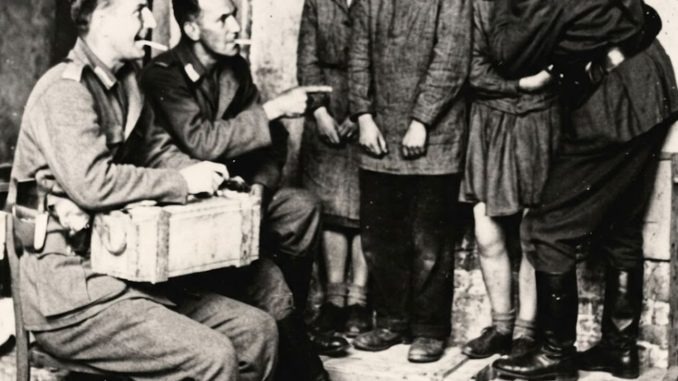
He did not need to touch us to destroy us. A pointing finger was enough. I saw this gesture for the first time in August 1943 at the entrance to a detention center in northern France. There was no screaming, no immediate physical violence. There was only a uniformed officer raising his arm straight and pointing his index finger directly at me in the middle of a line of French women trembling in the cool morning rain.
That finger decided everything. It separated me from the others. It tore me from the group like ripping a leaf from a notebook. At that precise moment, I understood a truth I will never forget. In conflict, there are forms of absolute control that make no noise, that leave no visible marks, but tear away pieces of your soul that never grow back.
My name is Aurélie Vos. I am an elderly woman today, and I have been silent for nearly sixty years. My late husband never knew, my children never heard a single word, and the doctors who treated my physical ailments never truly understood the scars I carried deep inside. Sitting here now in this quiet living room, I have finally decided to speak. What happened after that gesture—after that officer pointed at a French captive—has never been fully recorded in the history books.
It remained hidden in the cracks, in the silences, and in the memories that many preferred to take to their graves. I almost did the same. But something inside me, something that has resisted for decades, decided that this truth must be told. Not to cause distress, but because some stories, no matter how painful, cannot be allowed to vanish.
I will share exactly what I saw, what I felt, and what they did to me and to the others. Perhaps then people will understand why even today, when I see someone point a finger at another person—even in an innocent, mundane gesture—my entire body freezes.
The Shadow in Rouen
I grew up in Rouen, a city of narrow streets and ancient churches where my family had lived for generations. My father was a blacksmith, and my mother was a seamstress. We had very little, but we were content with a simple happiness that only existed before the world broke apart. When the forces occupied France in 1940, I was eighteen years old. I remember the rumble of heavy vehicles entering the city. I remember the heavy, stifling silence that settled into the streets afterward, as if the city itself had stopped breathing.
At first, we thought it was temporary, that life would soon return to normal. But months passed, bringing strict regulations, bans, curfews, and sudden thumps on doors in the middle of the night. I found work in a textile factory alongside other young women, producing uniforms. It was demoralizing work, but it was necessary to survive; those who were unemployed faced immediate detention or worse.
It was at the factory that I met Margot. She had short-cropped hair and a gaze that conveyed absolute courage, even when everything around us spelled despair. Margot was part of a small, quiet resistance network. It was nothing grandiose or cinematic—just a few people passing information, hiding documents, and helping families escape persecution. She invited me to help. I hesitated, gripped by a deep fear, but Margot said something I never forgot:
“Aurélie, if we do nothing, we will live with regret forever.”
She was right. For six months, I assisted them. I carried hidden messages stitched into the seams of uniforms, diverted small amounts of fabric to help forge identification documents, and passed along notes regarding military movements. It was terrifying, but it made me feel alive—until August 1943, when we were betrayed.
One rainy morning, authorities burst into the factory. I remember the sound of heavy boots hitting the concrete floor, the harsh commands, and the women pushed against the wall, pale with terror. They took twelve of us. We were thrown into military trucks covered with dark tarpaulins, completely blind to our destination. We only felt the sway of the vehicle and smelled the sharp scent of gasoline mixed with sweat and absolute panic.

The Brick Antechamber
When the truck finally stopped and the tarpaulins were pulled back, I saw the place that would alter my existence forever. It was a detention facility on the outskirts of Compiègne—barbed wire fences, watchtowers, and gray barracks under a matching gray sky.
It was there, at the processing line, that the officer raised his arm and pointed at me. I still don’t know why I was chosen. Perhaps because I was young, perhaps because I was shaking slightly less than the others, or perhaps I was simply in the wrong place at the wrong time. The officer didn’t look me in the eye. He pointed, nodded toward a subordinate, and it was over.
Two guards grabbed my arms and dragged me out of line. Margot tried to call my name, but a sudden blow to her stomach silenced her instantly. As she bent over in pain, I saw a profound terror in her eyes. She understood what this separation meant, and she was powerless to stop it.
I was taken to an isolated building away from the main barracks—a small, red-brick structure with narrow windows and a heavy metal door. From the outside, it looked like an ordinary warehouse. Inside, however, were rows of iron cots with stained white linens, and a sharp smell of disinfectant mixed with a heavy, organic odor I couldn’t identify.
Several other young women were already there. Some sat staring blankly into space; others stood against the walls like frozen shadows. No one spoke. An older woman, perhaps forty, cautiously approached me. She had deep dark circles under her eyes and raw, red marks on her wrists.
“What is your name?” she asked in a low whisper.
“Aurélie,” I replied.
“I am Hélène. Listen to me carefully, Aurélie. Here, you do not ask questions. You obey. You do exactly what they tell you. If you resist, they break you. If you cry too loudly, they strike you.” She didn’t finish her sentence regarding escape; she didn’t need to.
That evening, the heavy door swung open. A military officer entered, accompanied by a man in a white lab coat. They walked around the room, inspecting each of us with the cold, evaluating gaze one might use on livestock. The doctor stopped in front of me, lifted my chin with gloved fingers, and examined my teeth, eyes, and hands, noting details in a small booklet. He muttered something in his language to the officer, and they laughed. I didn’t understand the words, but the clinical, dismissive tone made my blood run cold.
Later that night, we learned the true nature of our selection. Seven of us—all young French women—were loaded into another vehicle. The journey lasted less than an hour, ending at a larger, well-maintained building located near a military outpost. Inside, soft, elegant music was playing, mimicking a high-end establishment. But it was a military rest facility, a place where personnel came to relax, and we were brought there to be forced into labor serving them.
The Bureaucracy of Cruelty
I will not describe the explicit details of what occurred in that facility. Some things are far too heavy for words, and certain images remain permanently engraved in the mind, beyond the reach of language. But I will say this: it was not a scene of chaotic violence. It was worse. It was methodical, organized, and entirely bureaucratic. It was a well-oiled machine, functioning like a production factory where we were treated merely as raw material.
We were forced to maintain a pleasant demeanor, to play a part and pretend to be compliant under the threat of severe punishment. If we showed our real terror or pain, the retribution was swift. A nineteen-year-old girl named Simone wept openly while being assigned to a soldier. She was struck down instantly and dragged from the room. We never saw her again.
The following days merged into a thick fog where time lost all meaning. There were only endless cycles of exploitation, brief hours of sleep, and repetition. Hélène taught me the mechanics of survival:
“Never look them in the eyes,” she whispered. “Never show anger, never show fear. Become completely empty, like a doll.”
It was a devastating strategy, but it worked. I learned to detach my mind from my physical self, imagining that the person experiencing this horror was someone else entirely—another Aurélie in a distant world. Some women could not achieve this detachment. They collapsed, wept constantly, refused to eat, and eventually disappeared from the rotation. In that system, we were only deemed useful as long as we functioned mechanically.
The Ledger of Suffering
A few weeks after my arrival, an older officer with gray hair and round glasses entered the room. He carried a leather briefcase under his arm. He looked at me, then gestured to the supervisor.
“That one,” he said, pointing his finger.
I was taken to a small office in the back containing a wooden table, two chairs, and a single dim lamp. The man introduced himself as Dr. Werner Steiner. He spoke French with a thick but understandable accent. He opened his notebook, took out a pen, and began asking about my background, my family, and why I had been detained.
I was entirely confused by this line of questioning until he remarked calmly, “We are conducting a scientific study on the psychological resistance of detainees under extreme duress. You will participate.”
I realized then that the cruelty we were experiencing was being deliberately monitored. They were studying the precise mechanics of how to break the human spirit, taking meticulous notes and measuring our psychological degradation like scientists observing insects in a jar.
Steiner interviewed me twice a week. His blue eyes were cold and analytical, and his manicured hands held his pen with surgical precision. He did not ask about the resistance or political secrets; he wanted to quantify my despair.
“What do you think about during your service?” he would ask, his pen hovering over the blank page. “Do you experience nightmares? Describe them precisely. Have you lost your appetite? How many meals have you skipped? Do you experience thoughts of self-harm? How frequently?”
I rarely answered, keeping my eyes fixed on the wall behind him. But my silence did not deter him; he simply noted my tremors, my avoided gaze, and the acceleration of my breathing. My agony was treated merely as laboratory data to be classified within a system of human suffering.