
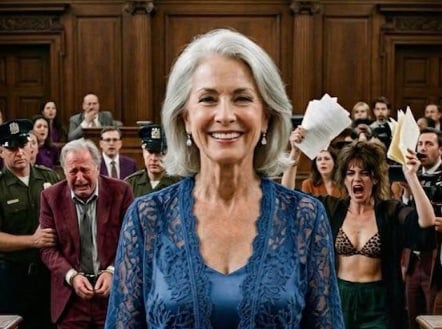
For twenty-two years, Margaret Hale had been my attorney.
She was the kind of woman people underestimated at first glance. Her silver hair, calm smile, and measured voice made strangers assume she was gentle.
She was.
But she was also incredibly prepared.
Margaret believed in facts, records, and patience. She never rushed into conflict. She simply made sure the truth was organized well enough to speak for itself.
When I called her that morning, she answered on the second ring.
“Has Robert moved out?” she asked.
“Yes.”
“Did he take anything besides personal belongings?”
“A few watches. Some photographs. A couple of boxes.”
“Good.”
Most people would have found that response strange.
But Margaret never celebrated problems. She celebrated clarity.
When something finally became visible, it could finally be addressed.
And after nearly five decades of marriage, clarity was exactly what I needed.
Looking Back at What Was Lost
Robert and I had been married for forty-eight years.
We built a life together.
At least, that was the story everyone saw from the outside.
There were company dinners, charity events, business milestones, and family celebrations. We appeared successful, stable, and united.
Over time, however, I began noticing something that was difficult to admit.
The partnership that once existed between us had slowly shifted.
Conversations became shorter.
Decisions became one-sided.
The respect that had once been mutual started feeling increasingly conditional.
When I faced a serious health challenge several years earlier, I expected us to become stronger as a couple.
Instead, I found myself feeling more alone than ever.
It was during that period that Margaret asked me a question I never forgot.
“Do you still believe Robert sees you as a partner,” she asked, “or are you holding on to the memory of who he used to be?”
The question stayed with me long after she left.
Not because it was cruel.
Because it was honest.
Quiet Preparation
Margaret never encouraged dramatic decisions.
She encouraged preparation.
“If everything improves,” she told me, “you’ll never need these records. If it doesn’t, you’ll be glad they exist.”
So I began organizing documents.
Not hiding anything.
Not moving anything improperly.
Simply documenting reality.
For decades I had helped manage the financial side of our business.
I reviewed budgets.
I negotiated contracts.
I tracked investments.
I monitored expenses.
I participated in strategic decisions that allowed the company to grow.
Many people assumed Robert was solely responsible for our success because he was the public face of the company.
I never corrected them.
But inside the organization, everyone understood how much work happened behind the scenes.
Margaret helped me review ownership structures, trust documents, property records, and governance policies.
Everything was legal.
Everything was transparent.
Everything was documented.
Most importantly, everything reflected the actual contributions that had built our success over the years.
Robert rarely paid attention to paperwork.
He preferred big-picture conversations and public appearances.
That tendency would eventually become important.
An Unexpected Filing
Several months later, Robert formally filed for divorce.
The documents arrived on a rainy Tuesday afternoon.
I sat at my kitchen table reading page after page.
What surprised me wasn’t the filing itself.
It was the assumptions behind it.
The paperwork suggested that Robert had been the primary driver of our financial success and that I had played a limited supporting role.
I laughed.
Not because it was funny.
Because it was so disconnected from reality.
Margaret read the documents later that evening.
“They’re relying on perception,” she said.
“What does that mean?”
“It means they’re assuming nobody will look closely.”
She closed the folder.
“That’s rarely a good strategy.”
The Day of the Hearing
The courthouse was quiet that morning.
Sunlight filtered through the tall windows as people moved through the hallways carrying folders and briefcases.
Robert arrived looking confident.
He greeted several people.
He smiled.
He appeared relaxed.
Perhaps he believed the process would be straightforward.
Perhaps he assumed the outcome had already been decided.
I honestly don’t know.
What I do know is that Margaret arrived carrying a single leather folder.
She looked completely calm.
That should have been a warning to everyone.
A Closer Look at the Facts
When the hearing began, Robert’s attorney presented their position.
The argument focused heavily on Robert’s public leadership role and future earning potential.
Margaret listened without interruption.
Then she stood.
“Your Honor,” she said, “we request that the court review Exhibit C.”
The judge opened the file.
The room grew quiet.
Inside were years of records.
Board resolutions.
Funding histories.
Property documentation.
Investment records.
Corporate governance filings.
The documents showed exactly who had funded various initiatives, who had approved key decisions, and who held specific responsibilities within the organization.
The story they told was simple.
Success had never been the result of one person.
It had been built through partnership.
And the records reflected that reality.
Questions Nobody Expected
The judge reviewed several pages before speaking.
Then came a series of questions.
Questions about ownership.
Questions about management authority.
Questions about documented contributions.
Questions about decision-making responsibilities.
Each answer pointed back to the same conclusion.
The business had always been far more collaborative than Robert’s filing suggested.
Margaret didn’t need dramatic arguments.
The records spoke clearly.
Every signature.
Every approval.
Every transaction.
Every board vote.
Together, they created a timeline that was difficult to dispute.
For the first time that morning, Robert looked uncertain.
The Property Records
Then the discussion shifted to real estate holdings.
Several properties had been acquired, managed, and maintained over decades.
Again, documentation mattered.
The records showed who had funded purchases.
Who had managed expenses.
Who had overseen improvements.
Who held legal interests.
There were no surprises for me because I had reviewed every document with Margaret beforehand.
But watching everything laid out in chronological order created a very different picture than the one Robert’s legal team had presented.
The judge spent considerable time reviewing the materials.
Nobody interrupted.
Nobody rushed her.
Everyone understood that details mattered.
The Truth About Leadership
One moment stood out more than any other.
The judge reviewed several governance documents related to the company.
Then she looked up.
“Leadership takes many forms,” she said.
It was a simple statement.
Yet it captured something important.
Public visibility and actual responsibility are not always the same thing.
Some people stand in front of the spotlight.
Others make sure the lights stay on.
Both contributions matter.
But only one of them is usually documented in spreadsheets, reports, and operational records.
Margaret smiled slightly.
She knew exactly what the judge meant.
A Different Perspective
As the hearing continued, the conversation became less about assumptions and more about evidence.
That shift changed everything.
When people rely on appearances, stories can become distorted.
When they rely on records, reality becomes easier to see.
For years, many individuals had assumed I played a minor role in our success.
Not because they had investigated the facts.
Because they had accepted the easiest narrative.
The hearing challenged that narrative.
Not through emotion.
Not through accusations.
Simply through documentation.
Lessons From a Long Marriage
During a break, I found myself reflecting on the previous forty-eight years.
I wasn’t thinking about business.
I wasn’t thinking about property.
I wasn’t even thinking about the hearing.
I was thinking about how easy it is for contributions to become invisible over time.
Especially contributions made quietly.
Many people spend years supporting families, organizations, communities, and businesses without seeking recognition.
They solve problems.
They keep records.
They handle responsibilities.
They create stability.
Then one day, someone assumes none of that mattered.
The truth is that it always mattered.
The challenge is proving it.
The Judge’s Observation
Near the end of the session, the judge made a comment I will never forget.
She looked at the documents stacked before her.
Then she said:
“Long-term success is rarely created by one individual alone.”
The courtroom remained silent.
The statement wasn’t dramatic.
It wasn’t intended to be.
It was simply accurate.
Behind every successful company, household, organization, or partnership are usually many contributions that never appear in headlines.
The records in front of her demonstrated exactly that.
Walking Forward
When the hearing concluded, people slowly began leaving the courtroom.
Margaret gathered her files.
Robert remained seated for several moments.
Neither of us said much.
There was nothing left to argue.
The documents had already spoken.
Outside, the afternoon sun felt warmer than expected.
Margaret handed me a copy of several filings.
“You did the hard part years ago,” she said.
“What hard part?”
“You paid attention.”
I smiled.
Because she was right.
Preparation isn’t dramatic.
Organization isn’t exciting.
Documentation rarely feels important in the moment.
Yet those ordinary habits can become incredibly valuable when life changes unexpectedly.
A New Chapter
As I drove home, I thought about the future.
Not about winning.
Not about losing.
Not about revenge.
Those ideas felt too small.
Instead, I thought about something Margaret had taught me years earlier.
Facts are not weapons.
Facts are foundations.
The stronger the foundation, the easier it becomes to move forward.
For years, I had quietly maintained records, organized information, and protected what mattered.
Not because I expected conflict.
Because responsibility required it.
And in the end, that responsibility became one of the most important gifts I ever gave myself.
The future remained uncertain.
But for the first time in a very long time, it felt like a future built on truth rather than assumptions.
And that made all the difference.