

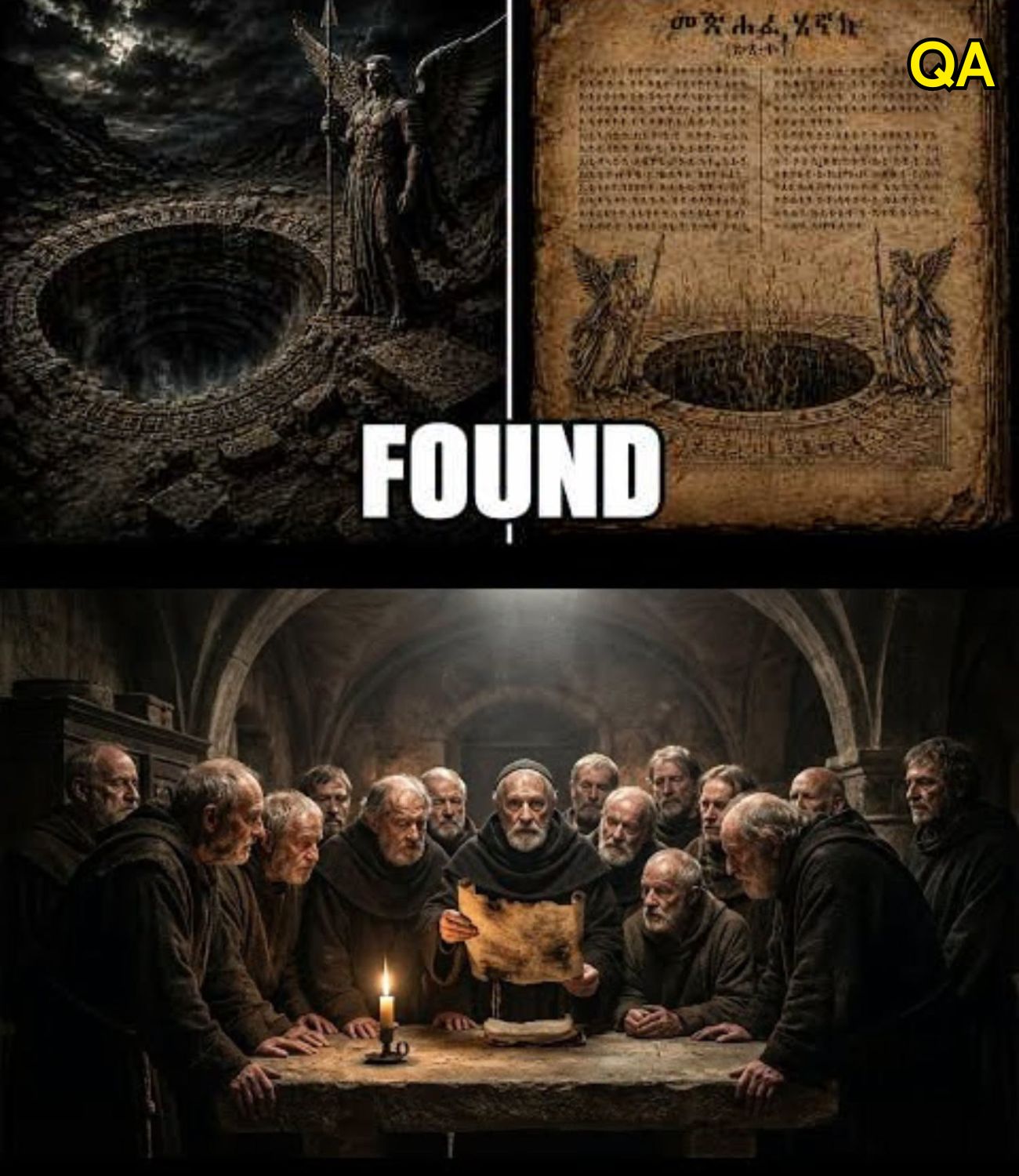
Few ancient writings have inspired as much curiosity as the Book of Enoch. Although it is not included in most modern biblical canons, the text has fascinated historians, theologians, archaeologists, and readers for centuries with its vivid descriptions of heavenly journeys, mysterious beings, and extraordinary landscapes.
Among its most intriguing passages are descriptions of a vast abyss—a place portrayed as a boundary between the earthly and the spiritual world. These passages have led some readers to speculate whether the author described an actual geographic location somewhere in the ancient Near East.
The rugged deserts surrounding the Dead Sea and the Negev are filled with dramatic cliffs, sinkholes, caves, and deep ravines that naturally inspire stories of hidden worlds. While no scientific evidence supports the existence of a literal supernatural gateway beneath these landscapes, the combination of striking geology and ancient literature continues to capture the imagination.
Understanding this subject requires looking at both the historical context of the Book of Enoch and the scientific realities of the region’s geology.
What Is the Book of Enoch?
The Book of Enoch is an ancient Jewish religious work believed to have been composed between the third and first centuries BCE.
Although it was highly influential among some early Jewish communities and is preserved in the canon of the Ethiopian Orthodox Church, it was not included in most Jewish or Christian biblical collections.
Interest in the text increased significantly after fragments written in Aramaic were discovered among the Dead Sea Scrolls near Qumran in 1947.
These discoveries confirmed that portions of the work were widely circulated centuries before the New Testament.
Enoch’s Journey Through Symbolic Landscapes
One of the book’s best-known sections, often called the Book of the Watchers, describes Enoch being guided by angels through remarkable cosmic locations.
He encounters towering mountains, fiery valleys, heavenly realms, and deep chasms.
Many biblical scholars understand these scenes as part of apocalyptic literature, a style of writing that uses symbolic imagery to communicate spiritual truths rather than geographic directions.
Nevertheless, the vivid descriptions have inspired generations of readers to wonder whether real landscapes influenced the author’s imagination.
Why the Judean Desert Inspires Mystery
The region surrounding the Dead Sea is unlike almost anywhere else on Earth.
Its landscape includes:
-
Steep limestone cliffs
-
Deep canyons
-
Salt formations
-
Sinkholes
-
Dry river valleys
-
Extensive cave systems
Extreme temperatures and unusual geological features have contributed to local traditions for thousands of years.
Ancient travelers encountering these dramatic environments naturally associated them with powerful religious symbolism.

Understanding Sinkholes and Deep Cavities
Modern geology provides clear explanations for many of the unusual landforms found near the Dead Sea.
Large underground cavities can develop when groundwater dissolves layers of salt and limestone.
Over time, the roof above these cavities may weaken and collapse, producing sinkholes that sometimes appear suddenly.
Scientists continue monitoring these features because they represent natural geological hazards rather than supernatural phenomena.
Fire, Smoke, and Ancient Observation
The Book of Enoch describes fire, darkness, smoke, and unusual atmospheric conditions.
Although these descriptions are often interpreted symbolically, some natural features may have influenced such imagery.
Examples include:
-
Heat rising from sun-baked rock
-
Dust carried by desert winds
-
Temperature inversions
-
Natural gas seeps in some regions
-
Optical effects caused by desert haze
Ancient observers often explained unfamiliar natural phenomena using the religious language available to them.
The Dead Sea Scrolls and Their Importance
The discovery of the Dead Sea Scrolls transformed modern scholarship.
Fragments of the Book of Enoch found at Qumran demonstrated that the text circulated widely among Jewish communities more than two thousand years ago.
These manuscripts have helped scholars better understand:
-
Early Jewish theology
-
Ancient biblical traditions
-
The development of apocalyptic literature
-
Religious thought during the Second Temple period
The scrolls remain among the most significant archaeological discoveries of the twentieth century.

Did Archaeologists Find the Abyss?
From time to time, stories circulate online claiming that archaeologists discovered a location matching Enoch’s descriptions or abandoned excavations after encountering unexplained phenomena.
To date, no verified archaeological evidence supports these claims.
Professional excavations in the Dead Sea region have documented settlements, caves, cemeteries, and geological formations, but none has confirmed the existence of a literal entrance to an underworld described in ancient religious texts.
Historians generally regard these stories as modern legends rather than documented archaeological findings.
Why Stories Like This Continue to Spread
Narratives connecting sacred texts with mysterious locations remain popular for several reasons.
They combine:
-
Ancient history
-
Religious tradition
-
Archaeology
-
Dramatic landscapes
-
Unanswered questions
The human imagination naturally fills gaps where evidence is incomplete, allowing folklore to grow alongside genuine historical discoveries.
The Value of Myth and History
Ancient texts should not be dismissed simply because they contain symbolic language.
Stories preserved for thousands of years often reveal how earlier civilizations understood morality, justice, nature, and humanity’s place in the universe.
Whether interpreted religiously, historically, or literarily, the Book of Enoch continues to offer insight into the beliefs of the communities that preserved it.
Continuing Scientific Research
Researchers continue studying the geology of the Dead Sea and surrounding deserts using satellite imagery, seismic monitoring, and field surveys.
Current research focuses on:
-
Sinkhole formation
-
Groundwater movement
-
Salt dissolution
-
Earthquake history
-
Climate change
-
Archaeological preservation
These studies improve understanding of one of the world’s most unusual geological regions.
Conclusion
The Book of Enoch remains one of the most fascinating works of ancient religious literature, blending powerful symbolism with descriptions of extraordinary journeys through mysterious landscapes. Although modern archaeology has not verified claims of a literal “gateway to the abyss,” the dramatic terrain of the Judean Desert and Dead Sea region continues to inspire reflection, scholarship, and imagination.
By distinguishing between literary tradition, cultural folklore, and scientific evidence, readers can appreciate both the spiritual significance of Enoch’s writings and the remarkable natural history of the landscapes that may have inspired them. The enduring appeal of these stories reminds us that humanity has always sought to understand the unknown—sometimes through faith, sometimes through exploration, and often through a combination of both.
Suggested References
-
National Geographic – The Dead Sea Scrolls
-
Biblical Archaeology Society
-
The Israel Museum – Dead Sea Scrolls Collection
-
Encyclopaedia Britannica – Book of Enoch
-
Geological Survey of Israel
-
Oxford Handbook of the Dead Sea Scrolls