


The windswept coastline of Scotland’s Inner Hebrides has long been a place where nature reveals unexpected surprises. Rocky shores, powerful tides, and the vast Atlantic Ocean regularly carry unusual objects onto quiet beaches, capturing the curiosity of local communities.
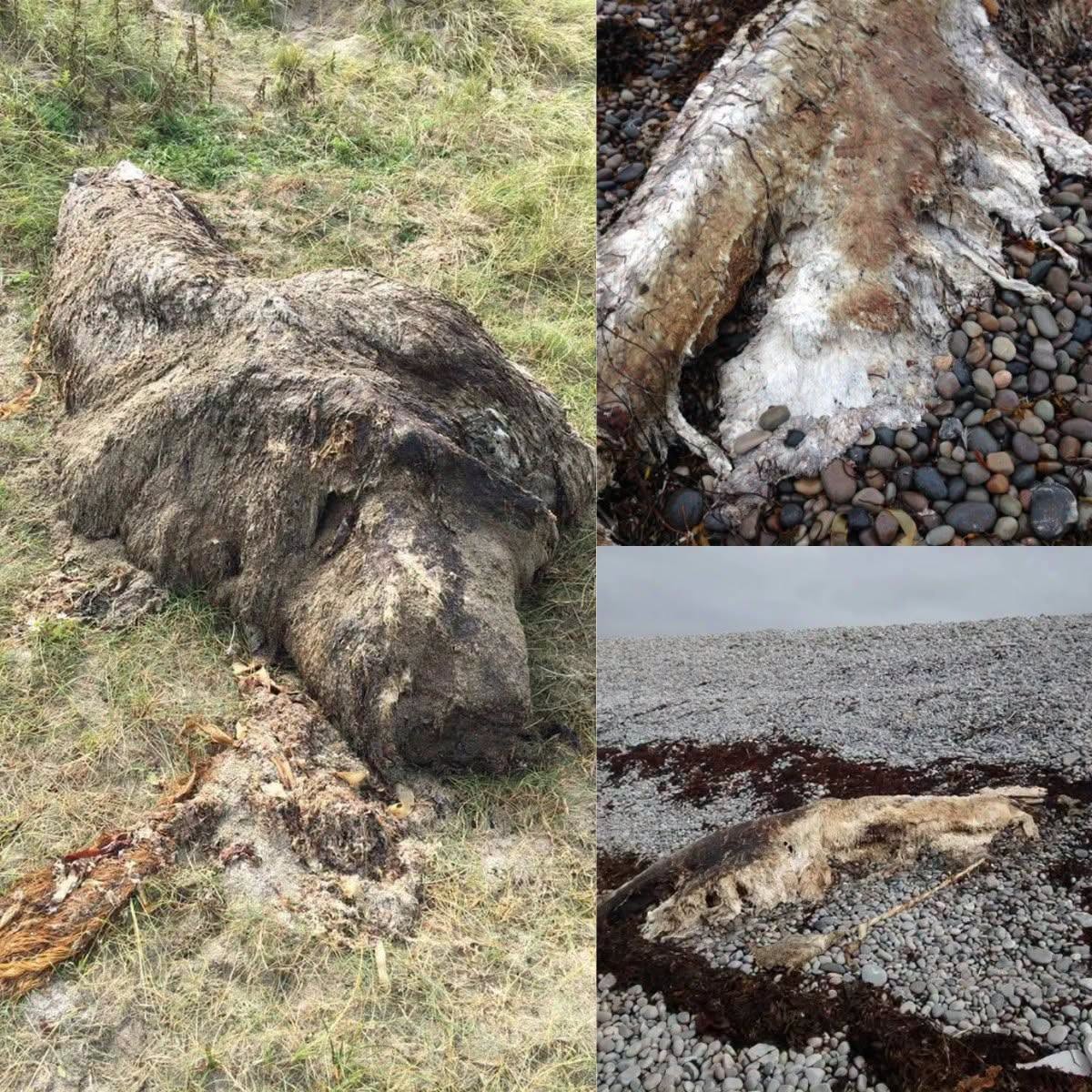
Recently, residents on the island of Colonsay encountered one of the area’s most puzzling discoveries. Several large decomposed animal carcasses washed ashore, initially appearing as indistinct grey masses partially covered with seaweed, sand, and marine debris. Their strong odor and advanced state of decomposition made identification nearly impossible.
As weeks passed and the surrounding debris gradually disappeared, patches of pale fur became visible. The mysterious remains quickly sparked speculation among island residents, with some wondering whether the animals might somehow be polar bears—a remarkable possibility considering the island lies far from the Arctic.
Although the unusual appearance fueled widespread discussion, wildlife experts urged caution, emphasizing that photographs alone cannot reliably identify highly decomposed animal remains. Instead, they pointed to modern forensic science and DNA analysis as the only dependable methods for determining the animals’ true identity.
The Discovery That Captured Public Attention
Residents reported that three large carcasses appeared along different sections of Colonsay’s western coastline after periods of rough weather.
At first, the remains resembled little more than weathered grey shapes.
Over time, however, exposure to wind and rain appeared to remove layers of debris, revealing pale hair-like material beneath.
Several local observers estimated that the carcasses measured approximately three meters in length.
Naturally, questions followed.
Could these be marine mammals?
Were they large land animals carried out to sea?
Or might they belong to an entirely different species?
Without complete skeletons or preserved anatomical features, answers remained uncertain.

Why Identifying Decomposed Animals Is So Difficult
Wildlife biologists explain that advanced decomposition dramatically changes an animal’s appearance.
As tissues break down, several processes occur:
Skin changes color.
Hair may separate from the body.
Fat deposits transform.
Marine organisms feed on exposed tissue.
Wave action alters the body’s shape.
These natural processes can make familiar animals appear almost unrecognizable.
Even experienced veterinarians may find visual identification extremely challenging when only partial remains are available.
For this reason, scientists avoid drawing conclusions until additional evidence becomes available.
Could Polar Bears Drift to Scotland?
The suggestion that the carcasses might be polar bears attracted considerable attention.
Polar bears normally inhabit Arctic regions including:
Northern Canada
Greenland
Svalbard
Alaska
Russia
These animals depend heavily on sea ice for hunting seals and traveling between habitats.
Occasionally, polar bears have been observed drifting considerable distances on floating ice.
However, wildlife experts note that Scotland lies far beyond their normal range.
Although climate change continues influencing Arctic sea ice, specialists consider it highly unlikely that multiple polar bear carcasses would naturally reach Scottish shores.
This does not make the theory impossible, but it does mean extraordinary evidence would be required before confirming such an identification.

The Role of DNA Analysis
When visual identification proves difficult, scientists rely on genetics.
DNA testing has become one of the most accurate methods for identifying unknown animal remains.
Researchers collect small tissue, bone, or hair samples and compare genetic material with international reference databases.
DNA analysis can determine:
Species
Geographic relationships
Population origins
Evolutionary connections
Unlike visual observations, genetic testing provides objective scientific evidence.
For mysterious discoveries like the Colonsay carcasses, DNA testing represents the most reliable path toward accurate identification.
Could the Animals Be Marine Mammals?
Some wildlife specialists suggested alternative possibilities.
Large marine mammals often undergo dramatic physical changes after prolonged exposure to seawater.
Depending on decomposition, seals, whales, dolphins, or walruses may lose many of their recognizable features.
Hair, skin, connective tissue, and fat can create unusual appearances unfamiliar to casual observers.
Because decomposition progresses differently depending on temperature, currents, and scavenger activity, photographs alone rarely provide enough information for definitive identification.
This explains why experts encouraged further examination before reaching conclusions.
Scotland’s Coastline and Ocean Currents
Scotland occupies a unique position where powerful ocean currents meet.
The North Atlantic transports floating objects across remarkable distances.
Every year, coastlines receive:
Driftwood
Fishing equipment
Marine plants
Animal remains
Natural debris
Storm systems can carry floating material hundreds or even thousands of kilometers.
For this reason, unusual discoveries occasionally appear far from their place of origin.
Scientists routinely study ocean currents to understand marine ecosystems, climate patterns, and wildlife movement.
Why Mystery Discoveries Fascinate People
Throughout history, mysterious objects found along coastlines have inspired stories and speculation.
Long before modern marine biology, coastal communities often interpreted unfamiliar remains through folklore.
Legends described:
Sea monsters
Unknown creatures
Mythical beasts
Ocean spirits
These stories reflected humanity’s natural curiosity about environments that remained largely unexplored.
Today, science provides tools unavailable to earlier generations.
Instead of relying solely on appearances, researchers combine genetics, anatomy, ecology, and forensic techniques to solve biological mysteries.

Polar Bears in Culture and Symbolism
Although science approaches wildlife through observation and evidence, polar bears have also held symbolic significance across northern cultures.
Indigenous Arctic communities have long respected polar bears as symbols of:
Strength
Endurance
Adaptability
Wisdom
Balance within nature
These cultural traditions celebrate the remarkable relationship between humans and Arctic wildlife.
Modern conservation science complements these traditions by studying polar bear populations and protecting their natural habitats.
Together, cultural heritage and scientific research deepen our appreciation for one of the world’s most iconic mammals.
Climate Change and Arctic Wildlife
Public discussion surrounding the Colonsay discovery also raised questions about climate change.
Scientists continue monitoring Arctic ecosystems because rising temperatures influence sea ice, wildlife habitats, and ocean conditions.
Research has documented changes including:
Earlier seasonal ice melt
Later autumn ice formation
Changing prey distribution
Altered migration patterns
These environmental changes present ongoing challenges for Arctic species.
However, experts caution against attributing individual wildlife discoveries directly to climate change without supporting scientific evidence.
Each unusual observation requires careful investigation before conclusions can be drawn.
Why Scientific Verification Matters
Extraordinary discoveries naturally generate excitement.
Yet science advances through careful investigation rather than immediate assumptions.
Researchers typically evaluate:
Physical anatomy
Bone structure
Hair characteristics
DNA evidence
Environmental context
Historical records
Only after multiple forms of evidence agree do scientists confidently identify unusual specimens.
This careful process protects scientific accuracy while ensuring reliable conclusions.
The Importance of Coastal Monitoring
Unexpected discoveries along coastlines provide valuable opportunities for research.
Marine biologists regularly encourage members of the public to report unusual animal strandings because each observation contributes to broader scientific understanding.
These reports help researchers monitor:
Marine biodiversity
Wildlife health
Ocean currents
Disease surveillance
Environmental change
Public participation continues playing an important role in expanding scientific knowledge.

A Reflection on Curiosity and Scientific Discovery
The mysterious animal remains discovered on the shores of Colonsay remind us that nature continues to present questions that challenge our understanding. While speculation about polar bears captured public imagination, science encourages patience, careful observation, and evidence before reaching conclusions.
Whether the carcasses ultimately prove to be marine mammals, another large species, or something entirely unexpected, the discovery highlights the value of modern wildlife research. DNA analysis, forensic biology, and ecological studies allow scientists to investigate mysteries with remarkable precision while separating possibility from proven fact.
Human curiosity has always driven exploration, from ancient coastal legends to today’s advanced genetic laboratories. By combining scientific inquiry with respect for nature, we continue learning more about the extraordinary world surrounding us. Every mystery, whether solved quickly or over many years, reminds us that our planet still holds countless discoveries waiting to deepen our understanding of life on Earth.
Sources
NatureScot. Wildlife monitoring and Scottish biodiversity resources.
Scottish Oceans Institute, University of St Andrews. Marine biology and coastal ecosystem research.
International Union for Conservation of Nature (IUCN). Polar bear species information and conservation assessments.
National Oceanic and Atmospheric Administration (NOAA). Marine mammal identification and ocean current research.
Polar Bears International. Scientific resources on polar bear ecology and Arctic conservation.
Smithsonian’s National Museum of Natural History. Animal identification, marine biology, and wildlife research.