
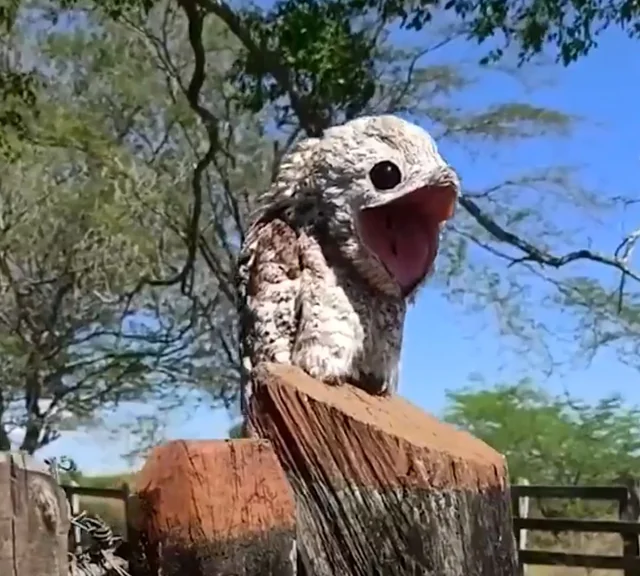
Imagine walking through a quiet countryside at dusk when you notice what appears to be a broken tree branch resting on a fence post. Curious, you step a little closer. Suddenly, the “branch” slowly opens two large golden eyes and stretches its wide mouth, revealing that it is not wood at all, but one of nature’s most extraordinary birds.
That surprising moment recently captured attention after a woman in Colombia encountered a Great Potoo, a remarkable nocturnal bird famous for its incredible camouflage and haunting nighttime calls. Often nicknamed the “Ghost Bird,” the Great Potoo has fascinated bird enthusiasts, photographers, and scientists for generations.
Although its appearance may seem mysterious, the Great Potoo is a fascinating example of evolutionary adaptation. Let’s explore what makes this unique bird one of the most remarkable masters of disguise in the natural world.
What Is the Great Potoo?
The Great Potoo is the largest member of the potoo family, a group of nocturnal birds found throughout Central and South America.
It belongs to the family Nyctibiidae, which is closely related to nightjars and frogmouths. These birds have evolved specialized features that help them survive in forest environments while remaining almost invisible during daylight hours.
Their unusual appearance has earned them colorful nicknames, including:
- Ghost Bird
- Phantom Bird
- Urutaú (in parts of South America)
Despite these names, the Great Potoo is simply a highly specialized bird perfectly adapted to its environment.

Why Is It Called the “Ghost Bird”?
The nickname comes from two remarkable characteristics.
Its Haunting Night Call
The Great Potoo produces long, mournful vocalizations that echo through forests after sunset.
To people hearing the call for the first time, the sounds can seem mysterious or eerie, inspiring local folklore across many regions where the bird lives.
Scientists recognize these calls as normal communication used for attracting mates and maintaining territory.
Its Unusual Appearance
When resting, the bird stands perfectly upright, stretching its neck and pointing its beak skyward.
Combined with its bark-colored feathers, this posture makes it resemble a broken tree branch.
Only when it moves or opens its eyes does its true identity become obvious.
The Incredible Camouflage of the Great Potoo
Perhaps the bird’s most famous feature is its extraordinary camouflage.
Its feathers display a mixture of:
- Gray
- Brown
- White
- Black
These irregular patterns closely resemble weathered tree bark.
During daylight hours, Great Potoos remain almost completely motionless, often choosing dead branches or tree stumps as resting places.
Even experienced birdwatchers can overlook one from only a few feet away.
This remarkable camouflage helps protect the bird from potential predators without requiring it to fly away.
Where Do Great Potoos Live?
The Great Potoo inhabits tropical and subtropical forests across much of Central and South America.
Its range includes countries such as:
- Colombia
- Brazil
- Peru
- Ecuador
- Venezuela
- Panama
- Costa Rica
- Guatemala
The species prefers habitats that include:
- Forest edges
- Riverbanks
- Woodlands
- Open forests with scattered trees
Because they are nocturnal, Great Potoos are much easier to hear than to see.

What Does the Great Potoo Eat?
Like many nighttime birds, the Great Potoo is an insect hunter.
Its diet mainly includes:
- Large moths
- Beetles
- Flying insects
- Occasionally small bats or other small flying vertebrates
The bird typically hunts from an elevated perch.
Rather than constantly flying through the forest, it waits patiently until prey passes nearby before making a quick, precise flight to capture it.
This energy-efficient hunting strategy allows the bird to conserve energy while taking advantage of nighttime insect activity.
Why Does the Great Potoo Have Such a Large Mouth?
One of the bird’s most surprising features is its enormous mouth.
When closed, the beak appears relatively small.
However, when feeding, the mouth opens extremely wide, allowing the bird to catch insects in flight with impressive accuracy.
This adaptation is common among several nocturnal insect-eating birds, including nightjars and frogmouths.
Can the Great Potoo See in the Dark?
Yes.
Great Potoos have exceptionally large eyes that gather available light efficiently.
Excellent night vision allows them to:
- Detect flying insects.
- Navigate through forests after sunset.
- Watch for potential predators.
Interestingly, scientists have also discovered tiny slits in the birds’ eyelids.
These allow them to detect movement even while their eyes appear closed, helping them remain hidden without losing awareness of their surroundings.

Myths and Folklore Surrounding the Ghost Bird
Across South America, the Great Potoo has inspired numerous traditional stories.
Some cultures believed its haunting calls carried messages from the forest or symbolized important natural events.
Others simply viewed the bird as a mysterious guardian of the night because of its unusual appearance and vocalizations.
While these stories are valuable parts of local cultural heritage, modern ornithology explains the bird’s behavior through natural adaptations developed over millions of years.
Its calls, camouflage, and posture all serve practical purposes related to survival rather than anything supernatural.
Is the Great Potoo Dangerous?
Despite its dramatic appearance, the Great Potoo poses virtually no threat to people.
It is:
- Shy
- Solitary
- Non-aggressive
- Primarily active at night
If approached too closely, the bird may:
- Open its eyes suddenly.
- Stretch its mouth wide.
- Fly to another nearby perch.
These behaviors are defensive displays intended to startle potential predators rather than harm them.
Why Did the Colombian Woman Get Startled?
The woman initially believed she had spotted an ordinary stick resting on a fence.
Only after approaching did the bird slowly open its eyes and mouth, revealing its true identity.
Such reactions are understandable because the Great Potoo’s camouflage is considered among the most effective in the bird world.
Many first-time observers report similar surprise when they realize what they are actually seeing.
The Science Behind Its Camouflage
Evolution has shaped nearly every aspect of the Great Potoo’s appearance.
Scientists believe natural selection favored birds that blended more effectively into tree bark.
Features contributing to this camouflage include:
- Bark-like feather coloration.
- Upright resting posture.
- Minimal daytime movement.
- Narrow body profile.
- Excellent patience while remaining still.
Together, these adaptations dramatically reduce the likelihood of being noticed by predators.
Why the Great Potoo Fascinates Bird Enthusiasts
Bird photographers and wildlife observers often consider spotting a Great Potoo a memorable experience.
Unlike brightly colored tropical birds, the Great Potoo impresses through subtlety rather than vibrant plumage.
Its remarkable ability to disappear into its surroundings demonstrates how evolution can produce survival strategies that are both effective and visually extraordinary.
The bird has become a favorite subject for wildlife documentaries because its behavior showcases the complexity of natural adaptation.
Conservation and Habitat Protection
The Great Potoo is currently listed as Least Concern by the International Union for Conservation of Nature, meaning the species is not considered globally threatened at present.
However, like many forest-dwelling birds, it benefits from the protection of healthy woodland habitats.
Conservation efforts that preserve forests also help maintain suitable nesting and hunting environments for Great Potoos and countless other wildlife species.
Conclusion
The Great Potoo reminds us that nature’s most remarkable creatures are not always the brightest or loudest. Sometimes, the greatest marvel lies in the ability to remain almost completely unnoticed.
Its haunting calls, extraordinary camouflage, and unique appearance have inspired centuries of folklore while also providing scientists with fascinating examples of adaptation and survival. Although stories may describe it as a “Ghost Bird,” the Great Potoo is simply one of the world’s most specialized nocturnal birds, perfectly suited to life among the trees.
Human curiosity often begins with moments of surprise, like mistaking a bird for a branch. By learning the science behind these encounters, we gain an even deeper appreciation for the incredible diversity and ingenuity found throughout the natural world.

Sources
- Cornell Lab of Ornithology – Birds of the World
- Smithsonian’s National Zoo & Conservation Biology Institute
- International Union for Conservation of Nature (IUCN) Red List
- All About Birds – Cornell Lab of Ornithology
- Reshareworthy – “Woman Gets a Scare From Ghost Bird Perched on Fence”
- National Geographic – Bird Adaptation and Camouflage Resources