

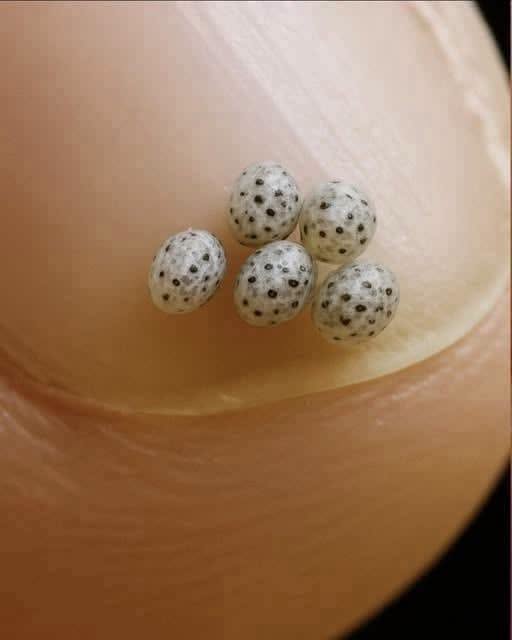
Imagine walking through a forest and spotting several tiny green spheres resting among fallen leaves. At first glance, they might look like miniature watermelons, decorative beads, or even colorful plant seeds. Their smooth surfaces and intricate patterns seem almost too perfect to be natural.
Surprisingly, these tiny objects are not fruits or seeds at all. They are the eggs of stick insects—one of nature’s most fascinating masters of camouflage.
Although stick insects are famous for resembling twigs and branches, their remarkable survival strategy begins long before they hatch. Even their eggs have evolved to blend seamlessly into their surroundings, helping the next generation survive in a world filled with natural challenges.
These extraordinary eggs offer a glimpse into the incredible creativity of evolution and remind us that some of nature’s greatest wonders are almost too small to notice.
What Are Stick Insects?
Stick insects belong to the order Phasmatodea, a group containing more than 3,000 known species found across tropical and temperate regions worldwide.
Their greatest strength is camouflage.
Many species resemble sticks, twigs, leaves, or even bark so convincingly that they can remain unnoticed even when sitting in plain sight. This remarkable disguise helps them avoid predators while they quietly feed on leaves during the night.
Their camouflage has fascinated scientists for decades, but their eggs may be even more extraordinary than the insects themselves.

Eggs That Look Like Tiny Watermelons
One of the first things people notice about stick insect eggs is their appearance.
Depending on the species, the eggs may resemble:
-
Tiny watermelon seeds
-
Miniature green melons
-
Small pebbles
-
Plant seeds
-
Decorative beads
Some species produce eggs with intricate textures, colorful patterns, or tiny ridges that make them appear almost handcrafted.
These features are not simply beautiful.
They serve important biological purposes that increase the chances of survival.
Why Do Stick Insect Eggs Look Like Seeds?
Unlike many insects that actively guard their offspring, most stick insects use a different strategy.
After laying eggs, females simply release them onto the forest floor.
At first, this might seem risky.
However, the eggs’ remarkable resemblance to seeds provides excellent camouflage.
Among fallen leaves, twigs, and natural debris, they become difficult for many animals to distinguish from ordinary plant material.
This form of protective mimicry helps reduce the likelihood that the eggs will be noticed before they hatch.
Nature often favors simple but effective solutions, and seed mimicry is one of the most impressive examples.

The Amazing Role of the Capitulum
One of the most fascinating features of many stick insect eggs is a tiny structure called the capitulum.
Although extremely small, it plays an important role in the insect’s survival strategy.
The capitulum contains nutrients that attract ants.
When ants discover the eggs, they often carry them back to their underground nests.
At first glance, this might seem dangerous for the developing insect.
In reality, it offers remarkable protection.
The ants consume only the nutrient-rich capitulum while leaving the actual egg untouched.
Once finished, they discard the egg inside or near the nest, where it remains safely hidden beneath the soil.
This unusual relationship benefits both species.
The ants receive food.
The stick insect eggs receive protection.
A Clever Example of Nature’s Cooperation
Scientists describe this type of interaction as a mutually beneficial ecological relationship.
Although the ants are primarily interested in the nutritious outer structure, their behavior unintentionally helps protect the developing insects.
Underground ant nests provide several advantages:
-
Protection from many predators
-
Stable temperatures
-
Increased humidity
-
Shelter from environmental changes
Without realizing it, the ants become important partners in the stick insect’s reproductive strategy.
This remarkable adaptation demonstrates how different species can influence one another in unexpected ways.
Built for Survival
Every part of a stick insect egg contributes to its survival.
Its shape helps it blend into leaf litter.
Its texture mimics natural objects.
Its coloration reduces visibility.
Its capitulum attracts helpful ants.
Together, these adaptations dramatically improve the likelihood that the developing insect will survive until hatching.
Rather than relying on parental care, stick insects invest in evolutionary design.
Their eggs do much of the protective work on their own.

Camouflage Begins Before Birth
Most people associate camouflage with adult animals.
However, stick insects demonstrate that effective camouflage can begin even before life truly starts.
Long before a young insect emerges, its egg has already been protecting it through disguise.
This illustrates an important concept in evolutionary biology.
Natural selection can shape every stage of an organism’s life cycle, from egg to adulthood.
In stick insects, camouflage is not simply a characteristic.
It is a lifelong survival strategy.
How Scientists Study Stick Insect Eggs
Researchers have long been fascinated by the incredible diversity of stick insect eggs.
Each species produces eggs with unique characteristics that help scientists identify them.
Using microscopes and advanced imaging techniques, researchers examine:
-
Surface texture
-
Shape
-
Coloration
-
Egg size
-
Capitulum structure
These details provide valuable information about species relationships, evolution, and ecological adaptations.
Some stick insect eggs are so distinctive that scientists can identify the species based solely on the egg’s appearance.
More Than Just Beautiful Patterns
The intricate designs found on stick insect eggs are not random decorations.
Their patterns may help with:
-
Camouflage
-
Structural strength
-
Moisture regulation
-
Species recognition
-
Environmental adaptation
Nature often combines beauty with functionality.
What appears artistic to the human eye frequently serves a practical biological purpose.
This balance between form and function makes stick insect eggs especially fascinating to both scientists and nature enthusiasts.
Why Tiny Creatures Matter
Although small, stick insects play important roles within forest ecosystems.
As herbivores, they contribute to plant interactions and serve as part of natural food webs.
Studying their life cycles helps researchers better understand:
-
Biodiversity
-
Evolution
-
Species interactions
-
Ecosystem balance
-
Adaptation strategies
Even the smallest organisms can provide valuable insights into how life evolves and survives.
Appreciating Nature’s Hidden Wonders
One reason stories like this capture people’s imagination is that they reveal extraordinary details hidden in everyday environments.
A tiny object lying among leaves might seem insignificant until viewed more closely.
Magnification often reveals remarkable complexity.
The closer scientists examine nature, the more intricate its designs become.
From microscopic textures to sophisticated ecological relationships, every discovery deepens our appreciation for the living world.
Conclusion
The tiny eggs of stick insects may resemble miniature watermelons or colorful seeds, but they represent one of nature’s most ingenious survival strategies. Through camouflage, clever interactions with ants, and specialized evolutionary adaptations, these remarkable eggs demonstrate how even the smallest details can play a vital role in the survival of a species.
Their story reminds us that nature often hides its greatest masterpieces in unexpected places. A simple walk through a forest may reveal objects that appear ordinary at first glance, yet upon closer inspection become extraordinary examples of evolution’s creativity.
Human curiosity has always been inspired by discoveries like these. The more carefully we observe the natural world, the more we realize that even the tiniest life forms possess remarkable stories waiting to be uncovered.
Sources
-
Smithsonian National Museum of Natural History
-
Australian Museum
-
Natural History Museum (London)
-
Encyclopedia of Life (EOL)
-
National Geographic
-
University of California Museum of Paleontology