

Life near wildlife habitats can bring unforgettable experiences. For people living in regions where large animals roam freely, encounters with nature are a part of everyday life. While most of these interactions pass without incident, occasionally an unexpected meeting captures worldwide attention.
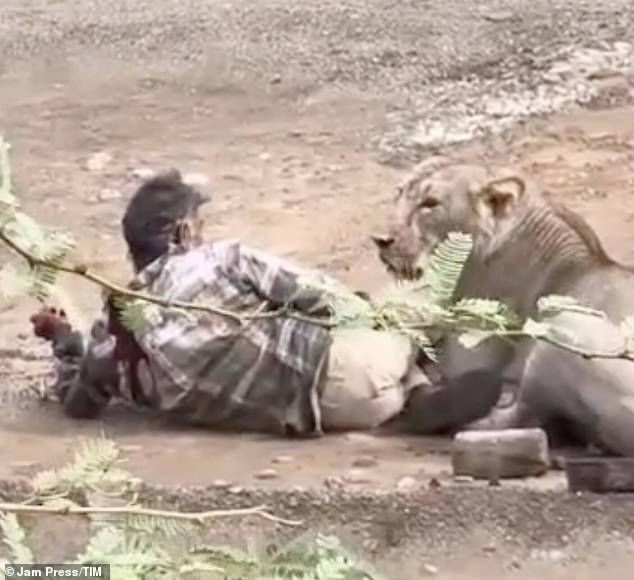
One such story emerged from Gujarat, India, where a cattle herder reportedly survived a prolonged encounter with a lioness. According to news reports, the man remained remarkably calm and gently stroked the animal until it eventually moved away on its own.
The dramatic footage quickly spread across social media, leading many people to wonder whether touching a wild lion could truly calm it. Wildlife experts, however, urge caution. Every encounter with a large predator is unique, and no single incident should be viewed as a reliable survival strategy.
This article examines the reported event, explores what scientists know about lion behavior, and explains why peaceful coexistence between people and wildlife remains so important.
The Reported Lioness Encounter
According to media reports, the incident took place on July 6, 2026, in Garajiya village, located in Bhavnagar district, Gujarat, India.
The cattle herder was reportedly tending to his livestock when a lioness approached and knocked him to the ground.
Witnesses described a tense situation in which the animal remained over the man for an extended period while nearby villagers called for help. Reports indicate that bystanders attempted to distract the lioness by shouting and throwing objects from a safe distance, but the animal initially stayed in place.
Eventually, the lioness reportedly released the man and returned toward nearby forested habitat. Emergency responders then transported the injured herder to a local hospital for medical treatment.
Because the event was documented from a distance, it attracted significant international attention.

Did Stroking the Lioness Really Calm It?
Several news reports suggested that the herder gently stroked the lioness while remaining underneath her.
Although this detail has fascinated audiences, wildlife specialists caution against drawing broad conclusions from a single incident.
Animal behavior is influenced by many factors, including:
The animal’s age
Its health
Whether it feels threatened
Its previous experiences
Its surroundings
The presence of nearby people
Because no two wildlife encounters are identical, experts cannot conclude that touching a lion will reliably reduce aggression.
Instead, the reported outcome likely reflected a combination of circumstances unique to that moment.
Understanding Asiatic Lions
The lioness involved was reported to be an Asiatic lion, a subspecies found almost exclusively in western India.
Unlike African lions, Asiatic lions have a much smaller natural range and are the focus of extensive conservation efforts.
Today, Gujarat remains the world’s only natural habitat for wild Asiatic lions.
Conservation programs over several decades have helped their population recover, making the species one of wildlife conservation’s notable success stories.
As lion numbers have increased, interactions between people and wildlife have naturally become more common in surrounding communities.
Why Do Human and Wildlife Encounters Occur?
Many rural communities share landscapes with wild animals.
People may travel through forests, graze livestock, or farm land located near wildlife habitat.
Large predators, meanwhile, move through these same areas while searching for food, water, or resting places.
Most encounters end without incident because both humans and animals generally prefer to avoid one another.
However, unexpected situations can occur when:
Animals are startled.
People unknowingly approach too closely.
Livestock graze near wildlife habitat.
Visibility is limited.
These situations highlight the importance of awareness rather than fear.

Can Wild Animals Sometimes Become Less Aggressive?
Wildlife researchers have observed that animals occasionally change their behavior during stressful situations.
An animal may pause, retreat, or stop displaying defensive behavior for many reasons.
Possible influences include:
Feeling less threatened.
Finding an escape route.
Changes in nearby activity.
Reduced environmental pressure.
However, predicting these responses is extremely difficult.
For that reason, wildlife authorities consistently advise people not to approach, touch, or attempt to interact with wild predators.
The reported incident should be viewed as an unusual event rather than an example to imitate.
What Wildlife Experts Recommend
Conservation organizations generally recommend several safety practices when living or traveling near large wildlife.
Stay Alert
Remain aware of your surroundings, especially near forests, grasslands, and protected wildlife areas.
Respect Wildlife
Observe wild animals from a safe distance.
Avoid actions that may encourage close interactions.
Report Sightings
If wildlife frequently appears near homes or livestock, notify local wildlife authorities.
Early reporting helps conservation teams respond appropriately.
Follow Local Guidance
Communities living alongside wildlife often receive advice from forest departments regarding seasonal animal movements and safe practices.
Following these recommendations benefits both people and animals.
Why Gujarat Is Special
Gujarat’s Gir landscape represents one of the world’s most important wildlife conservation achievements.
Once reduced to a very small population, Asiatic lions have gradually recovered through habitat protection, scientific monitoring, and community participation.
Recent population estimates indicate continued growth, reflecting decades of conservation work.
As the population expands into surrounding landscapes, wildlife managers continue working to balance conservation with public safety.
This balance requires cooperation among local communities, conservation organizations, and government agencies.

The Role of Community Awareness
People living near wildlife habitats often develop valuable local knowledge.
Simple habits can reduce the likelihood of unexpected encounters, including:
Traveling during daylight when possible.
Keeping livestock in secure areas.
Remaining attentive near forest edges.
Reporting unusual wildlife activity promptly.
Educational programs also help residents understand animal behavior while promoting safe coexistence.
Why Videos Can Be Misleading
Videos shared online often capture only a small portion of an event.
They may not show:
What happened beforehand.
The animal’s previous behavior.
Environmental conditions.
The presence of wildlife officials.
The distance between observers.
Without complete context, viewers may unintentionally misinterpret what influenced an animal’s behavior.
For this reason, wildlife experts encourage careful interpretation of dramatic online footage.
Conservation and Coexistence
The recovery of endangered wildlife species is an important conservation success.
At the same time, growing wildlife populations require thoughtful management to reduce conflicts between animals and nearby communities.
Conservation efforts increasingly focus on coexistence through:
Public education
Scientific monitoring
Habitat protection
Emergency response planning
Community partnerships
These approaches help protect both wildlife and the people who share the landscape.
Conclusion
The reported encounter between a Gujarat cattle herder and an Asiatic lioness is certainly remarkable, and it has understandably attracted worldwide attention. According to news reports, the man survived after remaining calm during an extended interaction with the animal before it eventually moved away.
While some reports suggest that gently stroking the lioness may have contributed to the outcome, wildlife science does not support treating this as a dependable response during encounters with large predators. Every situation involving wild animals is unique, and experts consistently advise maintaining a safe distance and following guidance from local wildlife authorities.
Beyond the dramatic headlines, the story also highlights an important reality: as conservation efforts help endangered species recover, people and wildlife increasingly share the same landscapes. Building a future where both can thrive depends on education, respect for nature, and informed decision-making.
Human curiosity naturally draws us to extraordinary wildlife stories. By pairing that curiosity with scientific understanding and responsible reporting, we can better appreciate both the beauty of wild animals and the importance of safely coexisting with them.
Sources
- Daily Mail – Man Pinned Down by a Lioness… but Survives After Stroking It
- International Union for Conservation of Nature (IUCN)
- World Wide Fund for Nature (WWF)
- Gujarat Forest Department
- National Geographic – Lion Behavior
- Smithsonian’s National Zoo & Conservation Biology Institute