
Few discoveries capture the imagination like the fossilized remains of a Tyrannosaurus rex. These ancient predators have fascinated scientists and the public alike for decades, offering valuable clues about life on Earth more than 66 million years ago. Every new fossil has the potential to answer questions about dinosaur biology, evolution, behavior, and prehistoric ecosystems.
Recently, one of the largest and most complete T. rex skeletons ever discovered made headlines after selling for more than $50 million at auction. While the remarkable sale set a new record for a dinosaur fossil, it also sparked an important debate within the scientific community about balancing private ownership with public access to irreplaceable natural history.
This article explores the discovery of the specimen known as “Gus,” why it is scientifically significant, and the differing perspectives surrounding fossil auctions.
Meet “Gus”: A Remarkable Tyrannosaurus rex
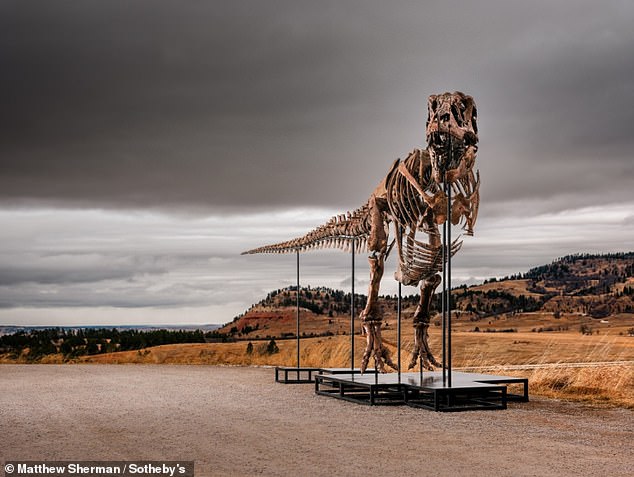
Gus is one of the most complete Tyrannosaurus rex specimens discovered in recent years.
The fossil was unearthed in South Dakota’s Hell Creek Formation, one of the world’s most famous dinosaur fossil sites. Dating to approximately 67 million years ago, the specimen preserves much of the animal’s skeleton, including an exceptionally well-preserved skull.
Standing roughly 12.5 feet (3.8 meters) tall when mounted, the fossil provides researchers with valuable information about one of history’s largest land predators.

Why the Hell Creek Formation Is So Important
Hell Creek Formation is one of North America’s richest fossil-bearing geological formations.
It preserves animals and plants that lived shortly before the event that marked the end of the age of non-avian dinosaurs.
Scientists have discovered numerous iconic species there, including:
- Tyrannosaurus rex
- Triceratops
- Edmontosaurus
- Ankylosaurus
- Various prehistoric mammals, turtles, and crocodilians
Because of its exceptional preservation, Hell Creek continues to play a central role in paleontological research.
What Makes “Gus” Scientifically Valuable?
Reports indicate that the skeleton is approximately 61 percent complete, making it one of the more complete T. rex fossils known.
Researchers value specimens like Gus because they allow scientists to study:
- Skull anatomy.
- Bone growth.
- Bite mechanics.
- Body proportions.
- Injury and healing.
- Evolutionary relationships.
The fossil also reportedly preserves evidence of ancient bite marks, providing additional opportunities to investigate prehistoric animal interactions.

A Record-Breaking Auction
The specimen was sold through Sotheby’s for more than $50 million, making it the most expensive dinosaur fossil publicly sold at auction.
The sale reflects increasing interest among private collectors in scientifically important fossils.
High-profile auctions have become more common in recent years, attracting museums, institutions, and private buyers from around the world.
Why Some Scientists Are Concerned
Many paleontologists believe scientifically important fossils should remain in publicly accessible collections.
The Society of Vertebrate Paleontology has long encouraged significant vertebrate fossils to be housed in accredited museums or universities.
Researchers point out that fossils continue to yield new discoveries decades—or even centuries—after their initial excavation.
As scientific technology advances, specimens collected long ago can reveal previously impossible information through modern techniques.
If important fossils become inaccessible to researchers, future scientific opportunities may become more limited.
The Value of Museum Collections
Natural history museums serve several important purposes.
They preserve fossils for:
- Scientific research.
- Public education.
- Student training.
- Future technological analysis.
- Long-term conservation.
Museum collections also allow scientists from around the world to examine the same specimen, compare findings, and collaborate across institutions.
Many landmark discoveries have resulted from reexamining fossils collected generations earlier.
The Role of Private Fossil Companies
Supporters of commercial fossil excavation argue that private companies contribute significantly to discovering important specimens.
Excavating large dinosaur fossils requires:
- Specialized equipment.
- Skilled personnel.
- Extensive fieldwork.
- Careful preparation.
- Long-term preservation.
Without private investment, some fossils might remain buried indefinitely or become damaged through natural erosion.
Many commercially recovered fossils have eventually entered museum collections through donations or purchases.

Advances in Fossil Research
Modern paleontology extends far beyond traditional excavation.
Scientists now use technologies such as:
- CT scanning.
- Three-dimensional imaging.
- Digital reconstruction.
- Isotopic analysis.
- Microscopic bone examination.
These methods allow researchers to study internal structures without damaging fossils.
As technology continues improving, today’s specimens may provide even greater scientific insights in the future.
Balancing Private Ownership and Public Science
The debate surrounding fossil ownership is complex.
Some experts suggest partnerships that allow private owners to retain ownership while granting researchers access for scientific study.
Possible approaches include:
- Long-term museum loans.
- Research access agreements.
- Digital scanning initiatives.
- Collaborative conservation programs.
These solutions aim to balance private collecting with scientific advancement.
Why Tyrannosaurus rex Continues to Fascinate Us
More than a century after its scientific description, Tyrannosaurus rex remains one of the world’s most recognizable dinosaurs.
Its popularity stems from:
- Massive size.
- Powerful anatomy.
- Rich fossil record.
- Frequent appearances in books and films.
- Continuing scientific discoveries.
Each newly discovered specimen contributes another piece to our understanding of this remarkable prehistoric predator.
Conclusion
The record-breaking sale of the T. rex specimen known as Gus highlights both the extraordinary public fascination with dinosaurs and the ongoing conversation about preserving scientifically important fossils. While private investment has played a significant role in recovering many remarkable specimens, researchers emphasize the importance of ensuring that exceptional fossils remain available for future scientific study and public education.
As paleontology continues to benefit from new technologies and discoveries, fossils become more than collectibles—they serve as irreplaceable records of Earth’s distant past. Whether displayed in museums or studied by researchers, these ancient remains help answer questions that continue to inspire scientists and curious minds alike.
Human curiosity has driven the exploration of prehistoric life for generations. Every fossil unearthed offers another opportunity to learn about our planet’s remarkable history, reminding us that the greatest treasures are often the knowledge they reveal.

Sources
- Society of Vertebrate Paleontology
- Smithsonian National Museum of Natural History
- American Museum of Natural History
- Natural History Museum
- University of Birmingham – Paleontology research
- University of Edinburgh – Vertebrate paleontology research
- Reuters – Reporting on fossil auctions and scientific perspectives