
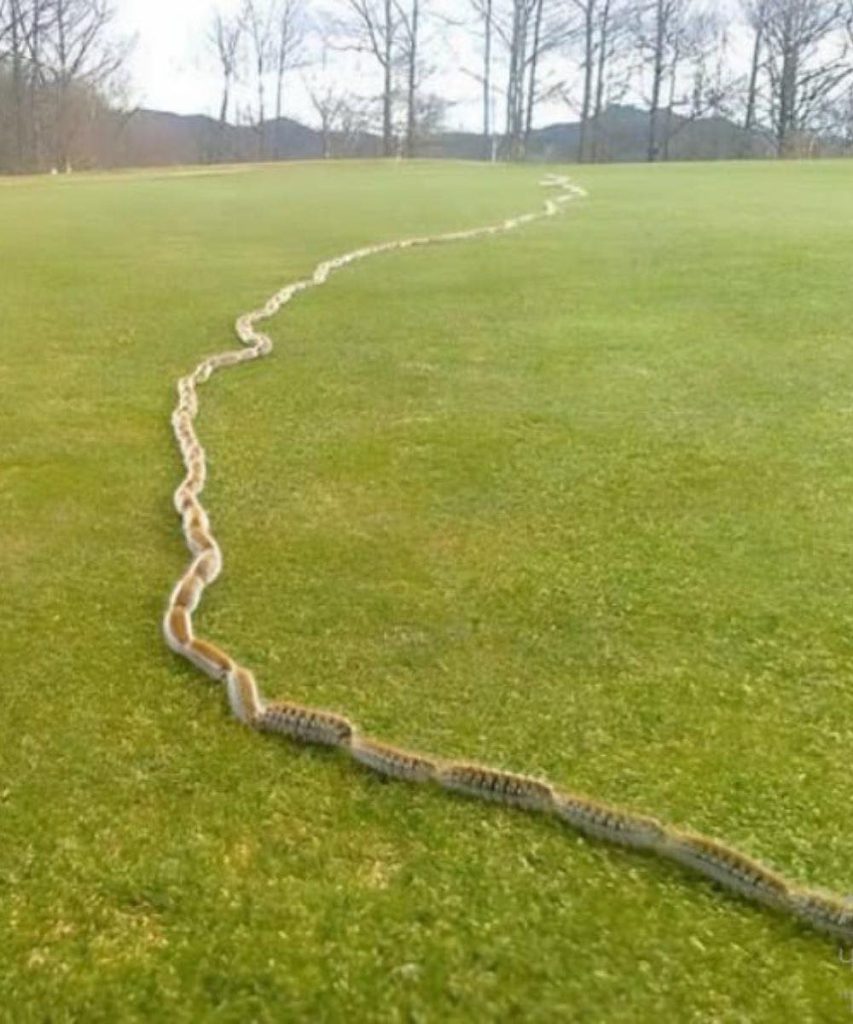
It began as an ordinary walk through the yard on a quiet afternoon. The grass swayed gently in the breeze, and everything seemed perfectly normal until something unusual caught my eye.
Lying across the lawn was what looked like a long, twisted rope.
For a split second, my imagination raced to the worst possible conclusion.
Could it be a snake?
I stopped walking immediately. My heart began to pound as I carefully studied the mysterious shape from a distance. It didn’t appear to move, yet something about it felt unsettling. Holding my phone tightly, I cautiously stepped closer, ready to back away if necessary.
With every step, my curiosity grew stronger than my fear.
When I finally got close enough to see clearly, I realized I had been completely mistaken.
It wasn’t a rope.
It wasn’t a snake.
It was an astonishing line of caterpillars.
A Living Chain of Tiny Travelers
Stretching across the grass was a procession of roughly 150 caterpillars moving together in a remarkably straight line.
Each caterpillar followed closely behind the one in front, creating what looked like a single moving ribbon.
I had never witnessed anything like it.
Instead of wandering in different directions as I expected, they stayed tightly grouped, advancing with surprising coordination.
Watching them felt almost hypnotic.
There was no obvious leader giving directions, yet the entire group seemed to move with a shared purpose.
For several minutes, I simply stood there observing one of nature’s most unusual sights.
Why Do Caterpillars Travel in Lines?
Afterward, curiosity led me to learn more about this remarkable behavior.
Scientists have observed that several species of caterpillars naturally travel in organized processions.
Although researchers continue studying the exact reasons, several scientific explanations have been proposed.
One possibility is protection.
When many caterpillars move together, predators may find it more difficult to isolate a single individual. Large moving groups can also appear bigger and more intimidating than a lone caterpillar.
Another explanation involves energy conservation.
Following directly behind another caterpillar may reduce the effort required to navigate obstacles or maintain a consistent path, especially over long distances.
Researchers also believe these processions may help caterpillars locate food more efficiently.
Instead of every individual searching independently, the group benefits from shared movement toward suitable feeding areas.
The precise reason likely varies among different caterpillar species and environmental conditions.
Species Known for Procession Behavior
Perhaps the most famous examples are processionary caterpillars, found in parts of Europe, Asia, and North Africa.
These caterpillars are well known for traveling nose-to-tail in long lines that can stretch for several feet.
Scientists believe they communicate partly through chemical signals called pheromones, allowing each caterpillar to follow the individual ahead with remarkable accuracy.
Other social caterpillar species around the world also display coordinated movement while searching for food or relocating to new feeding sites.
Although seeing hundreds together may appear unusual, this behavior is a natural part of their life cycle.
Nature Is Full of Surprises
Discoveries like this remind us how easily appearances can be misleading.
What first looked frightening became one of the most interesting wildlife encounters I had experienced.
It also reminded me that taking a moment to observe before reacting can completely change how we understand the natural world.
Many harmless insects display behaviors that seem mysterious until science provides an explanation.
The backyard, often overlooked, can become an outdoor classroom filled with unexpected discoveries.
When Tiny Creatures Appear Where They Shouldn’t
That memorable afternoon also reminded me of another experience involving tiny crawling creatures, although under very different circumstances.
Unlike the fascinating caterpillar procession, this second incident was far less enjoyable.
One evening, a friend and I were having dinner at a busy restaurant.
Everything appeared perfectly normal until she noticed several tiny dark specks resting on top of her salad.
At first, we assumed they were chia seeds or another garnish commonly used in salads.
Then something unexpected happened.
The tiny specks appeared to move.
Our curiosity immediately turned into concern.
Responding Calmly to an Unexpected Situation
Rather than making assumptions, we notified the restaurant staff so they could inspect the meal.
Out of an abundance of caution, we also decided to seek medical advice.
Healthcare professionals evaluated us, discussed our situation, and recommended precautionary treatment.
Fortunately, no serious health problems developed afterward.
The restaurant later suggested that ingredient quality may have contributed to the incident, although the exact cause was never fully confirmed.
Regardless of the explanation, the experience reminded me how important food safety practices are for both restaurants and customers.
Understanding Food Safety
Food contamination can occur for many reasons, including improper storage, transportation issues, or accidental exposure during food preparation.
For this reason, restaurants follow food safety procedures designed to reduce these risks.
Consumers also play an important role.
If food appears unusual, has an unexpected odor, or raises concerns for any reason, it is best not to consume it.
Instead, notify restaurant staff and seek medical advice if exposure is suspected or symptoms develop.
Most situations can be addressed safely when handled promptly and calmly.
Curiosity Can Lead to Better Awareness
Although these two experiences were completely different, they shared one important lesson.
Both began with noticing something that seemed unusual.
In one case, curiosity revealed one of nature’s most fascinating insect behaviors.
In the other, paying attention encouraged responsible action regarding food safety.
Whether observing wildlife outdoors or noticing unexpected details during everyday activities, awareness helps us make informed decisions.
Not every surprising discovery is dangerous.
Not every frightening first impression turns out to be what it seems.
Sometimes the best response is simply to slow down, observe carefully, and let evidence guide our conclusions.
A Reflection on Nature’s Mysteries
The natural world continues to surprise us in countless ways.
A line of tiny caterpillars can resemble a snake from a distance, while everyday objects can appear unfamiliar until examined more closely.
Science helps explain many of these remarkable observations, transforming mystery into understanding without taking away the sense of wonder.
Moments like these remind us that curiosity is one of our greatest tools. It encourages us to ask questions, seek reliable answers, and appreciate the extraordinary details hidden within ordinary days.
Sources
-
Smithsonian Institution – Insect Behavior Resources: https://www.si.edu
-
University of Florida IFAS Extension – Caterpillar Identification and Behavior: https://edis.ifas.ufl.edu
-
National Geographic – Caterpillar and Insect Behavior Articles: https://www.nationalgeographic.com
-
U.S. Food & Drug Administration (FDA). Food Safety Education: https://www.fda.gov/food
-
Centers for Disease Control and Prevention (CDC). Food Safety Information: https://www.cdc.gov/food-safety