


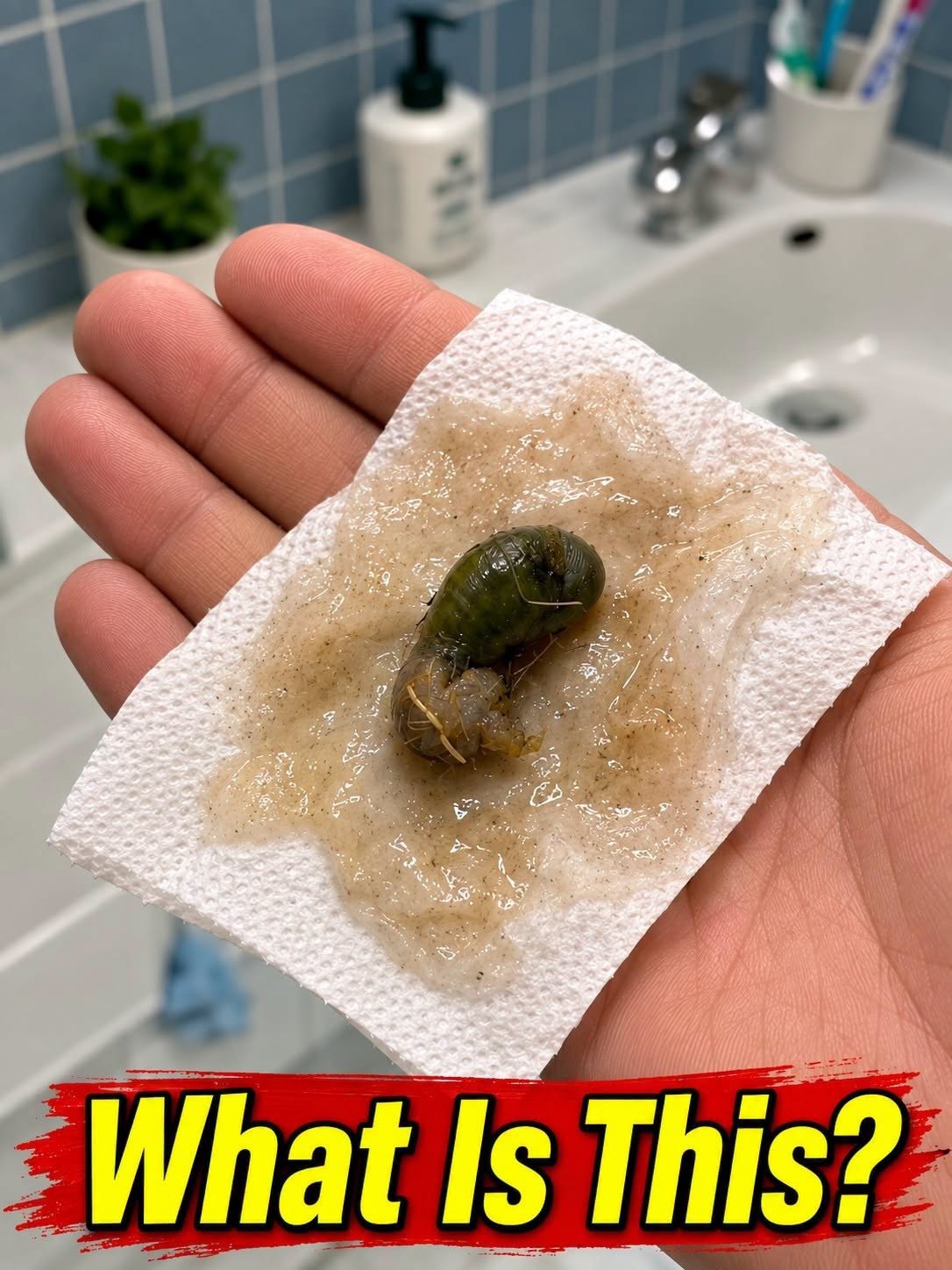
It was supposed to be an ordinary day at home.
The bathroom needed cleaning, the usual household routine was underway, and nothing seemed particularly unusual. Then, near the edge of the floor, something caught our attention.
It was small, green, and strangely segmented.
At first glance, it was difficult to understand what we were looking at. The unusual shape immediately sparked curiosity. Was it a piece of a plant? Something left behind by an insect? Or perhaps an object that had somehow found its way indoors?
Instead of immediately touching it, we stopped and observed it carefully.
The discovery may sound insignificant, but moments like this can turn an ordinary household chore into an unexpected lesson about nature. Sometimes, objects that appear mysterious are simply parts of biological processes that most of us rarely see.
In this case, the unusual object appeared to resemble a beetle pupa, an important stage in the fascinating life cycle of many insects.
What Was the Green Object?
A beetle pupa is a developmental stage that occurs between the larval and adult stages of certain beetles.
Many insects undergo a process called complete metamorphosis. Their life cycle generally includes four distinct stages: egg, larva, pupa, and adult.
The pupa is the transitional stage.
During this period, the insect undergoes significant internal changes as its body develops toward its adult form. Although the process is familiar to scientists, seeing an insect pupa outside of its usual environment can be surprising for someone who has never encountered one before.
The green, segmented appearance described in the original discovery is consistent with the general appearance of some insect pupae, although identifying an insect from a written description alone is not always possible.
Color, shape, size, and texture can vary considerably between species.
That is why comparing photographs with reliable identification resources is often more useful than relying on appearance alone.
What Is a Beetle Pupa?
To understand why a pupa might look so unusual, it helps to understand insect metamorphosis.
A beetle begins its life as an egg.
After hatching, it enters the larval stage. This is often the stage people recognize as a “grub” or caterpillar-like insect, depending on the species.
The larva spends much of its time feeding and growing.
As it develops, it eventually reaches a stage where it transforms into a pupa.
The pupal stage is remarkable because the insect’s body undergoes major developmental changes. Structures associated with the adult insect develop during this period, including features such as wings and adult body structures.
Eventually, the adult beetle emerges.
This transformation is one of the most interesting examples of biological development found in the natural world.
Why Would an Insect Pupa Appear in a Bathroom?
Finding an insect pupa on a bathroom floor may seem strange.
After all, bathrooms are not places where most people expect to encounter developing insects.
But insects can occasionally appear indoors for a variety of reasons.
Some species prefer damp or sheltered environments. Others may enter homes accidentally or develop in nearby areas before becoming noticeable.
A bathroom may provide several conditions that can attract or support certain small organisms, including moisture, warmth, darkness, and sheltered spaces.
However, finding one object does not necessarily mean there is an infestation.
A single insect or pupa can simply be an isolated discovery.
The surrounding circumstances matter.
If unusual insects repeatedly appear indoors, it may be worth investigating possible entry points, moisture problems, stored materials, or other environmental conditions.
Why Do Pupae Look So Different From Adult Beetles?
One reason insect pupae can be difficult to identify is that they may look completely different from the adults they eventually become.
This is a natural consequence of metamorphosis.
A beetle larva can look very different from an adult beetle. The pupa may look different again.
To someone unfamiliar with insect development, the pupa might appear to be an unusual object rather than a living stage of an insect.
This is one reason photographs found online can sometimes seem surprising.
People may recognize the adult beetle immediately but fail to recognize its earlier developmental stages.
Nature does not always make its transformations obvious.
The Science Behind Complete Metamorphosis
Complete metamorphosis is known scientifically as holometabolous development.
It is characteristic of several major insect groups, including beetles, butterflies, moths, flies, bees, wasps, and ants.
The four stages are generally:
Egg
The insect begins its life inside an egg. The egg provides the developing organism with the environment and resources necessary to begin development.
Larva
The larval stage is primarily focused on growth. Larvae often look very different from adults and may have different feeding behaviors.
Pupa
During the pupal stage, major structural changes occur. The insect develops many of the features that characterize its adult form.
Adult
The final stage is the adult insect. At this point, the insect typically has its mature body structure and reproductive capabilities.
This four-stage cycle demonstrates how dramatically an organism can change during its development.
Could the Object Have Been Something Else?
Absolutely.
A photograph or brief description is not always enough to identify an unfamiliar object with certainty.
Many insect larvae, pupae, plant material, shed insect skins, and other natural objects can look surprisingly similar.
Green coloration is particularly interesting because it occurs in numerous organisms and developmental stages.
Some insect pupae can be green, brown, pale, cream-colored, or other shades depending on the species and developmental stage.
Therefore, the safest approach is to avoid making a definitive identification without a clear photograph and appropriate reference material.
The original discovery may have resembled a beetle pupa, but a proper insect identification would normally require additional information.
What Should You Do If You Find an Unfamiliar Insect?
If you encounter something unusual in your home, there is no need to panic.
First, observe it from a safe distance.
If you want to identify it, take a clear photograph from several angles. Include an object nearby to provide a sense of scale.
You can then compare the image with reputable insect identification resources or consult a local entomologist, university extension service, or pest professional.
If you decide to remove the object, use a simple method that avoids unnecessary contact.
For an unknown insect, it is generally better not to handle it directly until you know what it is.
This is particularly sensible when children or pets are nearby.
When Should You Investigate Further?
One unusual insect does not automatically indicate a household problem.
However, repeated discoveries may justify a closer look.
If you regularly find larvae, pupae, or adult insects indoors, check areas where moisture accumulates and look for possible entry points around windows, doors, vents, and plumbing.
Stored food, organic material, houseplants, and damp areas can also attract different types of insects.
Keeping rooms clean and dry can reduce the conditions that some household pests prefer.
If the insects continue appearing despite basic cleaning and moisture control, professional identification may help determine what is happening.
Correct identification is important because different insects require different approaches.

Why Small Discoveries Can Be So Fascinating
There is something wonderful about discovering a tiny piece of nature in an unexpected place.
A strange object on a bathroom floor may initially seem meaningless.
But once identified, it can reveal an entire biological process.
A beetle pupa represents a moment of transformation that most people rarely observe directly. Hidden inside its developmental stage is the future adult insect.
The discovery therefore becomes more than an identification exercise.
It becomes a reminder that nature is constantly changing around us, even when we are not paying attention.
The Difference Between Fear and Curiosity
Our first reaction to something unfamiliar is often uncertainty.
The human brain naturally tries to identify unfamiliar shapes and patterns. When we cannot immediately explain something, it can be tempting to assume the worst.
But curiosity provides another response.
Instead of asking, “Should I be worried?” we can first ask, “What am I looking at?”
That simple question can change the entire experience.
A mysterious object becomes a research opportunity. A strange shape becomes a biology lesson. An unexpected discovery becomes a chance to learn something new.
This is particularly valuable when exploring the natural world.
Many creatures and biological structures look unusual simply because we rarely see them.
Frequently Asked Questions
What is a beetle pupa?
A beetle pupa is the developmental stage between the larval and adult stages of a beetle that undergoes complete metamorphosis. During this stage, major changes occur as the insect develops its adult structures.
Can beetle pupae be green?
Some insect pupae can have green coloration, although appearance varies considerably among species. Color alone is not enough to identify a particular insect.
Why would I find an insect pupa indoors?
An insect may enter a building accidentally, or a suitable sheltered environment may exist somewhere nearby. Moisture, warmth, organic material, and protected spaces can sometimes support insect development.
Does finding one pupa mean I have insects in my home?
Not necessarily. A single discovery can be isolated. Repeated sightings, however, may justify checking for possible sources or consulting a pest professional.
How can I identify an unfamiliar insect?
Take clear photographs from different angles and compare them with reputable identification resources. For difficult cases, a university extension service, entomologist, or qualified pest professional may be able to help.
Final Thoughts: Nature Is Often Hiding in Plain Sight
A mysterious green object on a bathroom floor may not sound like the beginning of a fascinating story.
Yet that small discovery can lead to a surprising journey into the world of insect development.
What initially appears strange may simply be a natural stage in the life of a tiny creature. A beetle pupa, if that was indeed the object discovered, represents one small part of an extraordinary transformation from egg to larva, pupa, and finally adult insect.
The experience also offers a useful reminder about how we respond to the unfamiliar.
Not everything mysterious is dangerous, and not everything unusual has an alarming explanation. Sometimes the most interesting discoveries are hiding in ordinary places.
Human curiosity encourages us to stop, observe, investigate, and learn.
And perhaps that is the most memorable lesson from a mysterious object on a bathroom floor: the natural world does not always announce itself. Sometimes, we simply have to notice it.

Sources
Encyclopaedia Britannica, educational information about insect metamorphosis and biological development.
University of Kentucky Entomology, educational resources concerning insects and their life cycles.
University of Kentucky Entomology
University of Florida Institute of Food and Agricultural Sciences Extension, educational resources on insects and household pest identification.
Smithsonian National Museum of Natural History, educational resources about insects and biodiversity.
Smithsonian National Museum of Natural History
The original source provided by the user was used as inspiration for the discovery narrative. Because the available description does not provide a verifiable photograph or formal species identification, the article presents the beetle-pupa identification as a likely possibility rather than an absolute scientific determination.