


The natural world is full of moments that challenge the way we think about animal intelligence and emotion. Among the most moving are encounters involving elephants, animals known for their complex social relationships, strong family bonds, and remarkable memories.
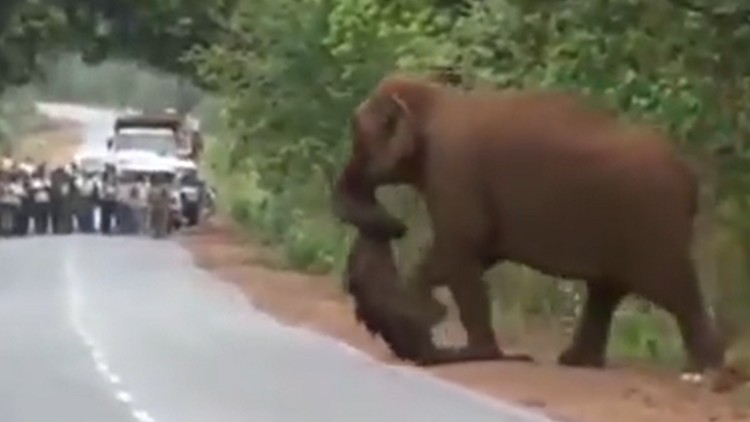
One widely shared video captured a herd of elephants gathered around the body of a young elephant. The footage showed one adult carrying the young elephant with its trunk before other members of the herd approached and remained nearby.
For many viewers, the scene looked remarkably similar to a farewell ceremony. But what do scientists actually know about elephant behavior after the death of a group member?
A Herd Stops to Gather Around a Young Elephant
The video was shared online in 2019 by Indian Forest Service officer Parveen Kaswan. It showed people and vehicles waiting along a road while elephants slowly moved through the area.
One adult elephant appeared to be carrying the body of a young elephant. After reaching the other side of the road, the adult placed the young elephant down.
Other elephants then approached.
Rather than immediately continuing along their route, members of the herd gathered around the young elephant. Several adults and younger elephants appeared to pause in the area before eventually continuing their journey.
The footage quickly attracted attention because of the apparent care shown toward the young animal.
To human observers, the behavior naturally raises an emotional question: Do elephants understand death?
The answer is more complicated than simply saying yes or no.
What Scientists Know About Elephant Responses to Death
Elephants have some of the most sophisticated social structures observed among land mammals. They live in family groups, communicate using a variety of sounds and physical signals, and can maintain relationships over many years.
Researchers have documented elephants displaying unusual behavior around dead or dying members of their species.
They may approach and inspect a body, touch it with their trunks, remain nearby, or return to the location later. In some observations, elephants have also been seen moving or attempting to lift the remains of another elephant.
These behaviors are particularly interesting because elephants appear to respond differently to dead elephants than they do to many ordinary objects in their environment.
However, scientists cannot determine exactly what an elephant is thinking or feeling simply by observing its actions.
Calling the behavior a human-style “funeral” may therefore be emotionally understandable, but it can also oversimplify a complex animal response.
Why Do Elephants Stay With Their Young?
There may be several reasons an elephant remains near a deceased calf.
Elephants rely heavily on social bonds. Young elephants are raised within family groups, where mothers, older siblings, and other females can all play important roles.
A young elephant is therefore not simply another animal within the group. Its presence can be important to the entire family.
When a calf dies, other elephants may investigate its body because the situation is unusual. They may use their trunks to touch, smell, or move it while trying to understand what has happened.
This investigation can sometimes continue for an extended period.
What appears to humans as mourning may involve several overlapping behaviors, including curiosity, social attachment, recognition, distress, and an inability to immediately leave a familiar group member behind.
Elephants Have Remarkably Strong Family Bonds
Elephant society is strongly centered around family relationships.
In many elephant populations, females and young elephants live together in groups led by an older female known as a matriarch.
The matriarch can provide knowledge about food, water, migration routes, and potential dangers. Younger elephants learn important survival behaviors by observing older members of the group.
This social structure means that the loss of a calf can affect more than one individual.
The mother may lose her offspring, siblings may lose a companion, and other members of the herd may lose an animal they have interacted with regularly.
That strong social connection is one reason elephant responses to death have attracted so much scientific interest.
Can Animals Experience Grief?
The question of animal grief is one of the most fascinating subjects in behavioral science.
Humans naturally interpret animal behavior through our own experiences. When we see an elephant touching a dead calf or remaining beside it, it can look similar to human mourning.
But researchers must be careful.
We cannot ask an elephant whether it understands death or feels sadness in the same way a person does.
Instead, scientists examine observable behaviors and compare them across situations.
Some animals have demonstrated behaviors that may indicate distress or changes in social behavior following the loss of another animal. Elephants are particularly notable because of their responses to deceased members of their species.
Still, terms such as “grief” and “mourning” should be used carefully when describing animal behavior.
They can be useful descriptions, but they do not necessarily mean animals experience emotions in precisely the same way humans do.
Why the Video Touched So Many People
The emotional impact of the footage comes partly from how recognizable the behavior appears.
People watching the scene see an adult elephant carefully carrying a young animal. They then see other members of the herd gathering around it.
The group eventually moves on, but the young elephant is not immediately abandoned.
For human viewers, these actions resemble a family struggling to leave a loved one behind.
That interpretation may not capture every biological reason behind the elephants’ behavior, but it helps explain why the video resonated with so many people.
It also reminds us that social bonds are not unique to humans.
Elephants May Return to the Remains of Other Elephants
Researchers have documented elephants showing interest in the remains of their own species on numerous occasions.
They may investigate bones, skulls, or bodies using their trunks and feet. Some observations suggest that elephants can show particular interest in the remains of other elephants rather than approaching the remains of unrelated animals in exactly the same way.
One possibility is that elephants recognize familiar individuals or respond to familiar scents.
Another possibility is that their behavior reflects an attempt to understand an unusual situation.
Scientists continue to study these behaviors because they may provide insight into elephant cognition, memory, and social awareness.
Memory May Play an Important Role
Elephants are famous for their memories, and this reputation is not entirely based on folklore.
Their ability to remember individuals, locations, and environmental conditions can be extremely valuable for survival.
Older elephants may retain knowledge about water sources, seasonal movements, and hazards encountered over many years.
Social memory may also help elephants recognize members of their family and wider social network.
This makes their reactions to deceased individuals particularly intriguing.
If an elephant can recognize a familiar individual after a long separation, it is reasonable to investigate whether similar recognition mechanisms play a role when elephants encounter a dead member of their group.
However, the exact mental processes involved remain an active area of research.
A Reminder of How Complex Animal Behavior Can Be
The video does not prove that elephants conduct funerals in the same way humans do.
It does, however, provide a striking example of behavior that deserves careful attention.
Elephants are highly social animals with sophisticated communication systems and strong family relationships. Their reactions to death appear to be more complex than simple indifference.
Whether we call these behaviors mourning, grieving, investigation, or social attachment, they reveal something important about elephant society.
Their world is built around relationships.
What We Can Learn From the Elephants
Perhaps the most meaningful lesson from scenes like this is not that elephants behave exactly like humans.
It is that animals can have social lives far more complex than we sometimes assume.
A herd depends on cooperation, communication, memory, and relationships. Young elephants learn from older members, and families remain connected over long periods.
When one member disappears, the group may respond in ways that reflect the importance of that individual.
The road in the viral video eventually became clear. The herd continued its journey, but the behavior captured along the way offered viewers a rare glimpse into the social world of elephants.
Final Thoughts
The image of an adult elephant carrying a young elephant while other members of the herd gather nearby is undeniably powerful.
It is tempting to describe the scene as a funeral, because that is how it appears through a human emotional lens. Science, however, encourages a more careful interpretation.
We may never know exactly what the elephants experienced internally.
What we can observe is that elephants often respond to their dead in distinctive ways, including touching, investigating, remaining near, and sometimes moving the body.
Those behaviors are another reminder that the animal world is filled with intelligence, social bonds, and behaviors that we are still learning to understand.
Sometimes, the most extraordinary lessons about nature come not from dramatic discoveries, but from simply watching animals care for one another.
Sources
- Parveen Kaswan, Indian Forest Service — original 2019 social-media post documenting the elephant procession.
- Scientific research on elephant responses to deceased conspecifics and elephant social behavior.
- Research literature on elephant cognition, communication, memory, and social relationships.