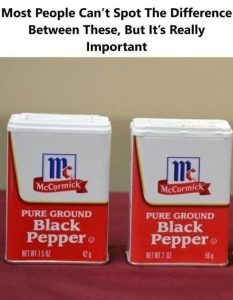



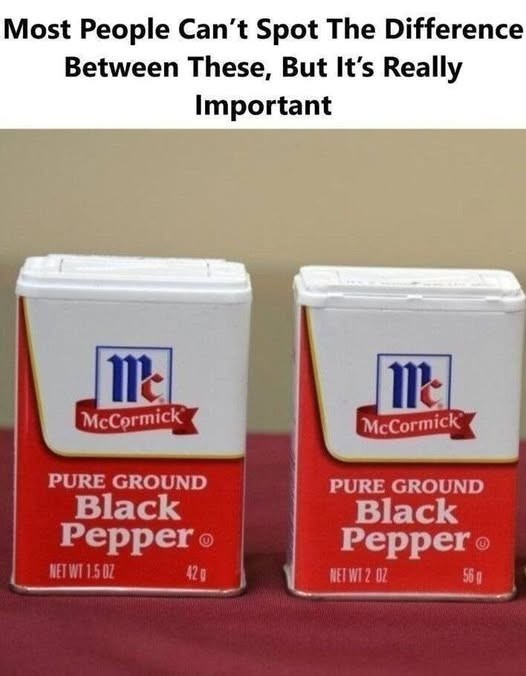
In the time it takes to grab a tin of pepper, you could be losing money without even realizing it. A familiar box, the same brand, the same bold red—yet less inside. On a crowded shelf, one small design tweak can quietly tilt the game. Is it smart marketing… or something closer to ma…
Most shoppers never stop to weigh a box in their hand or parse the fine print on a label. They rely on memory, habit, and the visual promise of a package that looks just like it always has. That is why McCormick’s decision to shrink the contents of its pepper while preserving the same imposing, opaque container feels unsettling to many. Side by side with Watkins’ clear, honestly revealing jar, the contrast becomes more than cosmetic; it becomes a question of character.
Legally, McCormick may be on solid ground if the net weight is properly disclosed. But trust is not built in courtrooms. It is built in the small, everyday moments when a shopper believes a brand is dealing straight with them. When packaging is engineered to exploit inattention, it may win the battle for shelf space, yet lose something far more valuable: the quiet confidence that keeps customers reaching for the same box, year after year.
The Invisible Tax in the Grocery Aisle
In the time it takes to grab a tin of pepper, you could be losing money without even realizing it. A familiar box, the same brand, the same bold red—yet less inside. On a crowded shelf, one small design tweak can quietly tilt the game. Is it smart marketing… or something closer to manipulation?
Most shoppers never stop to weigh a box in their hand or parse the fine print on a label. They rely on memory, habit, and the visual promise of a package that looks just like it always has. That is why McCormick’s decision to shrink the contents of its pepper while preserving the same imposing, opaque container feels unsettling to many. Side by side with Watkins’ clear, honestly revealing jar, the contrast becomes more than cosmetic; it becomes a question of character.
Legally, McCormick may be on solid ground if the net weight is properly disclosed. But trust is not built in courtrooms. It is built in the small, everyday moments when a shopper believes a brand is dealing straight with them. When packaging is engineered to exploit inattention, it may win the battle for shelf space, yet lose something far more valuable: the quiet confidence that keeps customers reaching for the same box, year after year.
Anatomy of “Slack Fill” and the Mechanics of Shrinkflation
What occurred in the spice aisle is a classic execution of shrinkflation—the practice of reducing a product’s weight or volume while maintaining its original retail price and package footprint. While manufacturers often frame shrinkflation as a necessary defense against rising raw material costs, the method of reduction determines whether consumers view it as a neutral price adjustment or an act of deception.
The Psychology of Consumer Habit and Heuristics
To understand why deceptive packaging works so effectively, one must look at how the human brain navigates decision-making in retail environments. The average supermarket carries tens of thousands of unique items, forcing consumers to rely on mental shortcuts—known as cognitive heuristics—to make fast purchasing decisions without experiencing decision fatigue.
Because the human eye evaluates three-dimensional volume inefficiently, shrinking a product’s internal volume while preserving its front-facing silhouette exploits a fundamental limitation in visual perception. A consumer standing in an aisle does not perform mental arithmetic; they reach for the familiar red tin because their brain recognizes a pattern established over decades.
The Legal Framework: Technical Compliance vs. Misleading Omission
The legal battle between spice manufacturers highlights a fascinating tension within consumer protection law. Under federal regulations—such as the United States Fair Packaging and Labeling Act (FPLA)—manufacturers are legally obligated to state the true net weight accurately on the front panel.
From a strict regulatory standpoint, if a tin clearly prints “6 oz” instead of “8 oz,” the manufacturer argues that full disclosure has occurred. However, false advertising laws (such as the Lanham Act) look beyond raw text compliance to evaluate the overall commercial impression. When a brand maintains an opaque container that could easily hold 8 ounces, but fills it with only 6 ounces without altering the outer packaging or providing prominent notice (such as “New Reduced Size”), competitors and consumers argue that the packaging operates as a misrepresentation by omission.
Competitors like Watkins took legal action not simply out of concern for consumer pocketbooks, but because non-functional slack fill distorts fair competition. If Company A sells 6 ounces of pepper in an 8-ounce tin for $4.00, while Company B sells 6 ounces of pepper in an honest 6-ounce clear glass jar for $4.00, Company A unfairly dominates shelf space and creates the false impression that it offers a better value.
The Erosion of Brand Equity and Long-Term Value
While shrinkflation may deliver short-term margin protection on a corporate balance sheet, it incurs a steep, long-term cost in brand equity.
Brand trust is an intangible asset accumulated through thousands of consistent, positive interactions. When a customer discovers that a product’s volume has been quietly reduced inside an unchanged container, their reaction is rarely limited to minor annoyance over a few lost ounces. Instead, it triggers a feeling of personal betrayal. The consumer realizes that the brand relied on their inattention to pull off a quiet extraction of value.
Once that psychological contract is broken, the consumer’s shopping behavior permanently shifts:
-
Hyper-Vigilance: The shopper begins scrutinizing unit prices, fine print, and alternative brands.
-
Loss of Brand Immunity: The emotional connection that previously shielded the legacy brand from cheaper generic competitors disappears.
-
Public Backlash: In the age of social media, viral photo side-by-sides exposing slack fill can inflict widespread, lasting reputational damage that far outweighs the short-term financial savings of shrinking the package.
The Shift Toward Radical Packaging Transparency
The contrast between opaque tins and clear glass jars symbolizes a broader movement in modern consumer goods. As shoppers become increasingly aware of shrinkflation tactics, transparency—both literal and operational—has become a powerful competitive differentiator.
Brands that opt for clear, fully visible packaging, or those that explicitly declare volume changes on their label (“Same Great Quality, Now in a Compact 6 oz Size”), demonstrate a fundamental respect for their customer base. They recognize that while market conditions may force price or weight adjustments, honesty remains the only sustainable long-term business strategy.
In the end, a tin of black pepper is more than just a kitchen staple. It is a test of corporate philosophy. Companies that attempt to maximize short-term profit through subtle visual misdirection may temporarily win the battle for the shelf. But those that choose clarity, honest sizing, and straightforward communication win something far more durable: a permanent, trusted place in the consumer’s home.