
If You See a Turtle or a Camel First …What It Reveals About How Your Brain Works
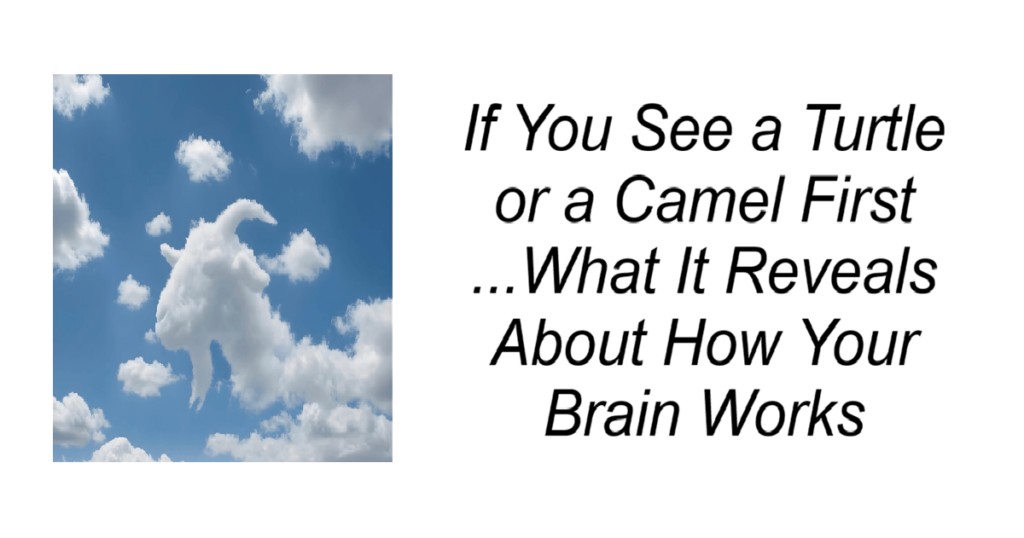
Did you notice a turtle first, or did a camel stand out immediately? Images that can be interpreted in more than one way are popular on social media because they invite people to compare what they see and what it might mean. They can be entertaining conversation starters, especially when paired with descriptions of creativity, intuition, logic, or attention to detail.
However, it is important to separate a lighthearted visual challenge from a scientific assessment of personality or brain function. Seeing one animal before another does not reliably show whether a person is more creative, more analytical, more emotional, or more practical. Human perception is complex, and what catches someone’s attention first can be influenced by the image design, viewing conditions, previous experiences, expectations, and simple chance.
Still, visual illusions offer an interesting opportunity to learn about how the brain interprets information. They demonstrate that seeing is not a passive process. The eyes gather visual signals, but the brain must organize those signals, identify meaningful shapes, and decide what is most important. This process happens remarkably quickly and is shaped by both the outside world and the observer’s own knowledge and attention.
Why People May See a Turtle or a Camel First
When an image contains overlapping outlines, hidden figures, or shapes that can be interpreted in multiple ways, the brain searches for familiar patterns. This ability is useful in daily life. It helps people recognize faces, read handwriting, navigate crowded places, and spot objects even when lighting or angles are imperfect.
In a turtle-and-camel image, one viewer may first focus on a curved shape that resembles a shell, head, or legs. Another may notice a longer outline that suggests a camel’s neck, hump, or profile. Neither response is inherently better, more intelligent, or more revealing of a fixed personality trait. Both are ordinary examples of visual interpretation.
Several factors can affect which animal appears first:
- Visual attention: People do not examine every part of an image equally. Their attention may land on the largest, darkest, brightest, or most distinctive feature.
- Context and expectation: If someone has recently seen an animal-related image, read about deserts, or visited a zoo, those memories may make a related shape easier to recognize.
- Past experience: Familiarity matters. A person who often sees turtles in their local environment may identify turtle-like details quickly, while someone more familiar with camels may notice the camel first.
- Image quality and display conditions: Screen size, brightness, distance from the screen, and cropping can all influence visual perception.
- Individual differences in scanning: Some people naturally look first at edges, central features, broad silhouettes, or small details. These habits can vary from moment to moment.
For these reasons, a single response to an optical illusion should not be treated as a diagnosis or a psychological profile. A person could look at the same image later and notice something different.
Optical Illusions and the Science of Visual Perception
Optical illusions are valuable because they reveal that perception is an active construction. The brain does not receive a fully labeled picture of the world. Instead, it uses visual input along with previous knowledge to make fast, useful predictions about what it is seeing.
Researchers in vision science often distinguish between “bottom-up” and “top-down” processing. Bottom-up processing begins with the sensory information entering through the eyes, including lines, colors, contrast, motion, and shape. Top-down processing refers to the influence of memory, language, expectation, and learned knowledge. In an ambiguous image, both processes work together.
For example, the outline of an animal might be incomplete or share features with another object. The brain fills in missing information based on what seems most likely. This is not a mistake in the usual sense. It is an efficient strategy that helps people make quick decisions in a visually busy world.
A related phenomenon is called pareidolia, the tendency to perceive familiar patterns in vague or random visual information. Many people have seen a face in clouds, a familiar figure in a rock formation, or an animal shape in a shadow. Pareidolia is a common feature of human perception and does not, by itself, indicate a problem or special personality type.
Does Seeing the Turtle First Mean You Are More Creative?
Online personality quizzes may suggest that spotting the turtle first means a person is imaginative, intuitive, emotionally aware, or naturally artistic. These descriptions can feel relatable because creativity and empathy are broad, valued qualities that many people recognize in themselves.
There is nothing wrong with using such descriptions as a prompt for self-reflection. Someone who enjoys art, writing, music, design, or imaginative problem-solving may feel a genuine connection to the idea of seeing possibilities that others miss. Creativity is an important human capacity, and it can be expressed in many fields, including science, education, engineering, parenting, business, and community work.
But the image alone cannot establish that a viewer has a particular creative style. Psychologists assess personality and cognitive abilities through carefully designed methods, often involving multiple questions, repeated measurements, and evidence that a test measures what it claims to measure. A one-image choice does not meet that standard.
Creative thinking also cannot be reduced to a single visual preference. It may involve generating ideas, combining knowledge in new ways, being open to alternative solutions, and revising an approach when circumstances change. People can be highly creative while also being organized and data-driven.
Does Seeing the Camel First Mean You Are More Analytical?
Likewise, some visual quizzes claim that seeing the camel first indicates a logical, structured, practical, or detail-oriented mind. These traits can certainly be strengths. Analytical thinking helps people compare evidence, plan projects, solve problems, manage resources, and make informed decisions.
Yet identifying a camel quickly in an ambiguous drawing is not proof of a person’s reasoning ability or preferred way of thinking. It may simply mean that a particular contour, angle, or feature was more visually noticeable at that moment. A person who spots the camel first can also be deeply imaginative, emotionally perceptive, and artistically talented.
In real life, logical reasoning and creativity usually support each other. A designer may use analytical skills to make a product easier to use. A scientist may need imagination to develop a new research question. A writer may use careful structure to shape a compelling story. A manager may combine empathy with practical planning when helping a team work through a challenge.
The Left-Brain and Right-Brain Myth
Descriptions of “left-brained” and “right-brained” people remain common in popular culture. The simplified version of this idea suggests that the left side of the brain controls logic and language while the right side controls creativity and emotion. From there, some quizzes claim to identify which side is dominant.
Modern neuroscience does not support the claim that people can be broadly divided into left-brained logical types and right-brained creative types. The brain’s two hemispheres do have some specialized functions, and language processing, for example, is often more strongly associated with the left hemisphere in many people. However, most everyday tasks depend on networks that involve many regions across both sides of the brain.
Creative thought, decision-making, emotional understanding, planning, memory, and problem-solving are not confined to one half of the brain. Brain imaging research has helped show that complex mental activities rely on coordinated communication among multiple brain systems. A person’s abilities and personality cannot be accurately summarized by a claim that one hemisphere is dominant.
This does not make visual illusions uninteresting. It simply means they should be appreciated for what they are: engaging examples of perception, rather than clinical tools or definitive personality tests.
What Psychology Can and Cannot Learn From Visual Tests
Psychological research does use visual tasks, but these are typically designed with clear scientific questions, standardized instructions, comparison groups, and careful analysis. Researchers may study how quickly people recognize objects, how attention shifts, how memory influences perception, or how the visual system responds to contrast and motion.
For a test to be meaningful, scientists consider reliability and validity. Reliability asks whether a test produces reasonably consistent results under similar conditions. Validity asks whether the test actually measures the trait it claims to measure. A viral illusion that assigns personality characteristics based on the first animal someone sees has not generally been established as a reliable or valid personality measure.
Established personality research is also more nuanced than simple labels. One widely used framework, often called the Five-Factor Model, examines broad traits such as openness to experience, conscientiousness, extraversion, agreeableness, and emotional stability. Even these measures do not define a person completely. Personality develops through a combination of temperament, experiences, culture, relationships, and changing circumstances.
How to Enjoy Visual Personality Quizzes Responsibly
There is no need to avoid a turtle-or-camel illusion if you find it enjoyable. The key is to keep the result in perspective. It can be a playful way to discuss perception or share a moment with friends and family, but it should not be used to make important judgments about intelligence, mental health, career suitability, or relationships.
Consider these practical guidelines when encountering visual personality content online:
- Treat bold claims about personality as entertainment unless they are supported by credible psychological research.
- Be cautious of posts that say a single image can reveal hidden trauma, diagnose a condition, or determine intelligence.
- Remember that personality is multifaceted and cannot be accurately captured by one quick choice.
- Look for sources from recognized medical, scientific, educational, or public health organizations when a post makes health-related claims.
- Use the image as a starting point for curiosity rather than a final conclusion about yourself or anyone else.
These habits are especially useful in an online environment where eye-catching claims can spread rapidly. Clear, evidence-based information helps people distinguish between a fun visual puzzle and advice that may affect well-being or self-image.
The Bigger Picture: Creativity and Logic Work Together
Whether you saw a turtle first or a camel first, the most accurate conclusion is simple: your brain made a rapid interpretation of an ambiguous visual image. That response may be influenced by attention, experience, context, and the specific way the image was presented.
It does not place you in a fixed category. People are capable of both imaginative and analytical thought, and they often draw on both skills every day. Imagination can help generate possibilities, while careful reasoning can test, refine, and put those possibilities into action. Empathy can improve communication, while organization can make goals achievable.
Visual illusions are a reminder that perception is not always as straightforward as it feels. They encourage us to notice how quickly the mind searches for meaning and how two people can view the same image differently without either person being wrong. That is the real fascination of the turtle-or-camel question: not a hidden personality verdict, but a small window into the active, adaptable nature of human perception.
Sources
Disclaimer: This content is intended for entertainment purposes only and is not based on real events.