

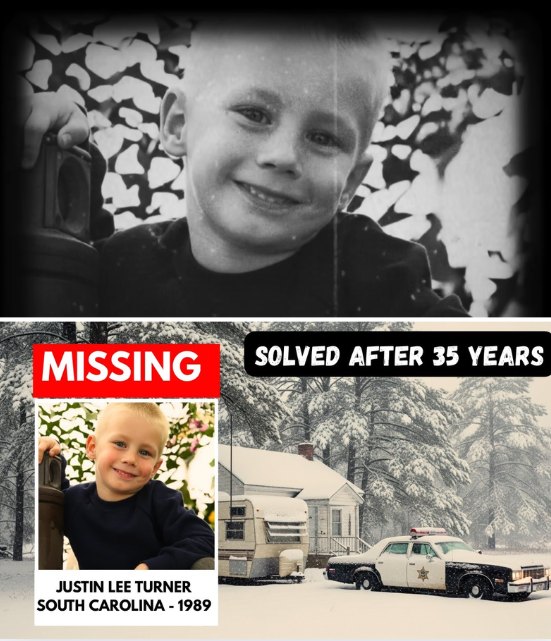
Thirty-Five Years of Silence: How Modern Technology Reopened the Search for Justin Lee Turner
The morning of March 3, 1989, began like countless others in the small town of Gaffney, South Carolina. It was a cool Friday, the kind that carried quiet anticipation for the coming weekend. Five-year-old Justin Lee Turner prepared for school, adjusting his backpack before stepping out the door. His walk was short, familiar, and considered safe—one he had taken many times before.
That morning, Justin never arrived.
By midday, concern turned into alarm. By nightfall, it became clear that something had gone terribly wrong. Justin Lee Turner had vanished without explanation, setting off one of the most painful and enduring searches in the region’s history.
A Community Mobilizes, but the Trail Goes Cold

The response to Justin’s disappearance was immediate and intense. Local authorities, state officials, and federal agencies joined forces. Search teams swept neighborhoods, wooded areas, and fields near Justin’s route to school. Helicopters scanned from above, volunteers walked shoulder to shoulder, and tracking dogs followed every possible scent.
Only a few troubling items were recovered. Justin’s backpack was found near the school, abandoned. A hair accessory that did not belong to him was discovered nearby. Beyond these fragments, there were no witnesses, no communications, and no clear direction for investigators to follow.
As days turned into weeks, hope began to erode. The search effort, once urgent and expansive, slowly scaled back. For Justin’s family and the wider community, the absence of answers became a constant, heavy presence. The case transitioned from an active investigation into an unresolved mystery—one that left a young child unaccounted for and a family trapped in uncertainty.
A Confession That Changed Everything—Then Changed Nothing

Four years later, in 1993, the case took a shocking turn. Dennis Stockton, a neighbor and acquaintance of the Turner family, was incarcerated on unrelated charges. While in custody, he made statements to another inmate claiming responsibility for Justin’s disappearance.
Stockton later repeated his account to investigators. He described involvement in Justin’s disappearance and directed authorities to a specific rural area in Cherokee County, where he claimed the child’s remains could be found. The confession was deeply unsettling and, on the surface, appeared to offer the long-awaited answer.
But there was a problem.
Stockton had a reputation for making unreliable statements while in custody. Investigators were well aware of the phenomenon of false or exaggerated confessions, particularly in high-profile cases involving intense public emotion. Without physical evidence to support his claims, authorities approached the confession with caution.
Search teams investigated the area Stockton identified. Despite repeated efforts using the tools available at the time, nothing was found. With no remains recovered and no additional corroboration, the confession was ultimately deemed unreliable and archived.
For Justin’s family, the impact was devastating. They were left in an impossible position—confronted with a confession that seemed to explain everything, yet officially dismissed by the system meant to deliver certainty. The case once again went silent.
Decades of Waiting and Unanswered Questions

For the next thirty years, Justin Lee Turner remained listed among the unrecovered missing. His case was periodically reviewed but never advanced. Dennis Stockton died in custody in 2003, taking with him the only detailed account of what might have happened.
As time passed, the disappearance became part of local memory—a story told quietly, with sadness and frustration. Advances in technology transformed criminal investigations elsewhere, but Justin’s case seemed frozen in time, defined by the limitations of an earlier era.
For his family, time did not heal the absence. Without answers, there was no closure—only endurance.
A Fresh Look Through a Modern Lens
In 2024, the case was reassigned to Detective Angela Wells, an investigator accustomed to working with cold cases and modern forensic tools. Rather than dismissing the old confession outright, Wells approached it with a different question: not whether Dennis Stockton was credible, but whether the technology used in 1993 had been sufficient.
Wells revisited the archived records, focusing closely on the coordinates Stockton had provided decades earlier. Using modern GPS systems, high-resolution satellite imagery, and historical land surveys, she overlaid past data with present-day mapping.
What emerged was a subtle but critical discovery. The area previously searched was broader and less precise than Stockton’s description suggested. When viewed through modern mapping tools, the location narrowed to a specific point near a property boundary—an area easily overlooked in earlier searches.
Years of natural changes to the landscape had further obscured the site. What once appeared as an unremarkable stretch of land now revealed a slight depression that stood out only under detailed analysis.
Returning to the Ground After Thirty-Five Years

With new evidence in hand, Detective Wells secured the necessary authorization to conduct a renewed search. An excavation team was assembled, and investigators returned to the rural location that had remained quiet for decades.
The excavation was careful and methodical. Within hours, the long-standing uncertainty came to an end. Human remains were discovered in a shallow grave, precisely where the reanalyzed data indicated.
Subsequent forensic examination confirmed what the Turner family had waited more than three decades to hear. Through modern DNA analysis and dental records, the remains were conclusively identified as those of Justin Lee Turner.
Truth, Too Late—but Finally Certain

The confirmation brought clarity—but also a profound sense of loss. Dennis Stockton’s long-dismissed confession was proven accurate. The failure was not one of disbelief, but of technological limitation. What could not be verified in 1993 became undeniable in 2024.
While the individual responsible had passed away years earlier, the discovery provided the Turner family with the only form of justice still possible: truth. Justin was no longer missing. He was found, identified, and finally returned to his family.
The Role of Technology in Justice Delayed
The case of Justin Lee Turner underscores how advancements in technology can transform long-dormant investigations. GPS precision, modern forensic science, and digital mapping tools allowed investigators to reinterpret old evidence in ways that were previously impossible.
It also highlights a difficult reality: justice can be delayed not only by human error, but by the limits of the tools available at the time. In Justin’s case, the answer existed for decades—but remained hidden, waiting for the right moment and the right technology.
A Name No Longer Lost
For thirty-five years, Justin Lee Turner’s name represented absence—an unresolved question in official records and in the hearts of those who remembered him. Today, it represents perseverance.
His case is a reminder that even when hope fades, it does not disappear entirely. Sometimes it waits, quietly, for the world to catch up.
Through the determination of a modern investigator and the evolution of forensic science, a child long missing was finally brought home. The silence that followed Justin’s disappearance has been broken—not by chance, but by persistence, patience, and the belief that every unanswered case still deserves the truth.