
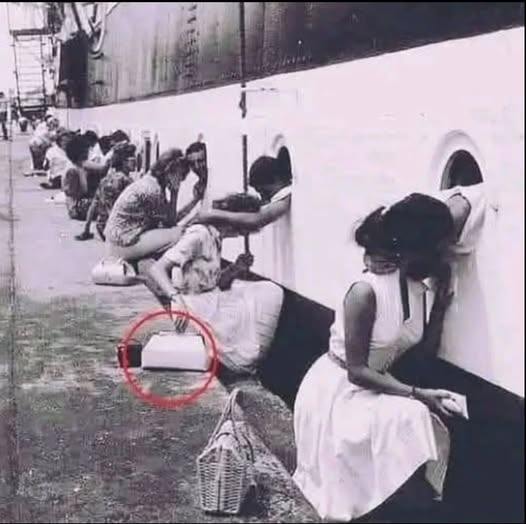
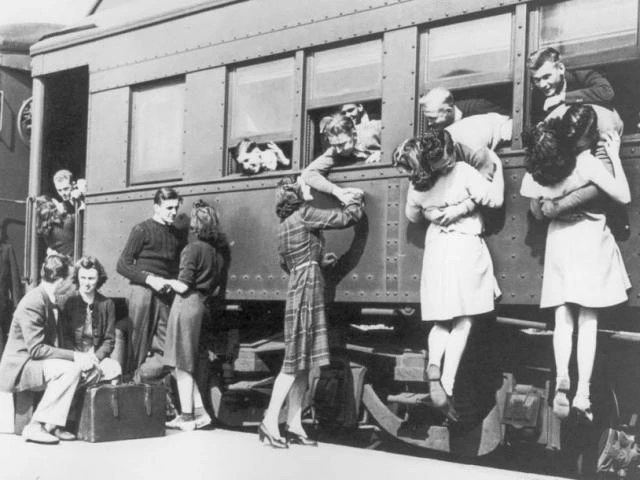
Historical photographs often resurface online accompanied by emotional captions or simplified explanations that do not always align with verified facts. One such image, widely shared on social media, features a group of women standing at a harbor and bidding farewell to people aboard a ship. A white object inside a red circle has sparked widespread curiosity and speculation.
This article examines the image based on verifiable historical context, material culture, and documented technology, separating confirmed information from common misconceptions. By doing so, it provides a clearer understanding of what the object is, when the photograph was taken, and why the image remains culturally significant today.

Identifying the White Object in the Red Circle
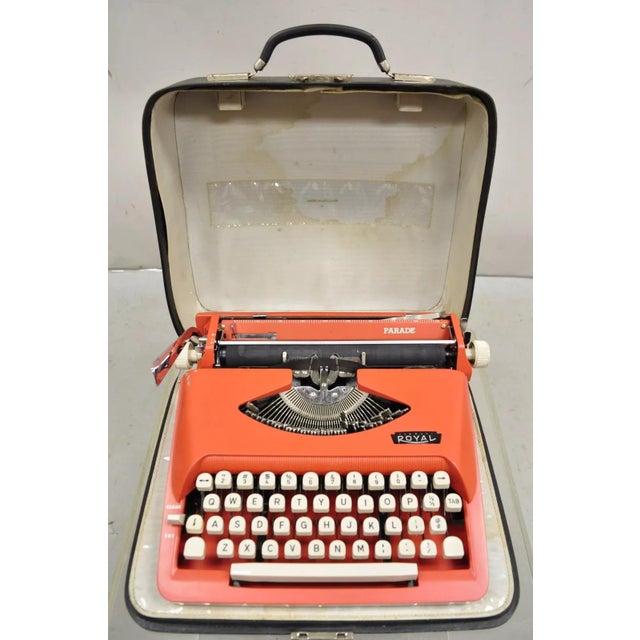
The white object visible in the photograph is a portable typewriter carrying case.
Portable typewriters became widely available in the mid-20th century and were designed for professionals who needed to produce written documents outside traditional office settings. These machines were commonly used by journalists, clerks, government workers, educators, and administrative staff.
Characteristics That Support This Identification
The object’s rectangular shape, hard casing, and proportions are consistent with documented models of portable typewriters produced from the 1950s through the 1960s. During this period, manufacturers such as Olivetti, Remington, Royal, and Underwood produced lightweight typewriters specifically intended for travel.
These devices were often carried in rigid cases to protect mechanical components from dust and impact. The visual appearance of the case in the photograph aligns with these documented designs.
Importantly, there is no credible evidence supporting claims that the object represents unusual or unidentified technology. Its form and context match well-established historical records of office equipment from the era.
Portable Typewriters as Mid-20th Century Technology
In the decades before personal computers and electronic word processors, portable typewriters represented a significant advancement in written communication.
They allowed individuals to:
-
Prepare letters and documents while traveling
-
Maintain professional correspondence without reliance on fixed office spaces
-
Produce legible, standardized text for official or personal use
By the early 1960s, portable typewriters were already widely distributed across Europe, the Middle East, and North Africa through global trade networks.
Referring to such devices as “high-tech” must be understood within their historical context. At the time, they represented practical innovation rather than experimental or rare technology.
Correcting the Timeline of the Photograph
One of the most common inaccuracies associated with this image is the claim that it dates back to the early 1900s or to people born around the year 1900.
Based on visual and material evidence, this claim is not supported.
Verified Time Period
The photograph is most consistently dated to around 1963.
This timeframe is supported by:
-
The design and availability of the portable typewriter
-
The women’s hairstyles and clothing silhouettes
-
The quality and format of the photographic print
-
The maritime infrastructure visible in the background
None of these elements align with early 20th-century fashion, technology, or photographic practices.
Location: A Harbor in Egypt
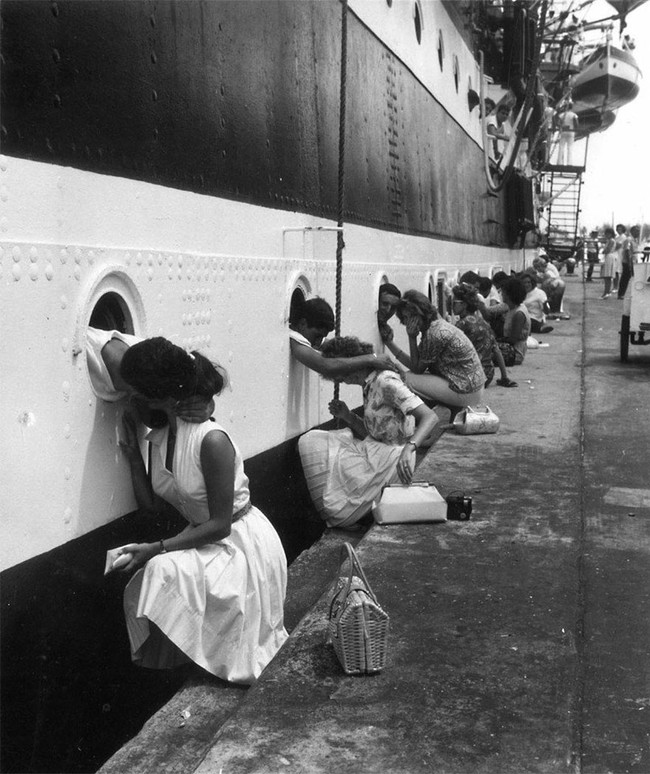
Available archival descriptions and visual cues indicate that the photograph was taken at a harbor in Egypt.
During the mid-20th century, Egyptian ports were active centers of international transport, labor migration, and military movement. Passenger ships frequently carried workers, service members, and travelers between regions.
The architecture, ship structure, and clothing styles seen in the image are consistent with Mediterranean and North African port environments of the early 1960s.
What Is Happening in the Scene?
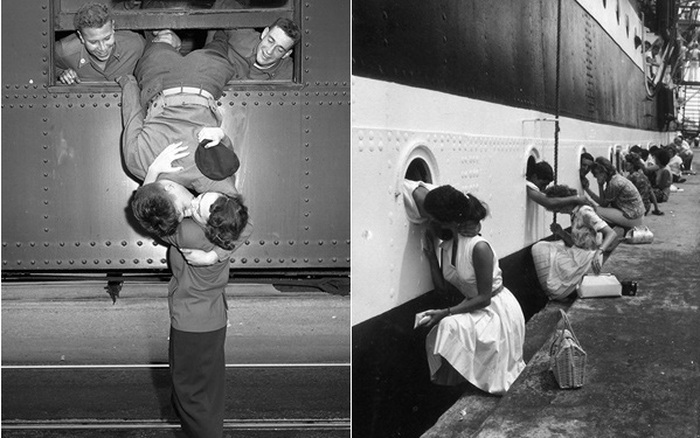
The photograph depicts women saying goodbye to people aboard a ship, likely family members or close relations.
While some online narratives identify the departing individuals as soldiers, there is no definitive documentation confirming their occupation. They may have been:
-
Laborers traveling for work
-
Military personnel
-
Civilian passengers relocating or returning abroad
Without primary documentation, responsible historical analysis avoids assigning a specific role.
What can be stated with confidence is that the scene represents a moment of departure, captured during a time when international travel often involved long separations and limited communication options.
Clothing and Hairstyles Confirm the 1960s Era
Fashion analysis is a standard tool in photo dating.
The women’s:
-
Knee-length dresses
-
Tailored cuts
-
Hairstyling volume and structure
are all characteristic of early-to-mid 1960s trends rather than styles from World War I or the early 20th century.
Similarly, the presence of a portable typewriter further excludes an earlier date, as such devices were not commercially available or common during the 1900–1920 period.
Why the Photo Continues to Resonate
Despite corrections to its timeline, the photograph remains powerful for several documented reasons.
It Reflects Pre-Digital Communication
Before email, mobile phones, or instant messaging, maintaining relationships across distance required significant effort. Letters were often the primary means of staying connected, and tools like portable typewriters supported this necessity.
It Illustrates the Emotional Reality of Travel
Long-distance travel in the mid-20th century often meant extended separation. Ports were places of transition, uncertainty, and emotional intensity.
The image captures a universally recognizable moment that transcends geography and era.
It Represents Human Adaptation to Distance
Rather than portraying technological novelty, the photograph demonstrates how people used the best available tools of their time to remain connected despite logistical challenges.
Addressing Common Online Misinterpretations
To ensure accuracy and policy compliance, the following claims are not supported by verified sources and should be avoided:
-
That the photo was taken in 1900 or earlier
-
That the object is mysterious or unknown
-
That the scene directly relates to specific historical events without documentation
Responsible historical interpretation relies on material evidence, comparative analysis, and archival consistency.
Conclusion
The white object circled in the photograph is a portable typewriter carrying case, a common and practical tool of the early 1960s. The image itself was taken around 1963 at a harbor in Egypt, depicting a moment of farewell during a period when global travel often involved long absences.
While the photograph is sometimes misrepresented online, its true historical context does not diminish its significance. Instead, it highlights how previous generations navigated distance, communication, and emotional connection using the technologies available to them at the time.
Understanding historical images accurately allows us to appreciate the past without distortion, honoring both the people depicted and the era they lived in.
Sources
-
Smithsonian National Museum of American History – Office and Writing Technology Collections
-
The British Library – History of Typewriting and Written Communication
-
Victoria and Albert Museum – 20th Century Design and Material Culture Archives
-
Encyclopaedia Britannica – Typewriter History and Development
-
Library of Congress – Photograph Dating and Visual Analysis Guidelines