

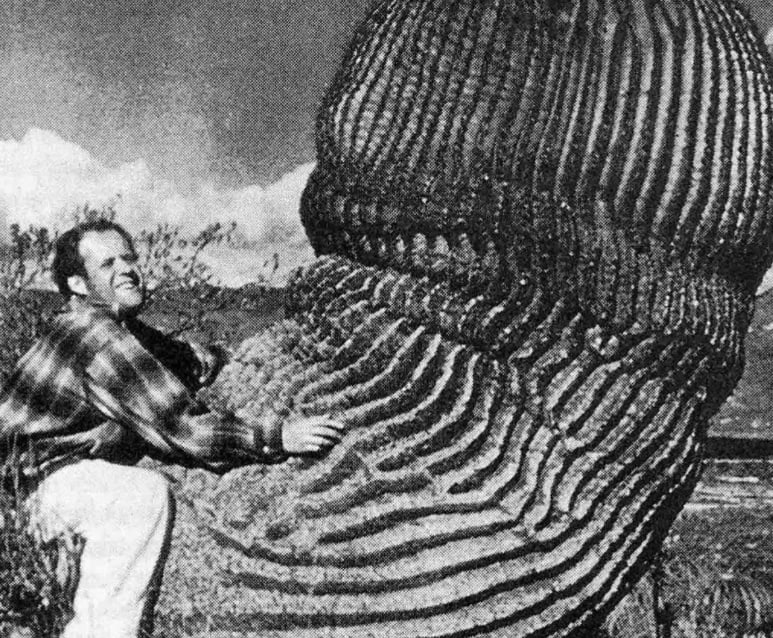
Sergei Eisenstein, one of the most influential filmmakers in the history of cinema, is widely recognized for his pioneering contributions to film theory and montage. Among the many images associated with his life and work, one photograph taken in Mexico around 1930–1931 has attracted sustained attention from historians and film scholars. The image shows Eisenstein posing beside a large cactus during his stay in Mexico, a period closely connected to his unfinished documentary project ¡Que Viva México!.
Rather than being merely a curious visual artifact, the photograph reflects a significant moment in Eisenstein’s artistic journey. When examined through verified historical sources and academic research, the image provides insight into his creative ambitions, his engagement with Mexican culture, and the broader historical circumstances surrounding his work during the early 1930s.

Sergei Eisenstein’s Journey to Mexico
In late 1930, Sergei Eisenstein traveled to Mexico after spending time in Europe and the United States. His visit was primarily motivated by the opportunity to work on ¡Que Viva México!, an ambitious film project intended to explore Mexican history, culture, traditions, and social structures. The project was supported financially by American writer and socialist sympathizer Upton Sinclair, along with Sinclair’s wife Mary Craig Sinclair and investor Hunter Kimbrough.
Eisenstein viewed Mexico as a country rich in visual symbolism, historical depth, and cultural contrast. According to film historians, he believed the landscape, architecture, and traditions of Mexico could provide powerful material for cinematic expression. His time in Mexico lasted from late 1930 until early 1932, during which he and his collaborators filmed extensively across the country.
The Historical Context of ¡Que Viva México!
The film ¡Que Viva México! was conceived as a multi-part documentary-style work, combining ethnographic observation with Eisenstein’s distinctive montage techniques. The project aimed to depict different eras of Mexican history, from pre-Columbian civilizations to contemporary rural life. Despite extensive filming, the project was never completed by Eisenstein himself due to financial disputes, political pressures, and visa complications.
The footage was later edited into several different versions by other filmmakers, none of which fully reflected Eisenstein’s original vision. Today, ¡Que Viva México! is widely discussed in film studies as an example of both Eisenstein’s artistic ambition and the challenges faced by international film productions during that period.

The Photograph and Its Setting
The photograph in question was taken during Eisenstein’s stay in Mexico, most likely between 1930 and 1931. While the exact location is not definitively documented, it is consistent with areas Eisenstein visited while filming in central and southern Mexico, regions known for large native cactus species and distinctive desert and semi-desert landscapes.
Visual records from this period show Eisenstein frequently posing for photographs in outdoor settings, often interacting with local environments. These images were commonly shared among friends, colleagues, and artistic circles, reflecting a tradition of documenting travel and creative work long before the era of digital media.
Clothing and Appearance
In the photograph, Eisenstein is dressed in practical attire suitable for travel and outdoor work. His footwear appears sturdy, consistent with boots commonly worn by travelers and filmmakers working in uneven terrain. Such footwear was typical for individuals involved in location filming during the early 20th century, especially in rural or undeveloped areas.
No verified historical records suggest any symbolic intent behind his clothing in this image. Film historians generally agree that Eisenstein prioritized practicality during filming, given the physical demands of traveling across Mexico with heavy equipment and limited infrastructure.
The Cactus as a Cultural Symbol
Cacti are a prominent feature of Mexico’s natural landscape and hold cultural significance in Mexican history and iconography. Various species of large cacti, including columnar and tree-like forms, are native to Mexico and have long been associated with resilience, adaptation, and regional identity.
Eisenstein’s documented interest in visual symbolism makes it reasonable to interpret the presence of the cactus as part of his broader fascination with Mexican forms and textures. However, there is no reliable academic evidence that he intended the cactus in this photograph to convey any hidden or metaphorical meaning. Scholars generally caution against projecting modern interpretations onto historical images without supporting documentation.

Academic Perspectives on Eisenstein’s Mexican Period
Film scholars view Eisenstein’s time in Mexico as a critical transitional phase in his career. During this period, he refined his ideas about visual rhythm, non-linear narrative, and the relationship between landscape and human history. The photographs taken during this time, including the well-known cactus image, are often studied as supplementary materials that help contextualize his creative process.
Reputable sources such as the British Film Institute, the Museum of Modern Art, and academic film journals emphasize Eisenstein’s deep engagement with Mexican art, architecture, and indigenous traditions. These institutions focus on the historical and artistic importance of his work rather than anecdotal or speculative interpretations of individual images.
Avoiding Speculation in Historical Interpretation
Modern discussions on social media have sometimes attached humorous or exaggerated interpretations to historical photographs, including Eisenstein’s image in Mexico. However, responsible historical analysis relies on verifiable documentation, correspondence, production notes, and scholarly research.
There is no confirmed evidence from letters, diaries, or academic biographies indicating that Eisenstein intended the photograph to serve as a joke or provocative statement. As such, reputable historical writing avoids unverified claims and focuses instead on the broader artistic and cultural context.

Lasting Significance of the Photograph
Today, the photograph of Sergei Eisenstein in Mexico remains valuable not because of novelty, but because it visually anchors an important chapter in film history. It reminds viewers of a moment when one of cinema’s most influential thinkers was immersed in a foreign culture, attempting to translate its complexity into a new cinematic language.
The image also highlights the human side of Eisenstein: a filmmaker traveling, observing, and engaging with the world beyond the studio. When interpreted carefully and responsibly, the photograph contributes to a deeper understanding of his artistic journey and the historical conditions under which he worked.
Conclusion
The photograph of Sergei Eisenstein posing beside a large cactus in Mexico around 1930–1931 is best understood through documented historical context rather than speculation. Taken during the production period of ¡Que Viva México!, the image reflects Eisenstein’s engagement with the Mexican landscape and his broader creative ambitions.
By grounding interpretation in reputable sources and established scholarship, the photograph serves as a meaningful historical record. It stands as a visual reminder of Eisenstein’s enduring influence on global cinema and his commitment to exploring culture, history, and form through film.
Sources
British Film Institute (BFI)
Museum of Modern Art (MoMA) Film Archives
Library of Congress Film Collections
David Bordwell, The Cinema of Eisenstein
Jay Leyda, Kino: A History of the Russian and Soviet Film