

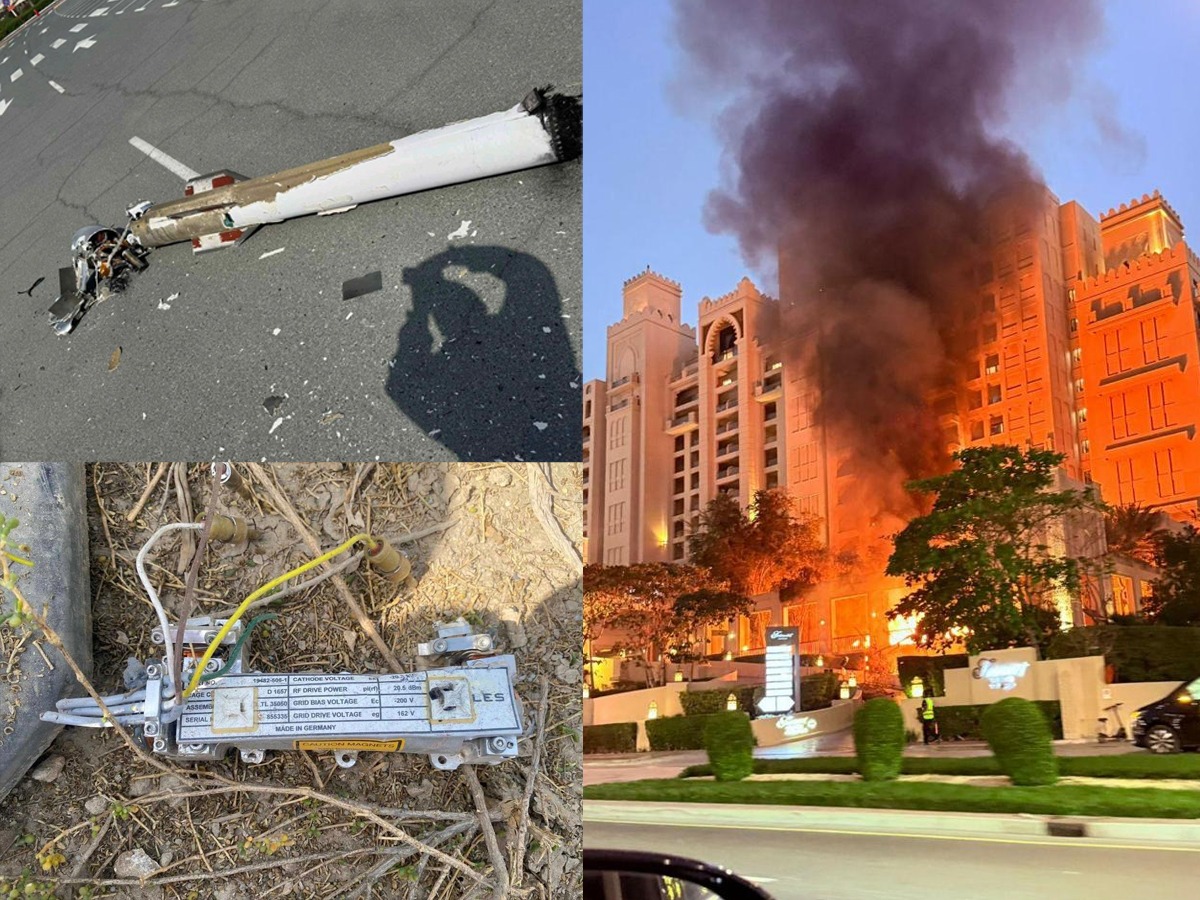
A wave of reported explosions and air defense activity across parts of the Middle East has intensified concerns about a widening regional conflict. According to reporting by The Guardian, multiple Gulf states experienced security incidents following strikes linked to escalating hostilities between Iran, Israel, and the United States. Governments across the region issued statements, activated emergency response systems, and moved to reassure residents as investigations continued.
The developments represent one of the broadest geographic expansions of confrontation in recent years, affecting countries that have long been considered relatively insulated from direct conflict.
Dubai: Fire Incidents and Air Defense Interceptions

Authorities in Dubai reported that debris from an intercepted drone caused a fire near a well-known luxury hotel in the Palm Jumeirah area. Initial social media footage showed flames near the entrance of the property, prompting widespread concern. However, officials clarified that emergency teams responded quickly and contained the situation.
The Dubai Media Office stated that Civil Defence units brought the fire under control and reported no confirmed injuries after a full assessment. Officials also acknowledged that a portion of Dubai International Airport sustained minor damage in a separate incident, though detailed technical explanations were not publicly released.
In Abu Dhabi, a post from airport authorities referencing casualties at Zayed International Airport was later deleted. Final official confirmation regarding fatalities was not publicly detailed in subsequent communications. Government messaging focused on rapid containment, infrastructure integrity, and operational continuity.
Residents described seeing air defense interceptions over the skyline, an unusual sight in a city globally known for commerce and tourism. Temporary airspace closures further heightened public concern, limiting travel options and underscoring the seriousness of the situation.
Bahrain: Security Agency and High-Rise Impact
In Bahrain, officials confirmed that a drone struck a high-rise building, resulting in structural damage and fire. Earlier reports indicated that facilities associated with national security agencies were also targeted. Social media footage appeared to show explosions near the U.S. naval base that hosts the U.S. Fifth Fleet, though official confirmation regarding direct impacts on military installations remained limited at the time of reporting.
Bahrain’s position as host to key U.S. naval operations places it at the center of regional security architecture. The reported incidents marked a notable escalation for a country that has historically maintained internal stability while serving as a strategic military hub.
Authorities moved quickly to assess structural damage and ensure public safety. Emergency responders secured affected areas, and investigations were launched to determine the precise sequence of events.
Kuwait: Airport Disruption and Infrastructure Damage

Kuwait reported that a drone crashed at Kuwait International Airport, injuring several employees and causing infrastructure damage. Airport operations were adjusted as officials evaluated safety conditions and inspected runways and facilities.
As a major transit point in the Gulf, Kuwait’s airport plays a crucial role in regional connectivity. Even limited disruptions can ripple across international flight networks, affecting passengers traveling between Europe, Asia, and Africa.
Government statements emphasized that response teams were deployed immediately and that authorities were working to restore normal operations as quickly as possible.
Jordan and Qatar: Missile Interceptions and Sovereignty Concerns
In Jordan, debris from intercepted missiles reportedly fell in the northern city of Irbid, igniting localized fires. Emergency services responded to extinguish the fires and secure residential neighborhoods. No large-scale casualties were immediately confirmed in official briefings.
Qatar described strikes on its territory as a direct threat to national security. Officials, along with other members of the Gulf Cooperation Council, condemned what they characterized as violations of sovereignty. Several Gulf states stated they reserve the right to respond in accordance with international law.
Iran’s foreign minister, Abbas Araghchi, told NBC News that Iran did not intend to target Gulf governments but was striking U.S. military bases in what it described as an act of self-defense. The distinction, however, did not ease concerns among host countries where physical damage was reported.
Lebanon and Iraq: Rising Regional Anxiety

Beyond the Gulf, neighboring countries experienced heightened anxiety. In Lebanon, long lines formed at gas stations within hours of the reported strikes. Beirut’s airport saw commercial flight cancellations, and grocery stores reported increased demand for essential goods.
Hezbollah issued a statement condemning what it described as violations of international law but did not confirm direct involvement in the expanding confrontation. Israeli officials, according to diplomatic reporting, indicated that any direct engagement by Hezbollah could trigger further escalation.
In Iraq, facilities linked to Iran-aligned groups were reportedly struck, resulting in casualties among members of Kataib Hezbollah. Iran-backed groups warned that they could join actions targeting U.S. military installations across the region.
The broadening scope of reported incidents suggested that hostilities were no longer confined to a single front but were influencing multiple theaters simultaneously.
Strategic Calculations Behind the Escalation
The Gulf states have long attempted to balance relations between Iran and Western powers, often serving as intermediaries in regional diplomacy. Reports indicate that some Gulf governments previously sought to discourage further military escalation, concerned about economic disruption and domestic stability.
The presence of major U.S. military bases in Bahrain, Qatar, Kuwait, and the United Arab Emirates makes these countries strategically significant. At the same time, their economies rely heavily on tourism, aviation, real estate, and energy exports. Damage to airports or hospitality infrastructure directly affects investor confidence and global perception.
Analysts have suggested that expanding strikes into Gulf territory could be intended to apply pressure on Washington through economic consequences. Others argue that such actions may have the opposite effect, strengthening regional security alignment with the United States.
International Law and Diplomatic Pressure

Under international law, sovereignty is a foundational principle. Strikes that land on the territory of third-party states, even if aimed at foreign military installations, create complex legal and diplomatic questions.
Gulf governments condemned what they described as violations of their sovereignty. Iran maintains that its actions were directed at U.S. military facilities and framed as defensive. The interpretation of such claims depends on evidence, intent, and impact, all of which are subject to international scrutiny.
The United Nations has historically called for restraint in similar crises, urging parties to avoid further escalation and prioritize civilian infrastructure protection. Diplomatic channels, including emergency consultations and back-channel negotiations, are often activated during such periods of heightened tension.
Economic and Energy Market Implications
The Gulf region is central to global energy supply and maritime trade. Although no widespread oil infrastructure damage was officially confirmed in early reporting, financial markets reacted to uncertainty with volatility.
Airspace closures disrupted major international transit hubs such as Dubai and Doha. Even temporary suspensions can affect airline schedules, cargo logistics, and insurance costs. Investors closely monitor such developments due to the region’s importance in global energy flows and sovereign wealth investment strategies.
Sustained instability could influence shipping routes, oil prices, and foreign direct investment. Governments across the Gulf have diversified their economies significantly in recent years, but regional security remains a critical foundation for long-term growth.
Public Sentiment and Social Impact

For residents, the psychological impact may be as significant as the physical damage. Witnessing air defense systems activate above city skylines is an unfamiliar experience in cities known for luxury tourism and commercial development.
Temporary airport closures, footage of fires, and online speculation amplified public anxiety. Governments worked to counter misinformation by issuing official updates and clarifying reports as investigations progressed.
In Lebanon and other neighboring states, public behavior reflected caution rather than panic. Fuel lines and grocery purchases were influenced by collective memory of past regional instability.
What Comes Next
The trajectory of the crisis will depend on diplomatic engagement, strategic restraint, and the willingness of involved parties to avoid further geographic expansion. Past regional confrontations have demonstrated that back-channel diplomacy can reduce escalation risks, even after significant flare-ups.
For Gulf states, restoring confidence will require transparent communication, robust security coordination, and diplomatic outreach. Their position as economic bridges between East and West places additional pressure on leaders to maintain stability while managing complex alliances.
As investigations continue and official statements evolve, the broader international community remains focused on preventing a deeper regional conflict. The coming days will be critical in determining whether the situation stabilizes or escalates further.
Sources
The Guardian – Reporting by William Christou
NBC News – Interview with Iranian Foreign Minister Abbas Araghchi
Official statements from Dubai Media Office and Abu Dhabi Airports
Public communications from Gulf Cooperation Council member states