
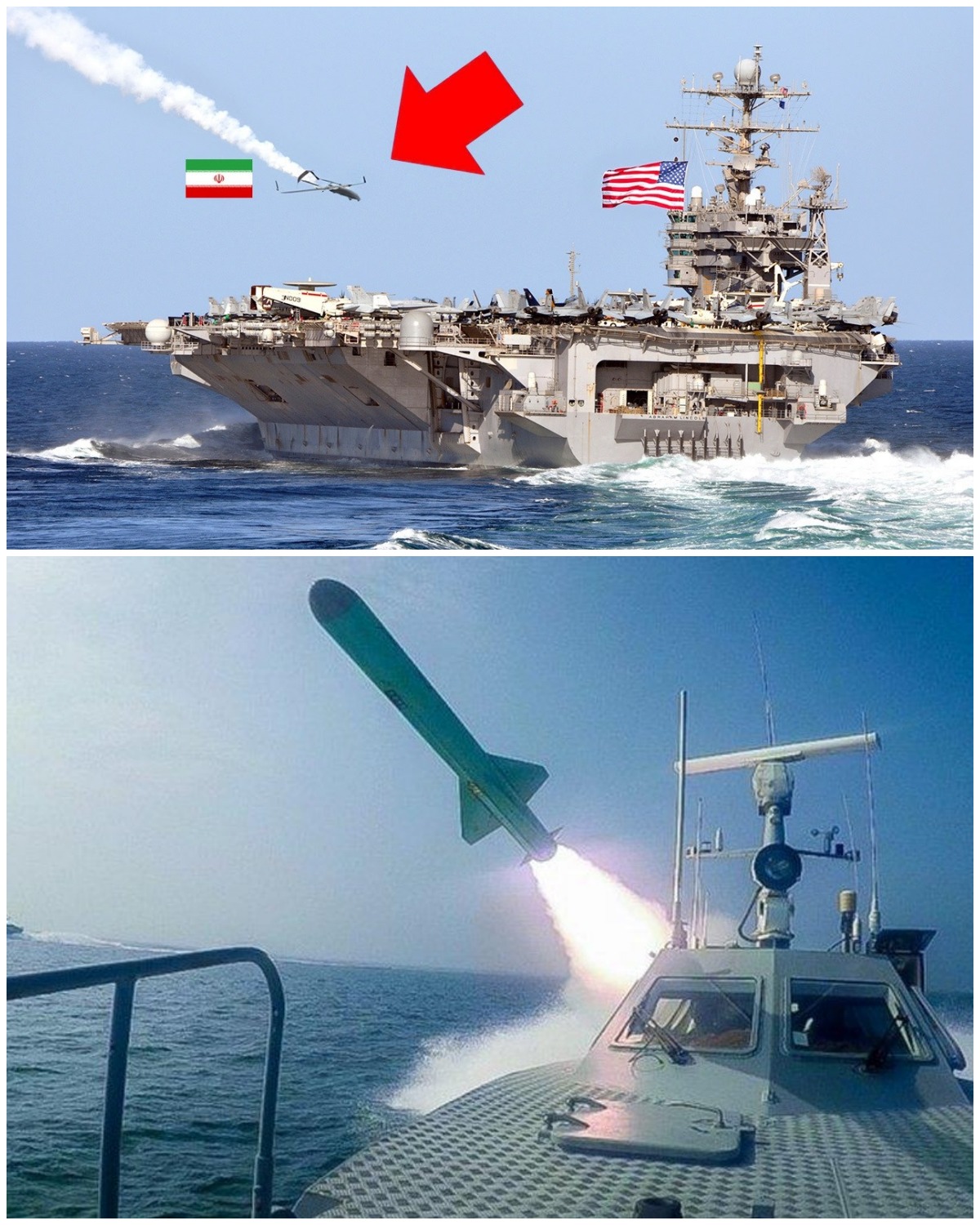
When Iran’s Revolutionary Guard published footage depicting a drone swarm striking a target modeled after a U.S. aircraft carrier, the symbolism was unmistakable. Inexpensive, mass-produced unmanned aerial vehicles overwhelming a costly warship. Quantity defeating quality. The message was crafted not just for a domestic audience in Tehran, but for military planners watching the strategic waterways of the Persian Gulf with close attention.
But propaganda videos simplify the realities of modern warfare. The actual technical picture is considerably more complex.
If a real-world scenario unfolded in which a large drone swarm was directed at a carrier strike group, it would likely begin with reconnaissance and incremental escalation rather than an immediate saturation strike. Coastal launch points would activate in sequence. One-way attack drones — similar in design to models like the Shahed-136 — would lift off in staggered waves, following pre-programmed navigation routes toward a naval formation operating in or near the Gulf.
These drones are not sophisticated autonomous hunters. They rely primarily on satellite navigation and fixed targeting coordinates. Once airborne, they cannot dynamically reroute around defensive systems or adapt to electronic countermeasures in real time. Their operational strength lies in cost and volume, not in flexibility or intelligence. That distinction matters enormously when considering how a modern naval defense network would respond.
Detection Begins Long Before Visual Contact

Detection of an incoming drone swarm would not begin at visual range. An E-2D Hawkeye airborne early warning aircraft orbiting at high altitude above a carrier strike group would likely identify such contacts well before they approached any engagement range. Its advanced radar system is specifically designed to track small, low-flying targets against complex background clutter, feeding data through Cooperative Engagement Capability networks that unify the entire strike group’s sensor picture into a single, coherent operational view.
In practice, this means that a destroyer operating dozens of miles away could generate an accurate firing solution using data it did not directly collect. A modern carrier strike group functions less as a collection of separate ships and more as a distributed, highly synchronized combat system — one in which information flows continuously between platforms and decisions can be executed across the formation simultaneously.
Initial engagements would draw on layered conventional defenses. Naval guns firing proximity-fused rounds can effectively neutralize slow-moving aerial targets at moderate distances. Close-in weapon systems such as the Phalanx are engineered to intercept threats within close range of a vessel. Rolling Airframe Missiles and Standard Missiles extend that protective perimeter outward considerably, creating overlapping defensive zones that a swarm must penetrate sequentially.
The Cost Asymmetry Problem — and How Technology Is Addressing It
Critics of traditional missile defense have long pointed to cost asymmetry as a structural vulnerability. Interceptor missiles costing millions of dollars versus drones assembled for tens of thousands. That arithmetic has shaped much of the drone-based strategic thinking seen from adversaries in recent years. A saturation strategy aims to exhaust missile magazines faster than they can be replenished, creating a moment of vulnerability once conventional interceptors are depleted.
But magazine depth is no longer the only variable in this equation.
In recent years, the U.S. Navy has been developing and testing directed energy systems — both laser platforms and high-powered microwave weapons — designed specifically to address the challenge posed by drone swarms. Unlike kinetic interceptors, these systems do not consume traditional ammunition. They draw from a ship’s electrical power generation capacity, meaning their operational sustainability is tied to energy management rather than a finite supply of physical projectiles.
High-powered microwave weapons are engineered to disrupt or destroy the electronic components of incoming threats by overwhelming their circuits with concentrated electromagnetic energy. Rather than physically detonating a drone, these systems can disable its guidance or flight control electronics, causing it to lose stability and fall without a conventional explosion. The effect is clean, rapid, and repeatable across multiple targets within a single engagement window.
If deployed at operational scale, such systems would fundamentally alter the economic logic that underpins saturation strategies. Instead of expending an expensive interceptor for each incoming drone, a destroyer equipped with directed energy capability could potentially neutralize multiple targets in rapid succession, limited primarily by power generation capacity and thermal management rather than by how many missiles remain in the magazine.
Integration Challenges and the Complexity of Multi-Threat Environments

This does not render conventional weapons obsolete. Directed energy systems depend on accurate targeting data and clear engagement geometries. Low-flying drones skimming just above the sea surface can complicate radar discrimination significantly. Environmental factors, atmospheric interference, and the need to coordinate defensive fire across a formation introduce real operational constraints.
In a complex combat environment that simultaneously includes ballistic missiles, cruise missiles, and surface threats, commanders must carefully deconflict engagement sectors to prevent interference between defensive systems. A high-powered microwave system, for example, cannot discriminate between hostile electronics and friendly ones. If a defensive interceptor were passing through an active engagement sector at the wrong moment, precise timing coordination would be essential. Modern Aegis combat systems are designed to automate much of this coordination, calculating engagement windows in fractions of a second and managing the sequencing of multiple simultaneous defensive actions.
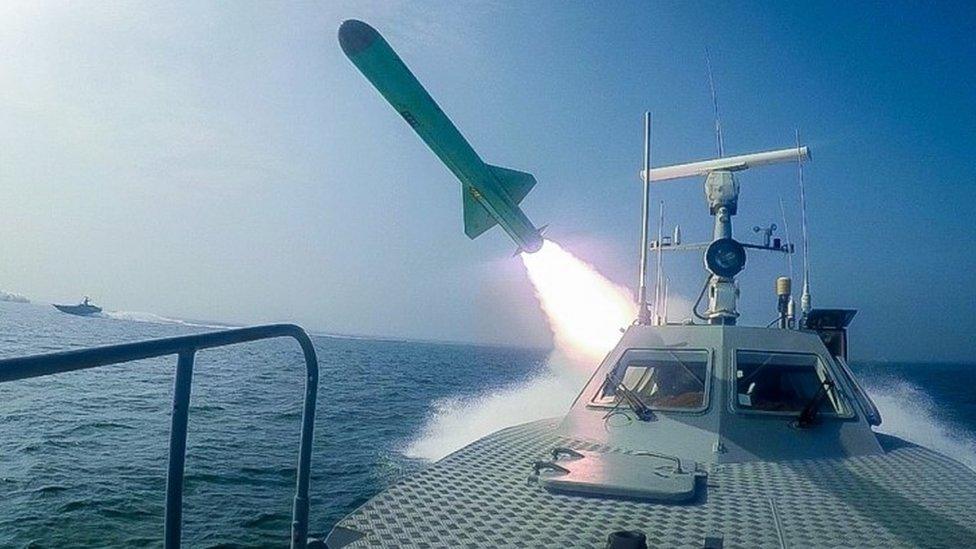
The most demanding scenario for any naval formation is not a single-vector drone attack, but a coordinated multi-domain strike. Strategic doctrine from adversaries like Iran emphasizes layered pressure: drone swarms to saturate defensive resources, anti-ship ballistic missiles to force the expenditure of high-value interceptors, and fast attack vessels armed with cruise missiles positioned to exploit any gaps that emerge. Such combined operations aim to create decision overload and timing conflicts that overwhelm even sophisticated automated defense networks.
Against ballistic threats, kinetic interceptors remain essential. Directed energy systems cannot replace every defensive layer. Standard Missiles would still be required for high-altitude intercepts to protect the carrier and its escorts from the most catastrophic potential impacts. Meanwhile, rotary-wing aircraft operating from the carrier’s deck would address surface vessel threats, using precision-guided munitions capable of neutralizing fast attack boats before they reached effective launch range.
Defense and Intelligence Gathering as Interconnected Operations

The interplay between these various systems creates a choreography of timing and sector management that operates far faster than any human decision cycle. Sensors track. Algorithms assign engagement responsibilities. Windows open and close in milliseconds. Human commanders provide oversight, but automated combat systems perform the real-time calculations that no person could manage alone under the pressures of active engagement.
In this environment, the cost asymmetry that once favored drone-heavy strategies begins to shift in a different direction — and in a way that is often overlooked in public discussion. A drone swarm that was designed to deplete missile magazines may, if the defending fleet retains its inventory while tracking every launch, instead expose the attacker’s own infrastructure. Every activation of a coastal radar system, every launch shelter opened, every telemetry signal transmitted becomes a piece of actionable data. Airborne early warning aircraft operating above electronic jamming layers can geolocate emissions with considerable precision. Launch facilities and support networks reveal themselves the moment they become operationally active.
The immediate tactical outcome — whether dozens or hundreds of drones are neutralized — matters less, strategically, than the long-term consequence. If a strike group retains the majority of its defensive inventory while simultaneously mapping an adversary’s coastal launch network, the balance of deterrence shifts significantly in the defender’s favor. That is the often-overlooked dimension of modern naval operations. Defense and intelligence gathering are not separate activities — they are deeply intertwined. The act of initiating an attack against a sophisticated naval formation exposes the attacker’s own infrastructure in ways that can have lasting strategic consequences.
What Modern Naval Power Actually Means
None of this guarantees absolute invulnerability. No defense system is flawless, and determined adversaries can adapt. Thermal limitations, radar blind spots, environmental interference, and sheer volume of incoming threats remain real variables. An adversary can modify flight profiles, introduce electronic countermeasures, or combine cyber operations with physical strikes to create new challenges for even the most advanced defensive architecture.
But the argument that inexpensive drones automatically and inevitably overwhelm advanced naval forces assumes that defenses remain static. Modern naval warfare has not remained static. The development and potential fielding of operational directed energy systems represents a meaningful shift in doctrine. Magazine depth becomes electrical capacity. The strategic calculus shifts from managing missile inventory to managing power generation. And the economic logic that underpins saturation-based strategies weakens considerably when the cost of each defensive engagement drops to a fraction of what it once was.
For those watching the evolution of these technologies, the most significant advances are often the least visible. The flat-panel antennas on a destroyer’s hull. The updated algorithms running inside an Aegis system. The additional power generation capacity routed from a ship’s engineering plant to its directed energy systems. These quiet upgrades, accumulated steadily over years of development and testing, often matter more than any single dramatic weapons demonstration.
Naval power in the modern era is not defined solely by the size of a carrier or the range of a single missile. It is defined by how seamlessly sensors, networks, and weapons integrate under operational pressure — and how effectively that integration is sustained when multiple threats arrive simultaneously from multiple directions.
Drone swarms test that integration directly. Whether any adversary’s strategy succeeds or fails depends not on a single weapon or a single engagement, but on the ongoing evolution of systems specifically designed to counter new threats as they emerge. In that quiet, technical competition, the outcome of any future confrontation is being shaped — not in propaganda videos, but in engineering laboratories, software updates, and operational testing far from public view.