
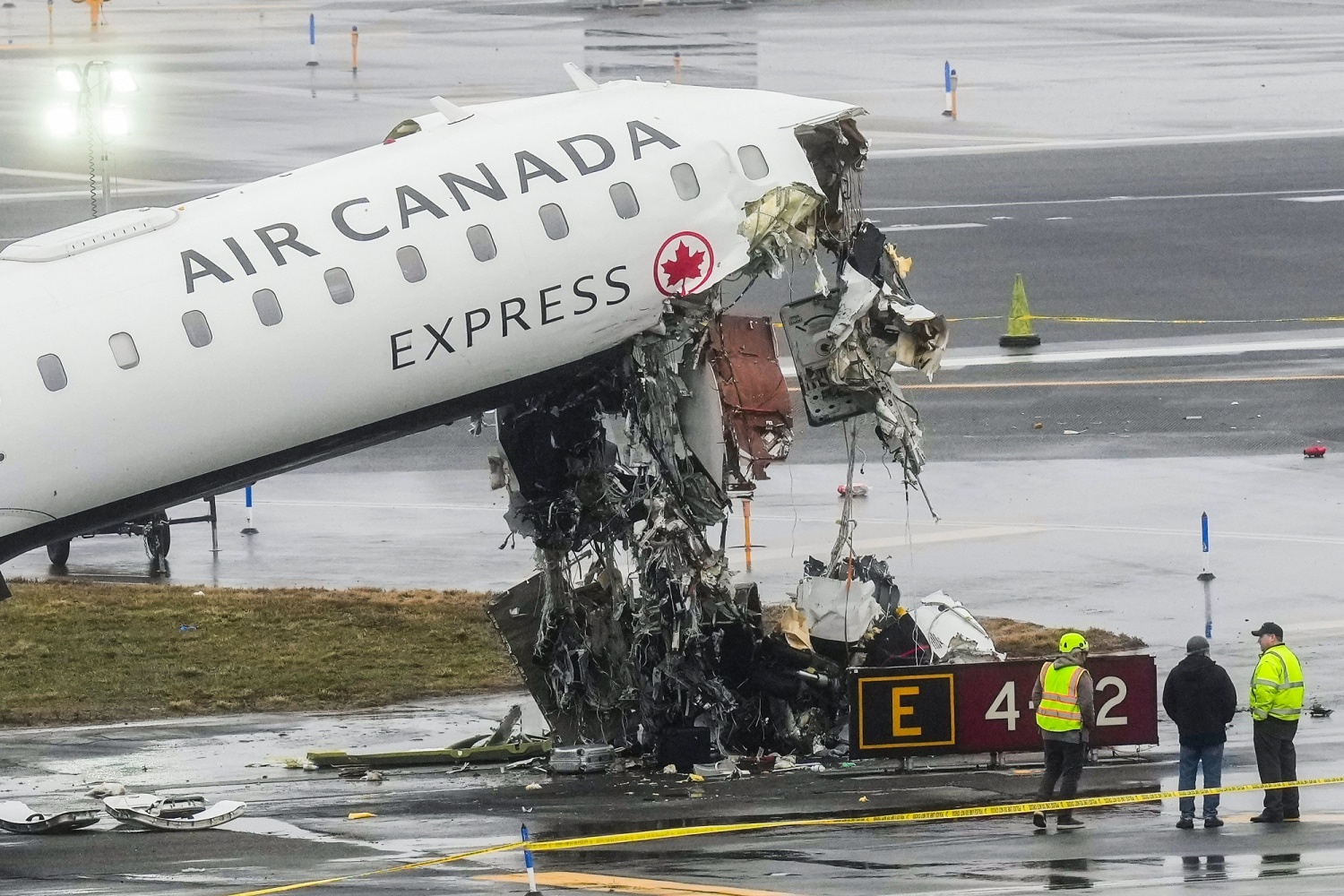
What began as a routine late-night landing at one of America’s busiest airports turned into one of the most harrowing aviation incidents in recent memory — and in the chaos of those final seconds, a decision made inside the cockpit may have been the only thing standing between 74 passengers and an unimaginable outcome.
A passenger aboard the Air Canada Express flight that collided with an emergency vehicle at LaGuardia Airport in New York is now speaking out, offering a raw and emotional firsthand account of what those terrifying moments felt like from inside the cabin — and why they believe the crew members responsible for that flight deserve to be remembered as heroes.
“We Felt a Jolt… Then a Loud Bang”

LaGuardia Airport was brought to a complete standstill for several hours following the collision, which took place late on a Sunday night. Officials confirmed that both the pilot and co-pilot lost their lives in the incident, while two fire service personnel sustained injuries. The airport, long considered one of the most challenging in the country due to its compact layout and heavy traffic volume, became the center of a national conversation about aviation safety in the hours and days that followed.
According to a firsthand account shared on a popular online forum, the plane had already touched down and was making its way along the taxiway when everything suddenly went wrong. The passenger, who posted under the username “bradysego12” and identified themselves as someone who had been onboard the aircraft, described the terrifying sequence of events in vivid detail.
“We had just touched down and maybe about 30 seconds later we all felt a jolt forward, then a loud bang, and what felt like sliding sideways down the runway,” the post read.
In those first moments, many of the passengers onboard had little understanding of how serious the situation truly was. The brain, in shock, often struggles to process extreme events in real time. But that confusion gave way almost instantly to panic as the full weight of what had just happened began to sink in.
Another passenger, Jack Cabot, described the collision to a Canadian news outlet in similarly chilling terms. “Right as we hit the ground, we kind of felt, like, the brake was pretty hard and we all felt something was wrong,” he said. “And then, it was just this sudden, overwhelming, like, panic, because we’d hit something and there was nobody in control.”
A Last-Second Decision That May Have Changed Everything
In the middle of all that fear and confusion, one particular detail emerged that has captured the attention of aviation observers and the general public alike. According to the Reddit post, someone on the flight mentioned that the pilot had attempted a reverse thrust maneuver in the final moments before the collision — a desperate, split-second effort to reduce speed and lessen the force of impact.
“But someone did say the pilot tried to reverse thrust at the last second,” bradysego12 wrote. “Honestly, they likely saved our lives. I wish I could tell their families how thankful I am. They are heroes.”
Reverse thrust is a technique in which the direction of an aircraft’s engine thrust is redirected to slow the plane down rapidly, most commonly used during landing. Deploying it at the precise moment before an unexpected collision — with no time to fully assess the situation — speaks to the kind of instinctive, trained response that separates experienced aviators from the rest.
Aviation experts have noted that even a modest reduction in speed during a ground collision can dramatically change the outcome in terms of structural damage and passenger safety. Whether or not those extra few miles per hour made the difference between life and loss for the 74 people onboard, passengers like bradysego12 are certain it mattered.
The Pilot Behind the Controls

Amid the grief and the investigation, the story of one of the pilots has begun to emerge, painting a picture of someone who dedicated their life to aviation with an uncommon level of passion and commitment.
One of the crew members has been identified as a 30-year-old from the province of Quebec, Canada, who fell in love with flying at a remarkably young age. His great-aunt, Jeannette Gagnier, shared emotional memories of him in a conversation with a major Canadian newspaper.
“He flew his first plane when he was 16 years old,” she recalled. She went on to describe a young man who never lost his devotion to the craft, even as the demands of training and certification grew more intensive over the years. “He was always taking courses and flying. He never stopped.”
In a detail that speaks to the depth of his dedication, he reportedly learned English specifically to improve his prospects as a professional pilot — a language requirement that is standard in international aviation. For him, becoming a pilot was not simply a career choice. It was a calling.
Chilling Audio From the Control Tower
While survivors processed the trauma of what they had experienced, recordings of air traffic control communications in the minutes leading up to the collision began to surface, offering a haunting window into the final moments before impact.
In the audio, controllers can be heard issuing an urgent instruction to stop a vehicle that had crossed onto the runway: “Truck 1, stop.” Seconds after that warning, the sequence of events that led to the collision appears to have already been set in motion. What followed was a moment of confusion, and then silence.
In the immediate aftermath, voices crackled over the radio attempting to make sense of what had just happened. “Alright, there’s an incident on the field,” one controller said. Another responded: “Yeah, we saw it, man.”
Perhaps the most emotionally striking part of the audio came shortly after, when one voice, seemingly overwhelmed by the weight of the moment, said simply: “I messed up.” Another controller responded with what sounded like both compassion and resignation: “No man, you did the best you could.”
Those words have since resonated widely online, reflecting the impossible pressures that air traffic controllers face every day in one of the most demanding jobs in transportation.
A Scene of Chaos at One of America’s Busiest Airports
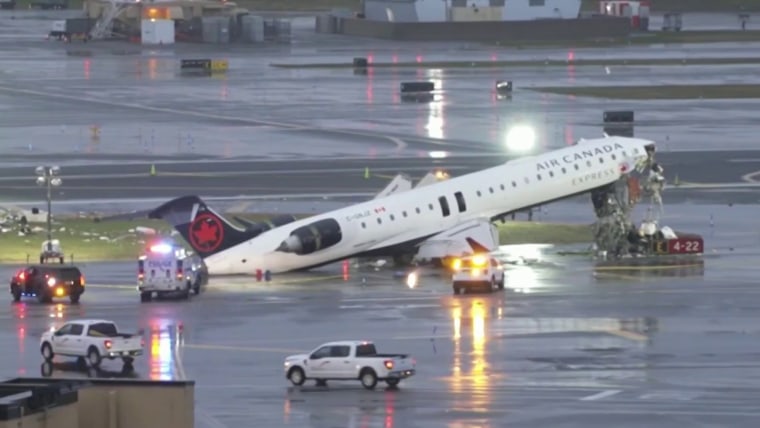
The collision brought operations at LaGuardia to an immediate halt. Flights were grounded, passengers were left stranded inside terminals with little information, and emergency crews flooded the airfield. The aircraft, which had arrived from Montreal with more than 70 people onboard, struck the emergency vehicle at approximately 24 miles per hour. Dozens of passengers were transported to nearby hospitals, though many were subsequently released after evaluation.
For travelers stuck inside the terminal as cancellations piled up, the atmosphere was tense and disorienting. “It’s scary. You never know if it could have been one of us,” one passenger said, after spending hours waiting for information that was slow to come.
Leo Medina, a 23-year-old who was onboard another aircraft on the tarmac at the time of the collision, described the scene from his unique vantage point. “We were literally like 100 metres away,” he said. “It was like the plane got cut in half.”
A Pattern of Concern at a Challenging Airport
The tragedy at LaGuardia has reignited a long-standing conversation about safety conditions at the airport — one that aviation professionals and regulators have been having, often quietly, for years.
Just months before this incident, in October, two regional aircraft operated by Delta collided while taxiing at LaGuardia, resulting in at least one hospitalization. Around the same period, a separate close call was reported at Newark Liberty International Airport, where two aircraft reportedly came dangerously close to landing on intersecting runways simultaneously.
Pilots have long raised concerns about the conditions at LaGuardia — from the challenges of heavy traffic flow and tight infrastructure to the mounting pressure placed on air traffic controllers, particularly during periods of bad weather when the pace of operations does not necessarily slow to match the increased risk.
The warning that may have been most prescient came from a pilot who filed a formal safety report with NASA’s Aviation Safety Reporting System the previous summer. In that report, the pilot described a close call at LaGuardia in which controllers failed to provide clear guidance about multiple nearby aircraft. The tone of the report was urgent, even pleading.
“Please do something,” the pilot wrote.
The same pilot expressed deep concern about the accelerating pace of operations at the airport. “The pace of operations is building in LGA,” they wrote. “The controllers are pushing the line.” The pilot went further, drawing a direct comparison to conditions that had preceded a catastrophic mid-air collision over the Potomac River in Washington, D.C., in January 2025, which claimed the lives of more than 60 people.
Heroes Remembered
As investigations continue and questions about airport safety protocols intensify, the passengers who walked away from Sunday night’s collision are carrying with them something that no official report will ever fully capture — the memory of a crew that, in its final moments, may have given everything it had to protect the lives in its care.
“They are heroes,” bradysego12 wrote. And for 74 people who made it home that night, those words are more than a tribute. They are a debt that can never fully be repaid.