

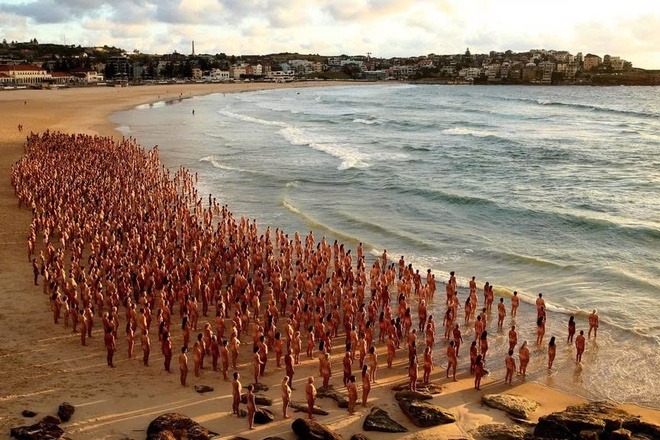
In recent years, large-scale public art projects have continued to push creative boundaries, inviting participants to become part of the artwork itself. One such event in Australia drew widespread attention as thousands of people gathered on a major bridge in Brisbane to take part in a striking visual installation.
The project, titled Rising Tide, was created by Spencer Tunick, an artist known internationally for organizing large-scale photography installations featuring human forms in natural and urban landscapes.
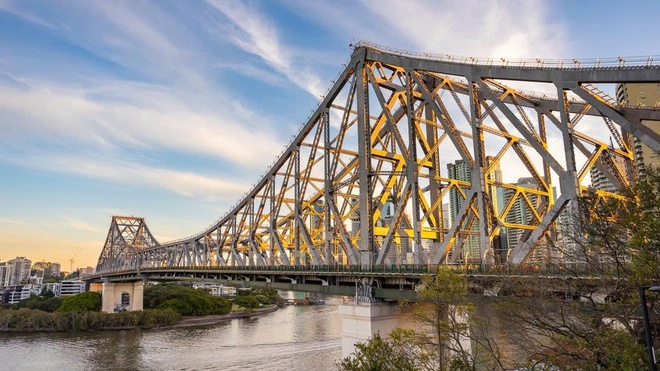
Set against the iconic Story Bridge, the event transformed a familiar city landmark into a temporary canvas, blending art, community, and symbolism.
The Vision Behind the Project
For over three decades, Spencer Tunick has created installations that explore themes of identity, unity, and the relationship between people and their environment. His work often involves large groups of volunteers who participate in carefully coordinated compositions.
The Rising Tide project aimed to highlight ideas of diversity, inclusion, and collective presence. According to organizers, the installation also sought to celebrate Brisbane’s vibrant community and raise awareness of social themes such as equality and representation.
Unlike traditional gallery exhibitions, these projects are temporary and experiential. Participants contribute directly to the artwork, making each installation unique and impossible to replicate.
A Tradition of Large-Scale Installations
This was not the first time Tunick had organized such an event in Australia. Previous installations, including one at Bondi Beach and another near the Sydney Opera House, attracted thousands of participants.
Globally, his projects have taken place in cities across Europe, North America, and South America, each time adapting to the cultural and physical context of the location.
These events often occur at sunrise, creating a specific visual atmosphere while also allowing for minimal disruption to daily city life.
The Experience From a Participant’s Perspective
Participants in these installations frequently describe the experience as unique and reflective rather than sensational. Many report feelings of calmness and connection, emphasizing the collective aspect of the event.
One participant from a previous project shared that standing among thousands of others in a quiet, early-morning setting created a sense of unity. Rather than focusing on individual differences, the moment highlighted shared presence.
This perspective aligns with how many contemporary art critics interpret Tunick’s work: as an exploration of human identity in its most universal form.
Cultural Context and Public Interpretation
Public reaction to such events can vary widely depending on cultural context. In some societies, large-scale body-based art installations are seen primarily as artistic expression. In others, they may prompt debate about social norms and public space.
In Australia, these events are generally framed within the context of art and community participation. Organizers work closely with local authorities to ensure that the installations are conducted respectfully and safely.
Cultural scholars note that these projects often serve as conversation starters, encouraging dialogue about topics such as body image, inclusivity, and the role of art in public life.
The Science of Collective Experiences
From a psychological perspective, participating in large group events can have a significant impact on how individuals perceive themselves and others.
Researchers have found that shared experiences, especially those involving coordination and cooperation, can increase feelings of connection and belonging. This is sometimes referred to as collective identity formation.
In the context of art installations, this effect can be particularly strong. Participants are not just observers but active contributors, which enhances engagement and emotional resonance.
Art, Environment, and Symbolism
Tunick’s installations often emphasize the relationship between people and their surroundings. By placing large groups within natural or urban settings, the artwork invites viewers to consider how individuals interact with space.
In the case of the Story Bridge event, the location itself carried symbolic weight. Bridges are often associated with connection, transition, and movement, making them a fitting backdrop for a project centered on unity.
The timing of the event, typically at dawn, also adds meaning. The early morning light creates a sense of renewal and possibility, reinforcing the themes of the installation.
Media Coverage and Public Interest
Events like Rising Tide tend to attract significant media attention due to their scale and visual impact. News outlets, photographers, and social media users all contribute to the spread of images and discussions.
However, experts emphasize the importance of context when interpreting such images. Without understanding the artistic intent, viewers may misinterpret the purpose of the installation.
Responsible coverage helps frame these events as cultural and artistic expressions rather than focusing solely on their visual novelty.
Balancing Art and Public Space
Organizing large public installations requires careful planning and collaboration. Authorities must consider logistics, safety, and community impact.
In Brisbane, sections of the bridge were temporarily closed to accommodate the event, ensuring that it could take place smoothly. These measures reflect the balance between creative expression and public responsibility.
Urban planners and cultural organizations often view such events as opportunities to activate public spaces in new and engaging ways.
A Reflection on Human Curiosity
Projects like this continue to draw attention because they challenge expectations. They invite people to see familiar environments differently and to reconsider how art can exist beyond traditional boundaries.
Human curiosity plays a central role in this process. People are naturally drawn to experiences that are unusual, thought-provoking, and visually striking.
At the same time, these installations remind us that art is not only about observation. It can also be about participation, connection, and shared meaning.
In the end, events like Rising Tide highlight the evolving relationship between culture, creativity, and community. They show that even in a rapidly changing world, there is still space for collective experiences that inspire reflection and dialogue.
Sources
BBC Culture. Public art and large-scale installations
The Guardian. Spencer Tunick’s global photography projects
National Geographic. The psychology of group participation
Arts Council England. The role of public art in communities
Smithsonian Magazine. Art, identity, and cultural expression