

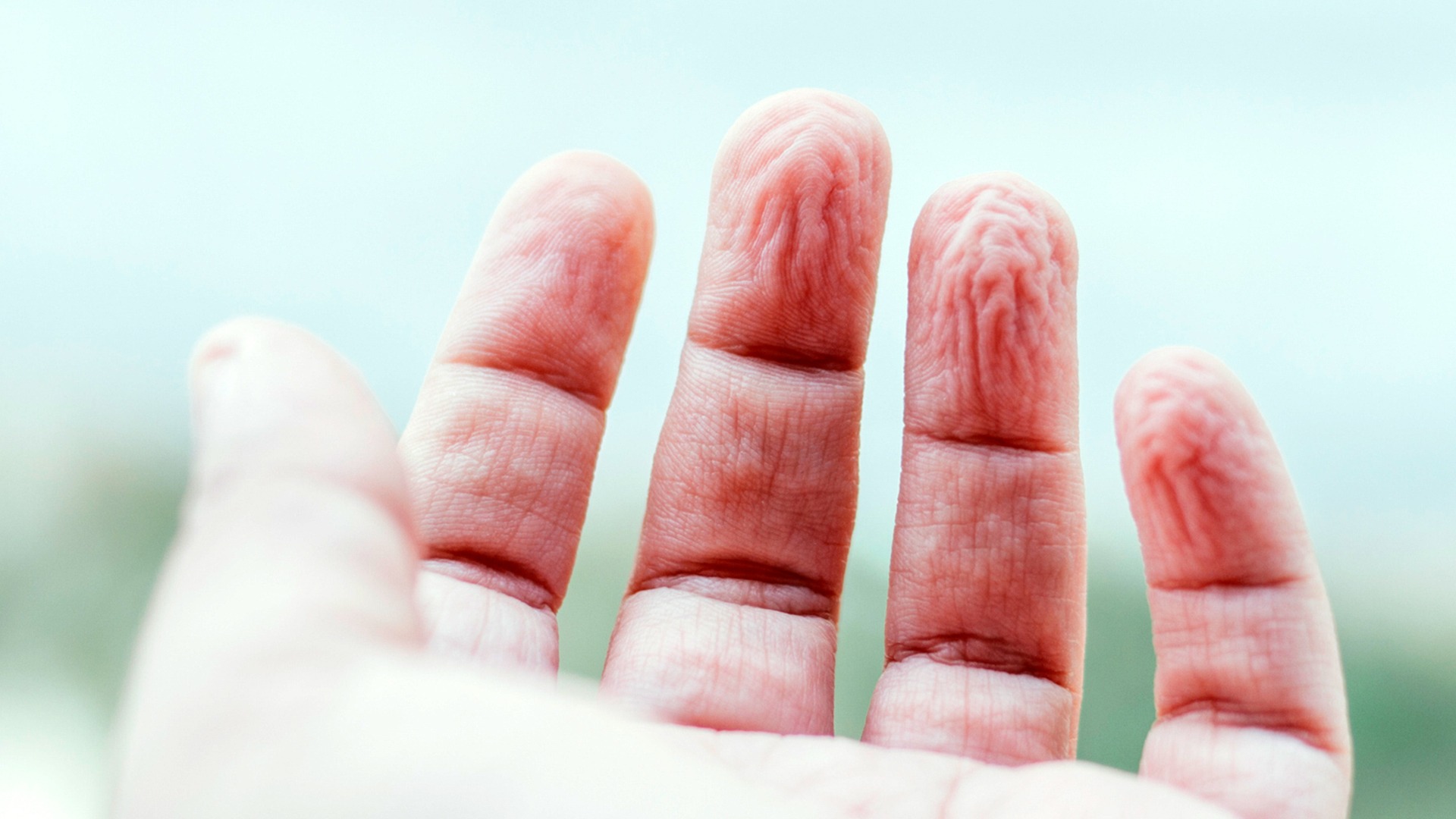
Almost everyone has experienced it at some point. After spending time in water, especially during a long bath or swim, your fingers and toes begin to wrinkle. At first glance, the effect can look unusual, even slightly unsettling. The skin appears shriveled, uneven, and dramatically different from its normal state.
For years, many people assumed this was simply because the skin absorbed water and swelled. However, modern science reveals a far more fascinating explanation—one that involves the nervous system, evolution, and the body’s ability to adapt.
What Happens to Your Skin in Water
The wrinkling of fingers and toes is not just a passive reaction. It is actually a controlled process involving both the skin and the nervous system.
When your hands or feet are submerged in water for an extended period, the outer layer of skin, known as the stratum corneum, begins to absorb moisture. This layer contains a protein called keratin, which allows it to retain water without breaking down.
As the outer layer expands, it interacts with deeper layers of skin that do not expand in the same way. This mismatch creates tension, leading to the formation of wrinkles.
But that is only part of the story.
The Role of the Nervous System
Research in Neuroscience has shown that finger wrinkling is actually controlled by the body’s autonomic nervous system.
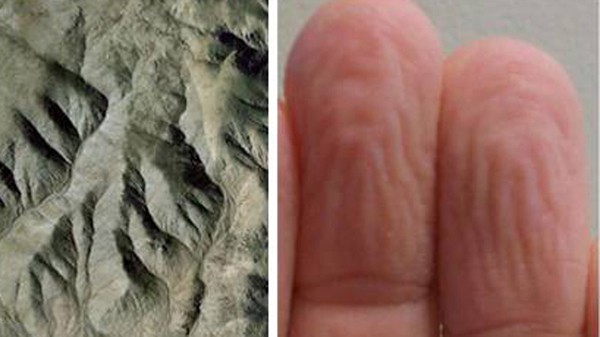
When the skin is exposed to water, blood vessels beneath the surface constrict. This reduces the volume under the skin, causing the outer layer to pucker and form wrinkles.
This means that wrinkling is not just about water absorption—it is an active biological response.
Interestingly, individuals with certain nerve damage do not experience this wrinkling effect, which further confirms the role of the nervous system.
An Evolutionary Advantage
So why does this happen at all?
Scientists believe that wrinkled fingers provide an advantage in wet conditions. The wrinkles create channels that help drain water away from the skin’s surface, improving grip.
This concept is similar to how tire treads work on a wet road.
Studies suggest that people with wrinkled fingers can handle wet objects more effectively than those with smooth skin. This may have been particularly useful for early humans who needed to gather food or move across slippery environments.

Why Only Fingers and Toes
One of the most interesting aspects of this phenomenon is that it primarily affects the fingers and toes.
The reason lies in the structure of the skin. These areas have a thicker outer layer compared to other parts of the body. This thicker layer can absorb more water and respond more dramatically.
In contrast, areas like the face or arms have thinner skin, so the wrinkling effect is much less noticeable.
This difference highlights how specialized different parts of the body are for specific functions.
The Science of Skin Structure
To understand this process more deeply, it helps to look at the structure of the skin itself.
The outermost layer contains keratin and dead skin cells known as corneocytes. These cells are arranged in a way that allows them to expand when exposed to water and return to their original shape once dry.
This flexibility is essential. Without it, the skin could become damaged or lose its protective function.
The wrinkling effect is essentially a temporary adjustment that allows the skin to handle changes in its environment.
More Than Just a Cosmetic Change
Although finger wrinkling might seem like a minor or purely visual effect, it reflects a complex interaction between multiple systems in the body.
It involves:
The skin’s structural properties
The nervous system’s control mechanisms
The body’s ability to adapt to environmental conditions
This combination makes it a small but remarkable example of human biology in action.
Cultural Reactions and Misunderstandings
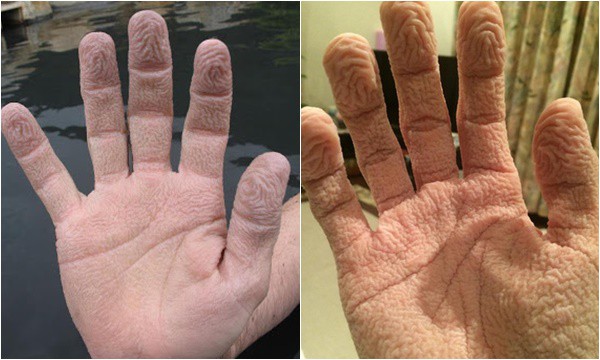
In many cases, images of wrinkled hands can cause confusion or concern, especially when seen out of context.
People may assume that something unusual or unhealthy is happening. In reality, this is a completely normal and temporary response.
Across different cultures, visible changes in the body are sometimes interpreted in symbolic or emotional ways. This can lead to myths or exaggerated reactions.
Understanding the science behind these changes helps replace uncertainty with knowledge.
When Should You Be Concerned
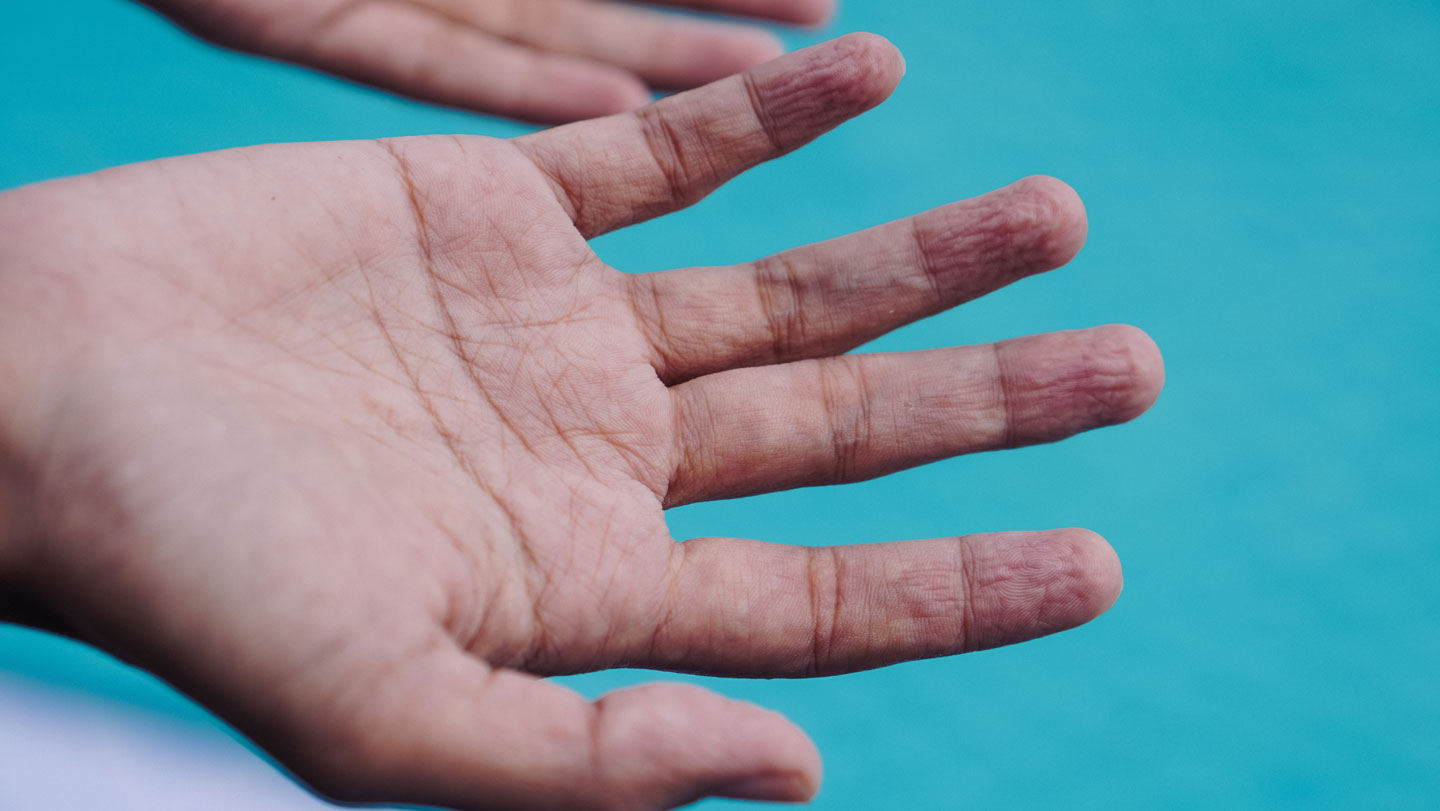
In most situations, finger wrinkling is harmless and disappears shortly after the skin dries.
However, if changes in the skin persist or are accompanied by other symptoms, it may be worth consulting a medical professional.
Conditions affecting the skin or nervous system can sometimes alter normal responses, so awareness is important.
That said, for the vast majority of people, wrinkled fingers after water exposure are simply a sign that the body is functioning as expected.
A Small Detail With a Big Story
What makes this phenomenon so fascinating is how something so ordinary can reveal such complexity.
A simple observation—wrinkled fingers after water—opens the door to discussions about evolution, biology, and the intricate design of the human body.
It shows that even the smallest details can have meaningful explanations.
Conclusion: The Body’s Hidden Intelligence
Finger wrinkling is a perfect example of how the human body adapts to its environment in subtle but effective ways.
What may look unusual at first is actually a well-coordinated response designed to improve function and protect the skin.
In a broader sense, it reminds us that many everyday experiences have deeper scientific explanations waiting to be explored.
Curiosity about these small mysteries not only helps us understand our bodies better but also highlights the remarkable intelligence built into human biology.
Sources
Scientific American
National Institutes of Health
American Academy of Dermatology
Nature