

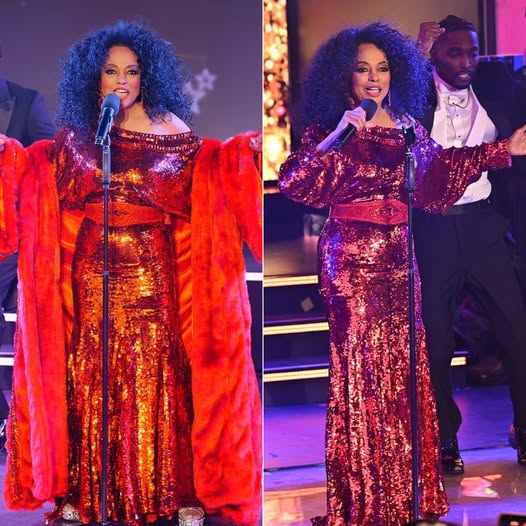
On December 31, 2025, one of the most recognizable voices in modern music history stepped onto one of the world’s most watched stages and reminded millions why her name still carries extraordinary weight. At 81 years old, Diana Ross delivered a commanding performance at Times Square during Dick Clark’s New Year’s Rockin’ Eve, helping usher in 2026 with elegance, confidence, and unmistakable star power.
The moment was more than a holiday appearance. It was a rare cultural convergence—an artist whose career spans nearly six decades standing at the symbolic heart of global celebration, performing live just minutes before the New Year arrived. In an era of rapid pop-culture turnover, Ross’s presence felt deliberate, resonant, and deeply meaningful.
A centerpiece moment on a massive broadcast

The 2025–2026 edition of New Year’s Rockin’ Eve was among the most ambitious in the program’s long history. The live broadcast spanned multiple cities across the United States, including New York, Las Vegas, Chicago, and Puerto Rico, featuring dozens of artists across genres. Hosted by Ryan Seacrest with international pop star Rita Ora joining as co-host, the show was designed to appeal to audiences of every age group.
Yet for many viewers, the emotional center of the night was unmistakable. Ross was positioned as the Times Square headliner, with her performance scheduled at approximately 11:37 p.m. Eastern Time—just moments before the famous ball drop. That placement alone spoke volumes. In live television, those final minutes before midnight are reserved for moments producers believe will hold attention, elevate energy, and define the night.
Times Square itself was transformed into a spectacle of light and sound. The iconic New Year’s Eve Ball—12.5 feet in diameter and embedded with thousands of Waterford crystals—hovered above a sea of spectators, slowly descending as the final seconds of 2025 approached. For the hundreds of thousands in attendance and tens of millions watching at home, Ross’s performance became inseparable from the countdown itself.
Early Nielsen estimates later confirmed what viewers already sensed: the broadcast drew approximately 34 million total viewers, with peak numbers approaching 30 million at midnight—marking the strongest performance for the program in several years.
A performance shaped by legacy, not nostalgia
When Diana Ross took the stage, she did not attempt to recreate the past. Instead, she presented a carefully structured medley that honored her catalog while feeling fully alive in the present moment. Backed by a live band and supported by a polished stage production, Ross moved seamlessly through songs that have defined multiple eras of popular music.
Among the most celebrated moments were her performances of:
-
“I’m Coming Out”, a song that has evolved into a global anthem of self-expression and confidence
-
“Upside Down”, the chart-topping 1980 hit that blended disco, pop, and rhythmic precision
-
Selections that nodded to her early years with The Supremes, the group that helped reshape American music in the 1960s
Rather than overwhelming the moment with spectacle, Ross relied on what has always been her greatest strength: presence. Her voice, phrasing, and timing carried the performance, while her interaction with the cameras and crowd conveyed warmth and authority. As the countdown neared, Times Square responded in kind—cheers rising, lights waving, and voices joining in.
An ageless figure in a youth-driven industry

What quickly became a dominant theme online was not just what Ross performed, but how she performed it. At 81, she stood comfortably under intense lighting, in cold December conditions, delivering a performance typically associated with artists many decades younger.
Social media reactions poured in almost immediately. Viewers expressed disbelief, admiration, and genuine joy at seeing Ross command such a massive stage with ease. Comments across platforms praised her posture, vocal control, and unmistakable confidence. Many contrasted her performance with those of newer artists, noting that stage presence and connection cannot be manufactured by trends alone.
This reaction revealed something deeper than surprise at her age. It highlighted a growing appreciation for longevity, craftsmanship, and artistic consistency—qualities that often get overshadowed in fast-moving entertainment cycles.
The habits behind the vitality
Ross’s Times Square appearance did not emerge in isolation. Earlier in 2025, she spoke openly about the routines and mindset that support her well-being. In interviews, she emphasized balance rather than extremes, framing longevity as a product of consistency and intention.
She described staying physically active through swimming, prioritizing rest, and maintaining a flexible approach to nutrition—one that allows for enjoyment as well as mindfulness. Beyond physical habits, Ross spoke about mental and spiritual grounding, noting that meditation, reflection, and gratitude play an essential role in her daily life.
Crucially, she tied her energy back to purpose. Her continued love for performing, she explained, provides emotional fuel and creative motivation. That perspective helps explain why her public appearances still feel engaged rather than obligatory.
A bridge between musical generations
The broader lineup for New Year’s Rockin’ Eve reflected the diversity of modern music. Performers from R&B, country, pop, and international scenes shared the broadcast, creating a multi-genre celebration. Artists such as Ciara, Little Big Town, Maren Morris, and LE SSERAFIM brought contemporary sounds to the program.
Within that context, Ross’s performance functioned as a connective thread. Her career predates many of the genres represented, yet her influence can be felt across them. From vocal styling to stage presentation, elements pioneered during the Motown era continue to echo through today’s music.
By placing Ross at the center of such a wide-ranging lineup, the broadcast subtly reinforced her role not just as a historical figure, but as a foundational influence whose work continues to shape popular culture.
Ratings, relevance, and live television’s resilience
The strong viewership numbers for the 2026 broadcast carried implications beyond a single night. In an era dominated by on-demand streaming and fragmented audiences, live events often struggle to maintain mass attention. Yet New Year’s Rockin’ Eve demonstrated that certain moments—when carefully curated—still draw collective focus.
Ross’s appearance played a significant role in that success. For many viewers, her performance provided a reason to tune in live rather than catch highlights later. It also reinforced the idea that legacy artists, when presented thoughtfully, can drive engagement rather than dilute it.
The result was one of the highest-rated entertainment specials of the year, reaffirming the enduring appeal of shared cultural rituals.
Why this moment resonated
Diana Ross’s Times Square performance mattered not simply because of who she is, but because of what she represented in that moment. She embodied continuity in an industry often obsessed with novelty. She demonstrated that artistic relevance is not confined to age brackets or trends.
Standing on that stage, she was not framed as a retrospective act or a symbolic gesture. She was presented as an active participant in the present—an artist whose voice and presence still command attention.
For audiences, that distinction was powerful. It reframed aging not as decline, but as accumulation: of experience, confidence, and perspective.
A year begins with music and meaning

As confetti filled the air and the final seconds of 2025 faded into history, Ross remained onstage, sharing smiles and gestures with the crowd and host Ryan Seacrest. The moment felt celebratory without being rushed, reflective without becoming sentimental.
Her performance marked the beginning of a new year, but it also served as a reminder of music’s unique ability to connect people across time. Songs written decades ago still found resonance in a modern crowd, carried by an artist who has spent a lifetime refining her craft.
In a cultural landscape that changes at extraordinary speed, Diana Ross’s New Year’s Eve appearance stood as a quiet but powerful counterpoint. It suggested that while styles evolve and platforms shift, authenticity, dedication, and artistry remain timeless.
As 2026 began, millions of viewers witnessed not just a countdown, but a living example of what it means to endure—and to continue shining—on one of the world’s brightest stages.