


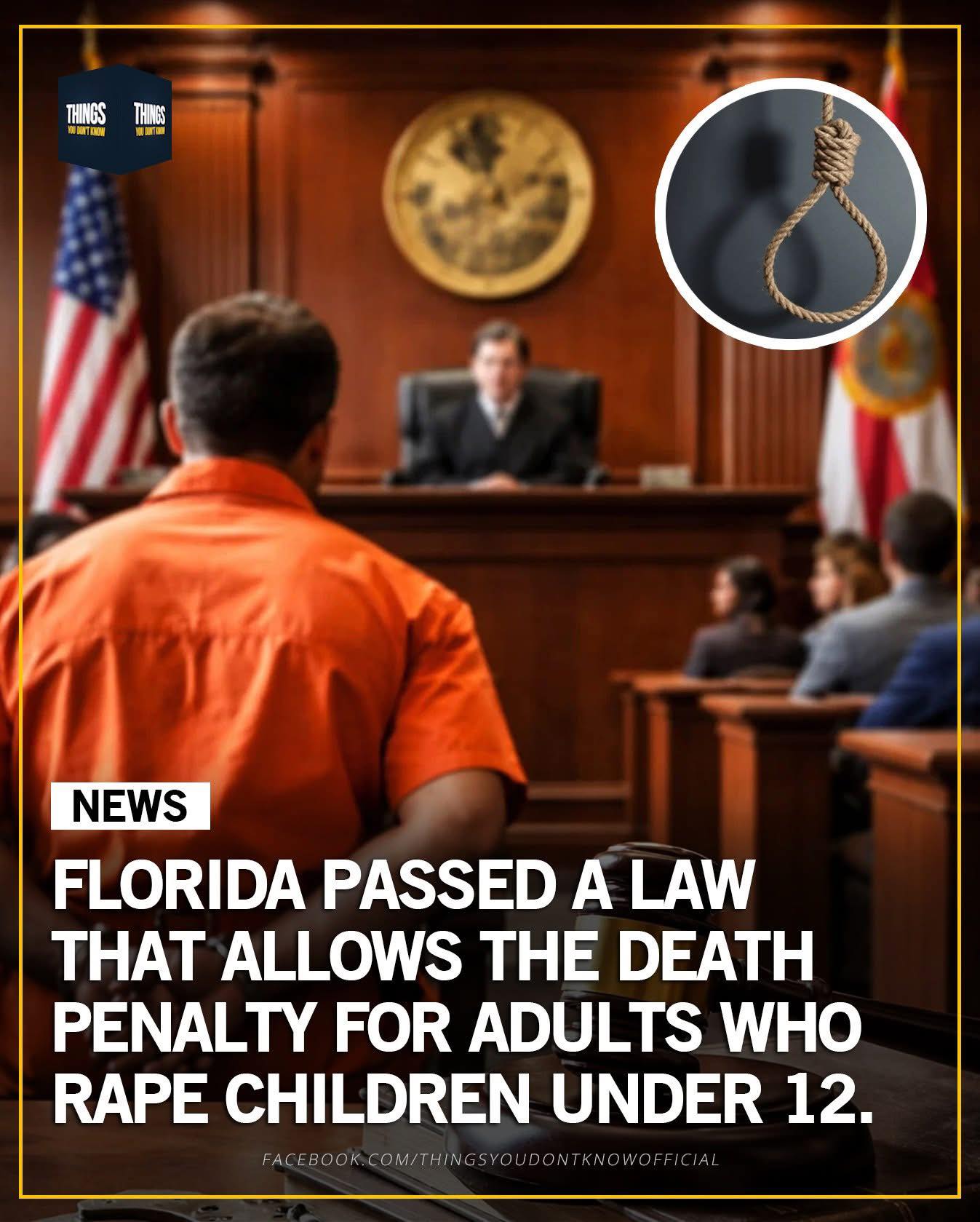
Florida’s New Law and the Renewed Death Penalty Debate
In recent years, debates over criminal punishment in the United States have increasingly focused on how states respond to crimes against children. In that context, a new law in Florida has reignited a national conversation about the limits of punishment, constitutional authority, and what actually protects victims in practice.
The statute allows prosecutors to seek the death penalty for adults convicted of raping a child under the age of 12. Supporters describe the law as a decisive statement that certain crimes represent the highest possible violation of social norms. Critics counter that, regardless of moral outrage, the law collides directly with existing Supreme Court precedent and may ultimately prove unenforceable.
This tension—between symbolic severity and constitutional constraint—sits at the center of the debate.
What the Florida Law Does

The law, known as HB 1297, expands Florida’s definition of capital offenses to include what it labels “capital sexual battery” against young children. Under the statute, prosecutors may seek a death sentence, and judges may impose it if at least eight of twelve jurors recommend that outcome.
Supporters emphasize that the law does not mandate execution but merely authorizes it as a possible punishment in the most extreme cases. They argue that giving juries and judges this option reflects the seriousness of the crime and affirms society’s duty to defend those least able to protect themselves.
The statute took effect in October 2023, setting the stage for immediate legal challenges.
The Moral Argument in Favor of Maximum Punishment
Advocates of the law frame their support in moral terms. They argue that child sexual violence inflicts profound harm that can last a lifetime, affecting mental health, relationships, and overall well-being. From this perspective, the harshest available punishment is seen as an appropriate response to the severity of the crime.
Some supporters also argue that extreme penalties can serve a deterrent function. While evidence on deterrence is contested, they believe that elevating the crime to capital status sends a clear signal about societal values and intolerance for such conduct.
For these proponents, the law is as much about moral condemnation as it is about punishment.
The Constitutional Barrier

Critics argue that the debate cannot be separated from constitutional reality. In 2008, the U.S. Supreme Court ruled that the Eighth Amendment prohibits the death penalty for the rape of a child when the victim does not die. That decision remains binding precedent.
Because Florida’s law directly conflicts with that ruling, legal scholars widely expect it to face swift constitutional challenges. Lower courts are obligated to follow Supreme Court precedent unless and until the Court overturns or modifies it.
As a result, opponents argue that the law’s practical impact may be limited, at least in the near term.
Why Precedent Matters in Practice
Supporters sometimes frame the law as an invitation for the Supreme Court to reconsider its earlier decision. While that is possible in theory, it is far from guaranteed.
Overturning precedent requires a majority of justices willing to reinterpret the Constitution’s limits on punishment. Even with shifts in the Court’s composition over time, legal experts caution that such changes are unpredictable and often incremental.
Until any reversal occurs, Florida courts are likely to treat the law as legally uncertain, complicating prosecutions and sentencing decisions.
The Cost of Legal Uncertainty for Victims

One of the most significant concerns raised by critics involves the impact of prolonged litigation on victims and their families. Capital cases are uniquely complex, involving extended trials, automatic appeals, and years—sometimes decades—of court proceedings.
If a death sentence is imposed under a statute that is later ruled unconstitutional, cases may be retried or resentenced. That process can force victims and families to relive traumatic events repeatedly through hearings, testimony, and media coverage.
Some victim advocates argue that certainty and finality matter more than symbolic severity, and that punishments likely to survive appeal may better serve survivors’ long-term well-being.
Life Without Parole as an Alternative
Florida already allows life imprisonment without the possibility of parole for serious sexual offenses against children. Critics of the new law argue that this punishment permanently incapacitates offenders while avoiding the procedural burdens of capital cases.
From this perspective, life without parole is seen as both severe and stable. It removes the offender from society for life without triggering the unique legal complexities associated with the death penalty.
Even some who support harsh penalties question whether pursuing executions under a legally vulnerable statute truly advances public safety.
Concerns About Unintended Consequences
Another frequently cited argument involves potential unintended effects. Legal scholars have long debated whether expanding the death penalty beyond homicide could alter offender behavior in dangerous ways.
The concern is that if rape carries the same maximum penalty as murder, an offender may perceive less risk in killing a victim to eliminate a witness. While empirical evidence on this effect is mixed, the possibility alone has influenced past Supreme Court reasoning and legislative caution.
Opponents argue that policy design must consider not only moral messaging but also behavioral incentives.
Symbolic Lawmaking Versus Practical Outcomes
Supporters of Florida’s law often acknowledge the constitutional hurdle but argue that symbolism matters. They view the statute as a declaration of values and a challenge to what they see as an outdated legal framework.
Critics respond that symbolic laws can have real costs. Prosecutors may pursue charges that lead to drawn-out litigation, courts may spend years resolving conflicts, and victims may be caught in legal limbo.
From this viewpoint, laws that cannot be enforced consistently may divert attention and resources from measures with measurable impact.
The Broader National Context
Florida is not the first state to consider expanding capital punishment in response to crimes against children. Similar proposals have surfaced elsewhere, often accompanied by debates over federalism, states’ rights, and evolving standards of decency.
These discussions reflect a broader tension in American law: the balance between state autonomy in criminal justice and the role of federal constitutional limits.
How Florida’s law fares in court may influence legislative efforts in other states.
What Research Says About Child Protection
Policy analysts note that the strongest evidence for reducing harm to children points toward prevention, reporting, and support systems rather than punishment severity alone.
Investments in child advocacy centers, specialized investigators, forensic technology, and survivor services have been shown to improve case outcomes and reduce repeat offenses. Encouraging reporting and ensuring swift, reliable prosecution can also enhance accountability.
These measures may not generate the same political attention as maximum punishment laws, but they often deliver clearer results.
Balancing Justice, Protection, and Process
The core question raised by Florida’s law is not whether crimes against children deserve condemnation—they do. The question is how to design a legal response that aligns moral outrage with constitutional constraints and practical effectiveness.
Justice systems must balance expressive goals with procedural realities. A punishment that appears strong on paper but collapses in court may ultimately undermine confidence in the system.
Effective protection requires both moral clarity and legal durability.
What Happens Next in Florida
Legal challenges to the law are widely expected. Courts will likely assess whether the statute can be applied at all under existing precedent or whether it must be set aside pending further review.
In the meantime, prosecutors may face difficult decisions about whether to seek death sentences under a law that could later be invalidated.
The outcome will shape not only Florida’s approach but also national discussions about the future of capital punishment.
A Measured Conclusion
Florida’s child-rape death penalty law expresses strong moral outrage and a desire to protect vulnerable victims. At the same time, it confronts a clear constitutional barrier that makes its long-term viability uncertain.
The risk is that years of litigation could follow, potentially increasing harm to survivors while offering little practical gain. Severe alternatives already exist that can incapacitate offenders without the special burdens of capital punishment.
If the ultimate goal is protection rather than symbolism, policies that strengthen prevention, reporting, investigation, and survivor support may offer more reliable benefits.
The debate, then, is not simply about how harsh punishment should be—but about how law can best serve justice, safety, and those most affected by these crimes.