
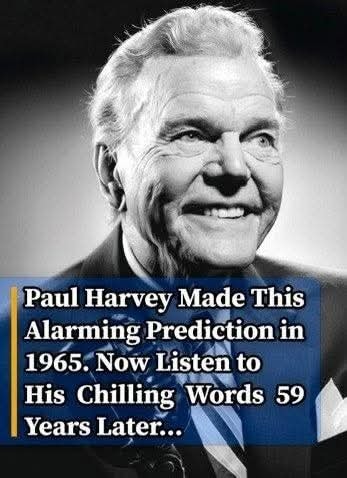
In 1965, a short radio commentary aired across the United States that would quietly outlive its era. It was not a political speech, nor a policy argument, but a carefully constructed thought experiment delivered in a calm, deliberate voice. More than half a century later, that broadcast continues to resurface—shared, debated, and reinterpreted by new generations who find its message unsettlingly familiar.
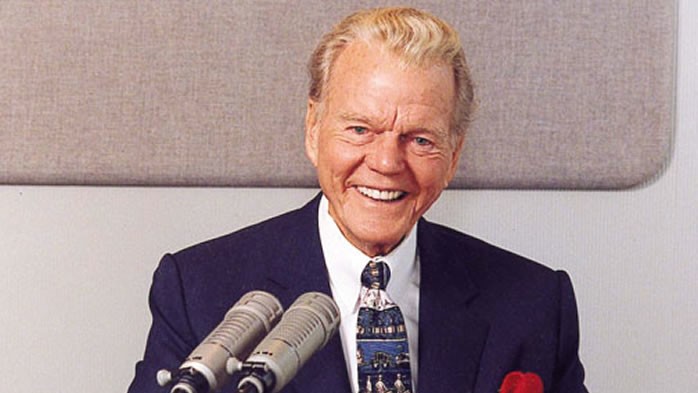
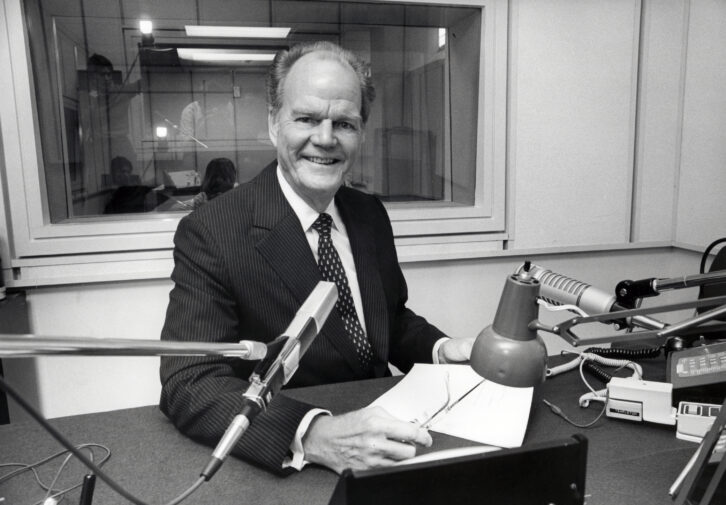
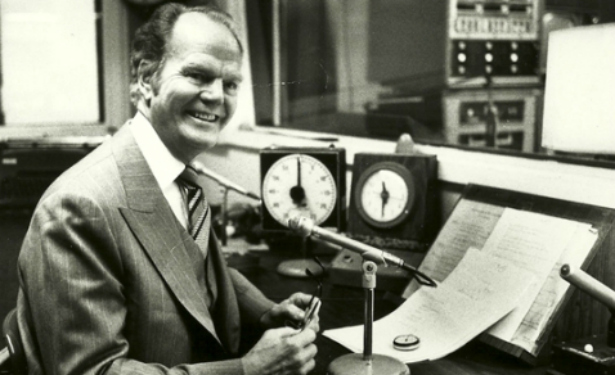
The broadcast, titled “If I Were the Devil,” was delivered by Paul Harvey, one of the most recognizable voices in American radio history. At the time, Harvey was known for blending commentary with storytelling, often offering moral reflections framed in vivid but accessible language. This particular monologue stood out even then, not because it predicted specific events, but because it described a slow and subtle process of societal change.
Rather than imagining destruction through war or catastrophe, Harvey posed a different question: how would a society unravel if it were never attacked directly? His answer focused on gradual erosion rather than sudden collapse. The speech suggested that values, beliefs, and shared norms could be weakened over time through small shifts—changes so incremental they might go unnoticed until the result was irreversible.
When the broadcast first aired, it was largely received as dramatic radio commentary. The mid-1960s were already a time of cultural transformation in the United States, marked by civil rights struggles, generational tension, and rapid social change. Many listeners understood Harvey’s message as a conservative moral warning shaped by the anxieties of that era.
Yet decades later, the monologue continues to circulate, often accompanied by claims that it “came true.” What has kept it alive is not its specificity, but its flexibility. The broadcast does not mention particular laws, leaders, or events. Instead, it speaks in broad terms about human behavior, cultural priorities, and the consequences of neglecting shared responsibility.
Modern listeners often hear echoes of contemporary concerns in Harvey’s words. Some connect his warnings to debates about education, media influence, civic engagement, or the role of faith in public life. Others interpret it as a critique of complacency—the idea that societies rarely fall because of one decisive moment, but because of countless small compromises.

From a media analysis perspective, the enduring appeal of “If I Were the Devil” lies in its rhetorical structure. Harvey does not accuse, lecture, or threaten. He invites the audience into a hypothetical scenario, allowing listeners to draw their own conclusions. This approach gives the message longevity, as it can be reinterpreted across different historical contexts.
It is also important to note that hindsight plays a powerful role in how the broadcast is perceived today. Humans naturally search for patterns, especially when faced with uncertainty or social tension. When a past message appears to align with present anxieties, it can feel prophetic—even if the message was intentionally broad.
Sociologists point out that many generations experience this phenomenon. Each era tends to rediscover older warnings and reinterpret them through a contemporary lens. What changes is not necessarily the accuracy of the message, but the context in which it is heard.
Still, the broadcast resonates because it touches on a universal truth: cultural change is rarely sudden. Institutions weaken slowly. Trust erodes incrementally. Norms shift one decision at a time. Harvey’s monologue captures this process in a way that feels intuitive, even decades later.
Another reason the speech remains relevant is its emphasis on influence rather than force. In an age dominated by digital media, algorithms, and constant information flow, the idea that societies can be shaped subtly feels particularly current. Harvey spoke long before social media, yet his focus on persuasion and gradual normalization aligns with modern discussions about attention, values, and cultural momentum.
Critics, however, caution against treating the broadcast as literal prophecy. They argue that framing it as “coming true” risks oversimplifying complex social issues and ignoring the agency of individuals and institutions. Societies evolve for many reasons, they note, and moral decline is often a subjective judgment shaped by personal beliefs.
From a journalistic standpoint, the enduring popularity of “If I Were the Devil” says as much about the present as it does about the past. It reflects a widespread sense of unease and a desire to find meaning in historical commentary. In times of rapid change, people often look backward for clarity.
The broadcast’s resurgence also highlights how older media can gain new life online. Clips of Harvey’s monologue circulate widely, often without full context, sometimes edited or paired with imagery that reinforces a particular interpretation. This selective framing can intensify its emotional impact while narrowing the range of possible readings.
Yet even when stripped of embellishment, the core message remains thought-provoking. Harvey was not offering a checklist of future events. He was warning against apathy, fragmentation, and the loss of shared values—concerns that are not confined to any single decade.
In that sense, the broadcast functions less as a prediction and more as a mirror. Each generation sees its own reflection in the words, projecting contemporary fears onto a timeless framework. The speech endures not because it foresaw specific outcomes, but because it articulated a pattern that societies repeatedly encounter.
More than 50 years after it first aired, “If I Were the Devil” continues to provoke discussion precisely because it resists closure. It does not end with solutions or prescriptions. Instead, it leaves listeners with an uncomfortable question: how much of what we worry about today happens by design, and how much happens because we stop paying attention?
As long as that question remains relevant, the broadcast will continue to resurface—less as a relic of 1965, and more as a reminder that cultural change is always happening, whether we notice it or not.