

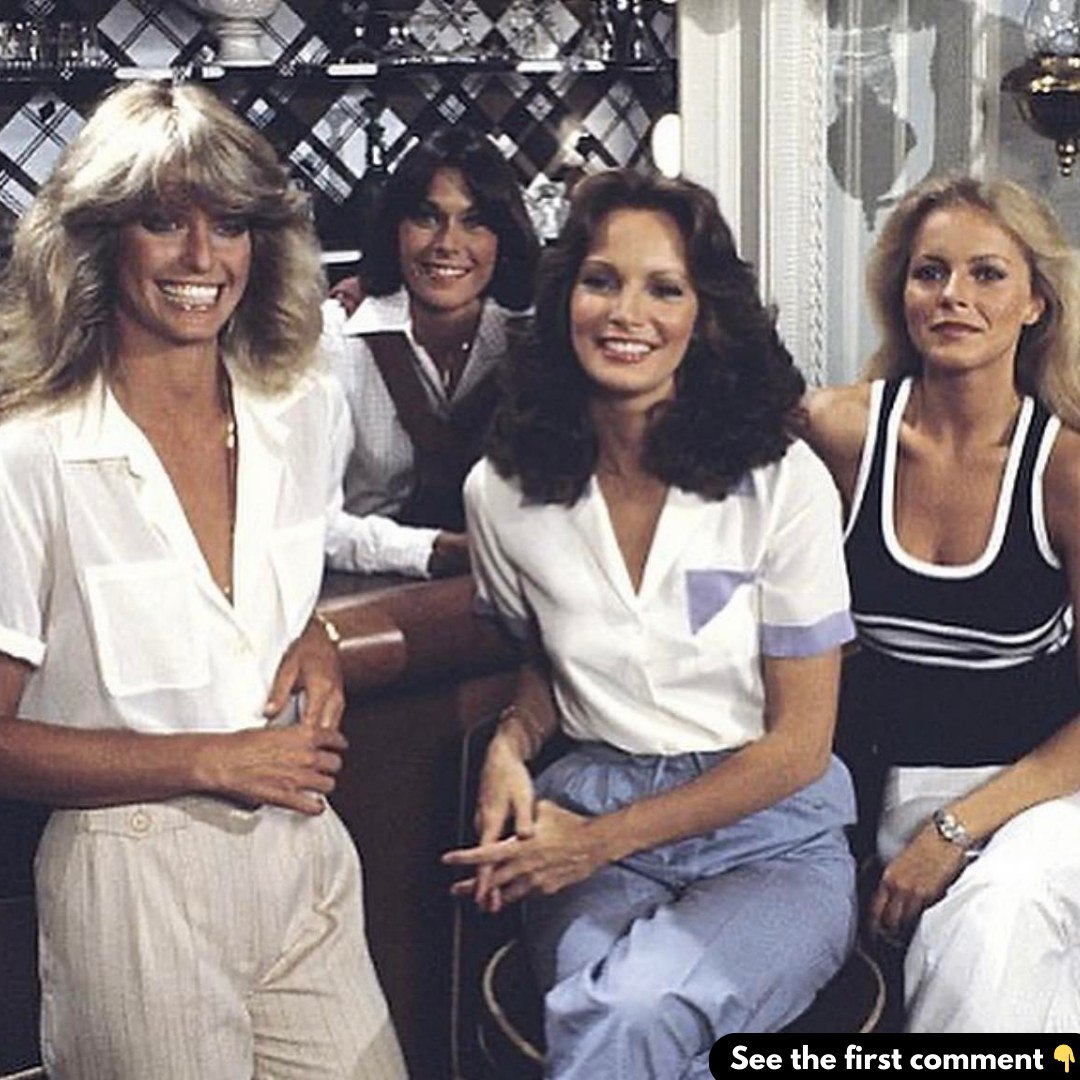
When “Charlie’s Angels” Arrived, Television Didn’t Know What to Do With It
When Charlie’s Angels premiered in 1976, it landed in the middle of a television landscape that still tended to treat women as side characters, love interests, or decorative additions to male-led stories. Crime dramas and action series were thriving, but the center of gravity—who got to be decisive, physical, clever, and respected—was still overwhelmingly male.

That’s why the show’s basic premise felt disruptive even before anyone saw an episode: three women solving serious cases, working in the field, and outsmarting criminals, with a mysterious boss—Charlie Townsend—who remained off-screen, guiding them through a speakerphone like a myth. Created by Ivan Goff and Ben Roberts, the series was packaged as a glossy crime show with style and humor, but the real cultural spark came from what it quietly insisted: women could be the heroes of an action story, and audiences would show up for it.
From the beginning, Charlie’s Angels wasn’t just entertainment. It was a cultural argument delivered through chase scenes, disguises, and tightly paced mysteries.
The First Trio That Defined the Brand

The original lineup—Farrah Fawcett, Kate Jackson, and Jaclyn Smith—became instantly recognizable. Not because they were presented as identical “types,” but because the show worked hard to differentiate them.
Kate Jackson’s character brought authority and a grounded intelligence that made the team feel credible. Jaclyn Smith’s Kelly Garrett became the emotional anchor and steady center. Farrah Fawcett’s presence carried a bright, charismatic energy that translated effortlessly to posters, magazine covers, and the broader pop culture machine.
The result was a trio that felt engineered for mass appeal, but also strangely new. They were glamorous, yes, but they were also competent. They weren’t simply reacting to events; they were driving the story. The cases had stakes. The team used strategy. And the “Angel” concept—women trained and capable, operating with confidence—was a strong hook that could be marketed in a single sentence.
In many ways, the show found its power by balancing two realities at once: it was a mainstream network series built to entertain, but it also nudged the boundaries of what women were allowed to be on prime-time television.
The “Jiggle TV” Label, and Why the Show Outlasted It

Very early on, Charlie’s Angels ran into a familiar problem: when women lead a popular show, critics often question whether the popularity is “earned” or simply a byproduct of image and styling. The series was sometimes dismissed with shallow labels that framed it as fluff rather than craft.
But the ratings and cultural longevity complicated that dismissal. Viewers didn’t just tune in for fashion or glamour. They tuned in because the show delivered a reliable formula: mystery, pace, chemistry between the leads, and a weekly promise that the Angels would win.
It’s also worth noticing how the show’s critics unintentionally revealed a bias: many male-led action series were allowed to be escapist without being insulted for it. Charlie’s Angels wasn’t the only stylish show on TV—it was simply the one that centered women, which made it an easier target.
And yet it dominated conversation for seasons. Even people who didn’t watch it knew the theme music, the silhouettes, the catchphrases, and the fantasy of being an Angel—capable, admired, and in control.
A Cast That Changed, and a Show That Refused to Collapse
One of the most unusual aspects of Charlie’s Angels is how directly its legacy is tied to cast turnover. Many series struggle when a breakout star leaves. In this case, change became part of the show’s identity.
Farrah Fawcett’s exit after the first season could have been a fatal blow. Instead, the series responded by introducing Cheryl Ladd as Kris Munroe. This wasn’t just a recasting. It was a strategic reinvention that kept the “three Angels” structure intact while allowing the chemistry to reset.
Ladd’s arrival also demonstrated something important: audiences were willing to accept a new Angel as long as the show protected the core fantasy—teamwork, competence, and a sense of belonging to the same world. Kris Munroe didn’t feel like an imitation. She felt like a new rhythm.
Later, when Kate Jackson left after season three, Shelley Hack joined as Tiffany Welles. Hack had a different presence—more poised, more reserved—which shifted the dynamic again. Her tenure was brief, and Tanya Roberts eventually took over in season five, bringing a fresher, more playful energy that aligned with the evolving tone of television in the late 1970s and early 1980s.
Through all these changes, Jaclyn Smith’s Kelly Garrett remained the constant. That continuity mattered. In rotating ensembles, the audience often needs one stable figure to hold onto. Smith provided that—an emotional throughline that allowed the show to change faces without losing its center.
Why New Angels Helped the Show Stay Relevant
The rotating cast wasn’t only a survival tactic. It also served the show creatively. New characters meant new interpersonal dynamics, different skill sets, and new kinds of story setups.
When a trio stays fixed for too long, a procedural format can become predictable. But swapping an Angel refreshed the energy without requiring the premise to change. The audience could see familiar patterns—undercover work, traps, reveals—through the lens of a new personality.
It also allowed the show to reflect shifting ideas about femininity and independence. A character introduced in 1976 didn’t have to feel the same as a character introduced in 1980. The Angels could evolve along with the audience’s expectations.
This is part of why Charlie’s Angels remained a cultural reference point: it wasn’t frozen in a single cast era. It functioned more like a brand of heroism—an adaptable template that could be updated while still recognizable.
The “Unseen Boss” and What He Symbolized
Charlie Townsend’s off-screen presence is one of the show’s cleverest devices. He was there, but not there. He controlled the mission, but he wasn’t the visible hero.
That choice created mystery, but it also created a kind of narrative tension: the Angels were in action, the Angels were solving the case, the Angels were taking risks—yet they were still “working for” a man who remained beyond view.
Depending on your interpretation, this can be read in two ways.
One reading is that Charlie represents the old power structure: the idea that women can be capable, but the system still expects male oversight. Another reading is more subversive: Charlie is essentially a plot tool, a voice that starts the mission, while the real power and screen presence belong entirely to the women.
Either way, the structure kept the Angels in the spotlight. Charlie was a concept, but they were the story.
A Blueprint for the Modern Female Action Lead
It’s difficult to trace a straight line from one show to every modern female-led action series, but Charlie’s Angels clearly helped normalize the idea that women could carry action, mystery, and danger on network television.
It didn’t do this through speeches or heavy messaging. It did it through repetition: week after week, women were competent on screen, dealing with serious threats, and finishing the episode as the ones who made things right.
That matters more than people often admit. Cultural change isn’t only driven by big statements—it’s driven by what becomes familiar. The Angels made the idea of female heroes familiar to mainstream audiences.
Later series would deepen realism, complexity, and emotional nuance. But Charlie’s Angels opened a door, and it did so at a time when that door was not guaranteed to stay open.
Glamour, Competence, and the Show’s Balancing Act
The show’s signature mixture—action plus glamour—was both its advantage and its vulnerability.
On the advantage side, it made Charlie’s Angels accessible. It didn’t ask the audience to “adjust” to women in action by stripping away traditionally feminine styling. Instead, it argued that femininity and capability could exist together. That was part of its appeal: the Angels could wear disguises, step into different roles, and still be believable as professionals.
On the vulnerability side, the styling gave critics an easy angle. It allowed some people to pretend the show had no substance, even when the writing and performances delivered consistent entertainment.
But the balancing act is precisely why the show became iconic. It refused the false choice between strength and beauty. It insisted the characters could be both. Whether you think that was empowering or market-driven, it shaped the way audiences remembered the series.
What Made the Angels Work: Chemistry and Trust
For all the talk about concept and marketing, the show’s heartbeat was chemistry. The Angels needed to feel like a team, not three individuals placed together for a photo.
That team energy was built through small things: the way they briefed each other, trusted each other in the field, and shared reactions after a close call. Even when episodes leaned into playful tones, the underlying message was consistent: they were safer together, smarter together, and stronger together.
This is another subtle reason the cast changes didn’t destroy the show. The “Angel” wasn’t only a single character—it was membership in a unit with shared purpose. As long as the show protected that team feeling, it could survive transitions.
Legacy: Why the Series Still Gets Mentioned Today
Decades later, Charlie’s Angels is still discussed as more than a nostalgic relic. It remains a shorthand reference for a certain kind of female-led action fantasy: stylish, fast-moving, and driven by camaraderie.
It’s also remembered because it sparked debates that never fully disappeared—about representation, about how women are framed on screen, about whether a show can be both commercially packaged and culturally meaningful.
The answer is yes. Many things that change culture are also designed to sell. Charlie’s Angels understood television as a business and still managed to nudge expectations in the process.
And its influence persisted through sequels, reboots, and reinterpretations—some successful, some not—because the core idea continues to attract attention: women who solve the case, take the risks, and remain the center of the story.
Conclusion: A Pop Hit That Quietly Rewrote the Rules
Charlie’s Angels didn’t just entertain. It normalized the image of women as action leads for a mass audience. It did so with a structure simple enough to be iconic and flexible enough to survive major cast changes.
It faced skepticism, carried the weight of unfair labels, and still became a cultural landmark. The series proved that the “female hero” wasn’t a niche concept—it was a mainstream possibility.
And perhaps that’s the reason it still matters: it didn’t ask permission to exist. It simply arrived, took over the airwaves, and left behind a template that modern television continues to refine.
Sources
-
Charlie’s Angels overview and production background (general reference): Wikipedia entry for “Charlie’s Angels” (use as starting point only; if you want, I can replace with only primary/official sources like ABC archives, interviews, and reputable entertainment histories).