

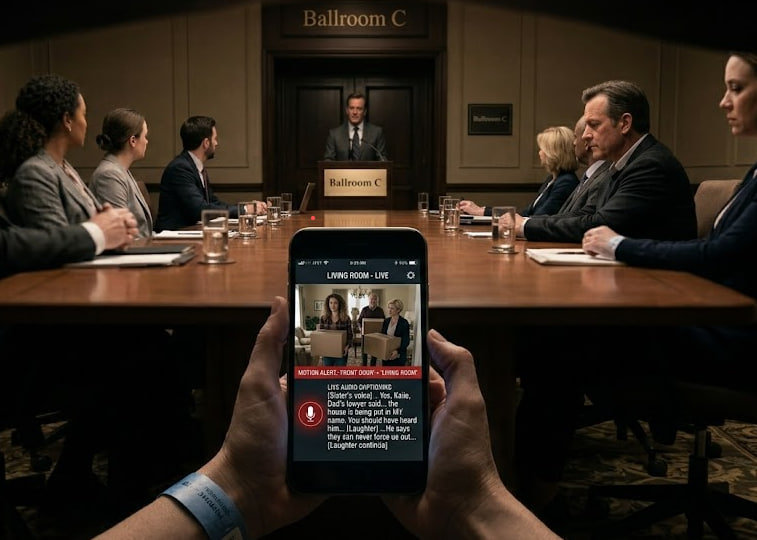
“Cancel your return flight,” my attorney said.
I was still sitting on the window ledge outside Ballroom C.
People in conference badges walked past carrying coffee and tote bags.
Someone laughed nearby.
The ordinary sounds felt disconnected from my reality.
“What?” I asked.
“Book the earliest flight you can find.”
His voice remained calm.
Professional.
But underneath it was something else.
Urgency.
“Why?”
“Because if what your sister said is true, someone is acting on information they don’t actually have the authority to act on.”
I stared at the frozen image on my phone.
Chloe standing in my living room.
My living room.
“I don’t understand.”
“You don’t have to understand yet,” he replied.
“You just need to get home.”
That was enough for me.
I booked the first available flight.
Three hours later I was in an airport terminal trying unsuccessfully to focus on emails while my stomach twisted itself into knots.
My mother sent a text at 6:11 p.m.
Hope Denver is going well. Love you.
I stared at it for a long time.
Then put the phone away.
For the first time in my life, I didn’t know how to respond to her.
The flight landed shortly after midnight.
I drove directly from the airport.
No hotel.
No sleep.
No stopping for coffee.
The closer I got to Brookside, the harder my hands gripped the steering wheel.
The neighborhood looked exactly the same.
Streetlights.
Tree-lined sidewalks.
Front porches.
Everything ordinary.
Everything familiar.
Then I turned onto my street.
And saw three unfamiliar vehicles parked in front of my house.
The porch light was on.
My porch light.
The one I rewired myself.
I parked across the street.
For several minutes I simply watched.
No movement.
No urgency.
No sign that anyone inside considered themselves guests.
At 12:47 a.m., the front door opened.
My mother stepped outside carrying a trash bag.
She walked toward the garbage bins with complete confidence.
Not the behavior of someone temporarily staying with family.
The behavior of someone who believed she lived there.
Something inside me went cold.
Not anger.
Not yet.
Certainty.
I took out my phone and started recording.
Documentation.
Always documentation.
My attorney had taught me years ago that facts matter more than feelings.
Feelings are remembered differently.
Video isn’t.
I waited until my mother went back inside.
Then I crossed the street.
The porch boards creaked beneath my feet.
The same creak they had made for eight years.
I unlocked the front door.
With my key.
The key that still worked perfectly.
And stepped inside.
The first thing I noticed was the smell.
Not bad.
Different.
A different laundry detergent.
Different candles.
Different people.
The house no longer smelled like home.
It smelled like someone else’s version of it.
Boxes lined the hallway.
Family photographs sat on tables.
Not my photographs.
Theirs.
My mother’s church group picture stood where my travel photo from Seattle used to be.
My father’s fishing portrait occupied a shelf that had once held books.
Someone had rearranged my life.
The living room light flicked on.
Chloe appeared in the doorway.
For a moment she looked genuinely shocked.
Then the surprise disappeared.
“Well,” she said.
There was no apology.
No embarrassment.
Nothing.
Just annoyance.
As though I had interrupted her evening.
“You’re back early.”
I set my suitcase down.
“Yes.”
Silence.
Neither of us moved.
Then she crossed her arms.
“You could have called.”
I actually laughed.
The sound surprised both of us.
“Called?”
“You didn’t tell anyone you were coming home.”
I stared at her.
Slowly.
Carefully.
Trying to understand how a person arrives at a point where that sentence feels reasonable.
“This is my house.”
Chloe rolled her eyes.
“Technically.”
Technically.
The word landed like a stone.
Before I could respond, another voice came from the kitchen.
“Chloe?”
My mother.
She appeared moments later.
And froze.
For several seconds nobody spoke.
Then she smiled.
The same smile she used at church.
The same smile she used with neighbors.
The same smile she used whenever she wanted difficult conversations to disappear.
“You’re home.”
I looked around.
At the boxes.
The furniture.
The changes.
Then back at her.
“Apparently.”
Her smile faltered slightly.
Only slightly.
“We were going to explain everything.”
“When?”
Neither answered.
I nodded.
That told me enough.
My mother took a breath.
“Your father wanted Chloe to have stability.”
There it was.
The justification.
The explanation that somehow always arrived after the decision.
Never before.
Always after.
I remembered being ten years old and giving up my bedroom so Chloe could have more space.
Being sixteen and sharing my car because she needed transportation.
Being twenty-two and loaning money that was never repaid.
Every sacrifice had been presented the same way.
Chloe needed something.
Therefore I should understand.
Therefore I should give.
Therefore I should be reasonable.
I was tired of being reasonable.
“Where’s Dad?”
Neither woman answered immediately.
That concerned me.
Finally my mother spoke.
“At the retirement community.”
I frowned.
“What retirement community?”
The silence that followed felt different.
Heavier.
More complicated.
Then Chloe looked away.
And suddenly I understood.
Not everything.
Just enough.
The lawyer.
The house.
The strange confidence.
The rushed move.
The missing details.
My father wasn’t making these decisions.
Other people were making them for him.
My attorney’s words echoed in my mind.
Someone is acting on information they don’t actually have authority to act on.
I looked directly at my mother.
“What aren’t you telling me?”
Her expression changed.
For the first time all evening, uncertainty appeared.
Not guilt.
Fear.
That was when I knew this story was bigger than a house.
Much bigger.
My father had spent his entire life keeping records.
Detailed records.
Financial records.
Property records.
Trust documents.
Everything organized.
Everything documented.
If someone suddenly believed ownership was changing, they believed it because they thought they had paperwork supporting it.
And paperwork leaves trails.
My phone vibrated.
A text from my attorney.
Only five words.
Do not sign anything tomorrow.
I stared at the message.
Then back at my family.
Tomorrow.
Something was scheduled for tomorrow.
Something they hadn’t told me about.
Something important enough that my attorney already knew.
I slipped the phone back into my pocket.
“Interesting,” I said quietly.
My mother’s eyes narrowed.
“What is?”
I looked around the room one last time.
At the boxes.
At the moved furniture.
At the people who had treated my home like a problem already solved.
Then I smiled.
Not because I was happy.
Because I finally understood one thing.
They thought this was over.
They thought the paperwork was finished.
They thought I was walking into a completed decision.
What they didn’t know was that my attorney had already started asking questions.
And the answers he was finding suggested that somebody—possibly several people—had misunderstood exactly what my father had put in writing.
The meeting scheduled for tomorrow wasn’t going to transfer my house.
It was going to reveal who had been relying on assumptions instead of facts.
And for the first time since my phone vibrated in that conference ballroom, I wasn’t worried.
I was curious.
Because when people become comfortable enough to move into your house before the paperwork is finished, they usually make one critical mistake.
They stop being careful.
And careless people leave evidence everywhere.