
Dr. Caroline Pierce stood behind the podium.
Ten thousand people applauded.
The stadium echoed with cheers.
Then she looked directly at my row.
At me.
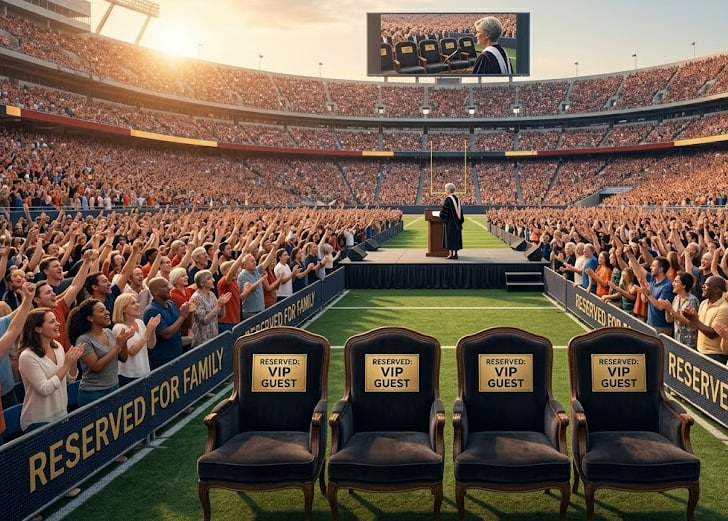
At the four empty VIP seats beside me.
And something changed.
She slowly closed the folder containing her prepared keynote speech.
The applause faded.
Faculty members exchanged confused glances.
The dean leaned forward in his seat.
This wasn’t part of the program.
Dr. Pierce adjusted the microphone.
“I prepared a speech about medicine today.”
The crowd settled.
“But after seeing something a few moments ago, I’d rather talk about something else.”
Silence spread across the stadium.
Her voice carried effortlessly.
Clear.
Confident.
Impossible to ignore.
“Every year we celebrate academic achievement.”
She paused.
“We celebrate intelligence, discipline, and perseverance.”
Her eyes returned to my row.
“But sometimes the most extraordinary accomplishments are achieved by people who receive very little support while earning them.”
My stomach tightened.
I knew where this was going.
I wanted her to stop.
I wanted her to continue.
Both feelings existed at the same time.
“There is a graduate here today,” she continued, “who worked overnight ambulance shifts while attending medical school.”
Several students looked around.
Some already knew.
Most didn’t.
“This graduate often studied during breaks between emergency calls.”
More silence.
“This graduate graduated at the top of her class.”
I felt heat rise into my face.
The dean was smiling now.
He knew exactly who she was talking about.
Dr. Pierce placed both hands on the podium.
“Most importantly, this graduate learned how to keep going even when encouragement was scarce.”
The stadium became completely still.
Then she said my name.
“Clara Evans.”
A spotlight wasn’t necessary.
Ten thousand heads turned anyway.
I wanted to disappear.
Instead, I stood.
The applause started slowly.
Then spread.
Then grew.
Within seconds, thousands of people were on their feet.
I looked around in disbelief.
Students.
Faculty.
Families.
Complete strangers.
Standing.
Cheering.
For me.
The sound crashed over me like a wave.
For years I had imagined what it might feel like to hear my parents say they were proud.
Instead I was standing inside an arena full of people I had never met, receiving the recognition I had spent my entire life chasing.
I was crying before I realized it.
Dr. Pierce waited for the applause to settle.
Then she delivered the sentence that changed everything.
“Clara, would you join me on stage?”
The stadium erupted again.
My legs felt unsteady as I walked toward the platform.
The dean helped me up the steps.
Dr. Pierce greeted me with a warm smile.
Then she turned back toward the audience.
“I want everyone here to understand something.”
She rested a hand on my shoulder.
“This young woman earned every opportunity she has received.”
The giant screens displayed my face.
Mortifying.
Humbling.
Unforgettable.
“Talent matters,” Dr. Pierce continued.
“But resilience matters more.”
She glanced toward the empty seats.
Everyone followed her gaze.
The four vacant chairs suddenly seemed enormous.
“I hope every graduate here receives support from the people they love.”
A pause.
“And if they don’t, I hope they learn what Clara learned.”
The stadium remained silent.
“You do not need someone’s approval to become extraordinary.”
For a moment nobody moved.
Then the applause returned.
Louder than before.
I couldn’t speak.
I simply stood there while thousands of strangers celebrated something I had almost convinced myself wasn’t worth celebrating.
The ceremony eventually continued.
Names were called.
Degrees awarded.
Photographs taken.
By the time it ended, my phone contained dozens of notifications.
Classmates.
Professors.
Residents.
Former coworkers.
People congratulating me.
People sharing photos.
People tagging clips from Dr. Pierce’s speech.
Apparently several attendees had already uploaded videos online.
The clips were spreading rapidly.
I didn’t realize how rapidly until I checked my phone while walking back to the parking garage.
Three missed calls.
All from my mother.
Five texts.
Then ten.
Then fifteen.
The first message read:
Why did Dr. Pierce mention you like that?
The second:
People keep sending me videos.
The third:
Call me immediately.
I stared at the screen.
Hours earlier she had been drinking margaritas beside a cruise ship pool.
Now she wanted my attention.
I kept scrolling.
Another message arrived.
Your aunt just called.
Then:
Why is everyone asking where we were?
And finally:
This has become very embarrassing.
Embarrassing.
Not hurtful.
Not regrettable.
Not disappointing.
Embarrassing.
Even then, she was worried about appearances.
I slipped the phone back into my pocket.
For the first time in years, I felt nothing.
No anger.
No desperation.
No hope.
Just clarity.
That evening the medical school hosted a reception for graduates and faculty.
I almost skipped it.
I was exhausted.
Emotionally drained.
Ready to go home and sleep for a week.
But Dr. Pierce insisted.
“One hour,” she said.
“You’ve earned at least that.”
So I went.
The ballroom buzzed with conversation.
Faculty members mingled with graduates.
Families took photographs.
Champagne glasses clinked.
I was speaking with two future residents when I heard someone call my name.
“Dr. Evans.”
I turned.
Not Clara.
Not student.
Not trainee.
Dr. Evans.
The words hit differently.
Standing across the room was Dr. Pierce.
Beside her stood a silver-haired man in an expensive suit.
I recognized him immediately.
Everyone in pediatric surgery recognized him.
Dr. William Mercer.
One of the most respected surgeons in the world.
My heart nearly stopped.
Dr. Pierce smiled.
“Clara, I’d like you to meet someone.”
The next ten minutes felt unreal.
Dr. Mercer asked questions about my research.
My residency plans.
My goals.
He had apparently reviewed several of my published papers.
Papers I assumed nobody read.
When the conversation ended, he handed me a business card.
“I think you’ll do very well.”
I stared at the card.
Then at him.
Then back at the card.
He smiled.
“Call me after your first year of residency.”
I managed a thank-you.
Barely.
The evening became a blur after that.
By the time I returned to my apartment, my phone had over fifty missed calls.
Most were from family members.
Apparently the videos had reached social media.
Relatives were sharing them.
Former teachers were commenting.
Old classmates were congratulating me.
People my parents hadn’t spoken to in years were suddenly asking questions.
One message from my father stood out.
It arrived just after midnight.
Can we talk tomorrow?
Nothing else.
No excuses.
No explanations.
Just five words.
I stared at the message for a long time.
Then placed the phone face down on the table.
Outside my apartment window, the city lights stretched into the distance.
For years I had imagined this day differently.
I imagined my parents cheering.
Taking photographs.
Bragging about me to strangers.
Instead they missed everything.
And somehow, despite all the hurt, I realized something important.
Their absence hadn’t ruined the day.
Because the people who truly believed in me had been there.
Dr. Pierce.
My classmates.
My mentors.
The patients who had trusted me.
The colleagues who had watched me work.
Family isn’t always the people who share your last name.
Sometimes it’s the people who see your effort before they see your success.
I picked up Dr. Mercer’s card again.
Then smiled.
Tomorrow my parents would want explanations.
Tomorrow relatives would call.
Tomorrow there would be uncomfortable conversations.
But tonight?
Tonight, for the first time in a very long time, I wasn’t thinking about what I hadn’t received.
I was thinking about everything I had earned.