


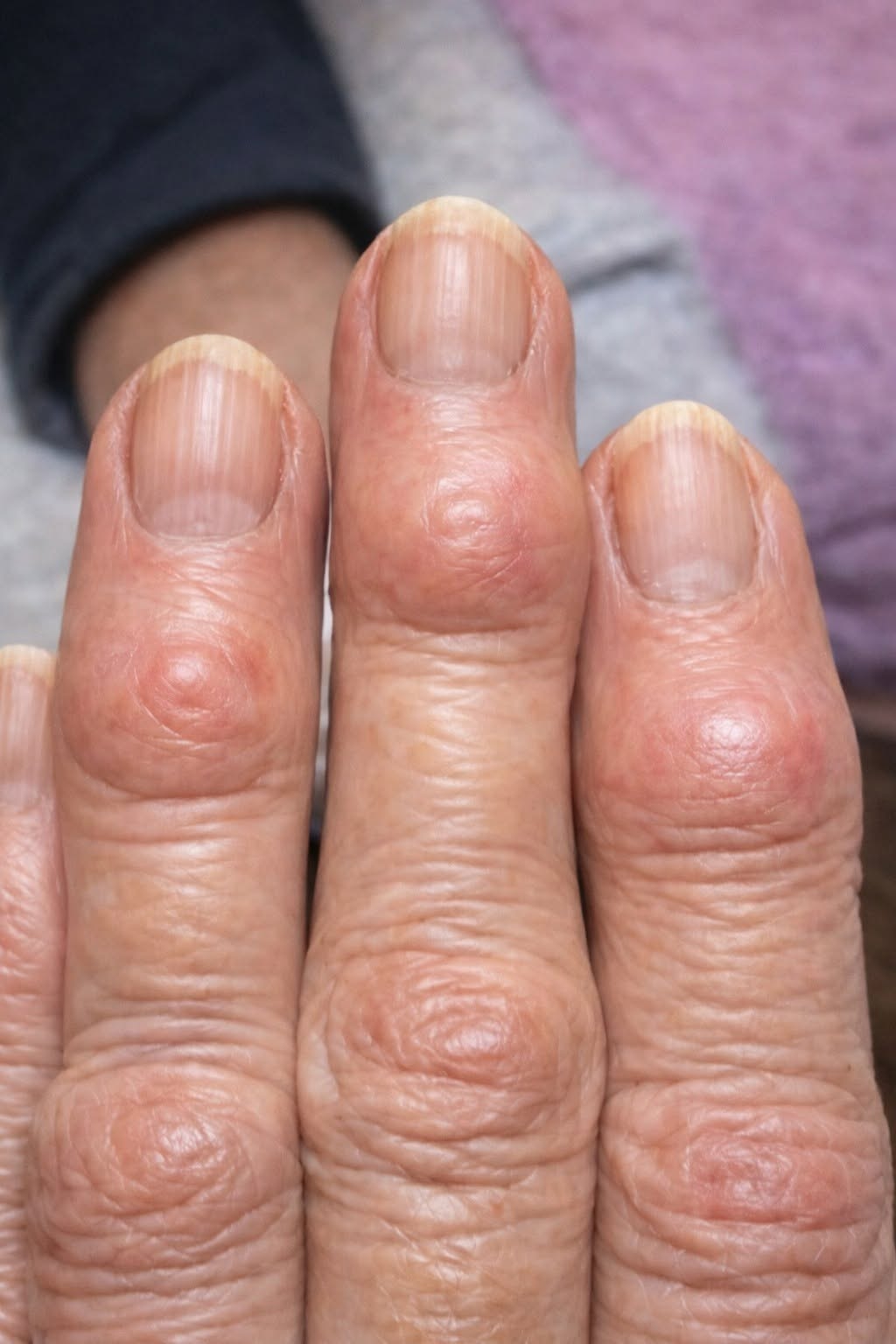
One morning, you notice something different about your hands.
Perhaps there is a small, hard bump near the end of one finger. Maybe another has appeared on a neighboring joint. At first, you might assume it is simply part of getting older. Then you notice that the bumps seem more noticeable than they were before, and a simple question begins to grow in your mind:
What is happening to my hands?
Hands carry much of our everyday lives. They prepare meals, open doors, hold cups, type messages, care for children, write notes, and perform countless tasks that we rarely stop to appreciate.
So when their shape begins to change, it can feel surprisingly personal.
Fortunately, hard bumps around the finger joints are often associated with a common form of arthritis called osteoarthritis. When these bony enlargements occur at the joints closest to the fingertips, they are commonly known as Heberden’s nodes. Similar changes affecting the middle finger joints are called Bouchard’s nodes.
Although their appearance can be unsettling, they are not usually a sign of something suddenly spreading through the body.
Understanding the science behind them can replace fear with a clearer picture of what may be happening.
What Are Heberden’s Nodes?
Heberden’s nodes are firm, bony enlargements that develop around the distal interphalangeal joints, which are the joints closest to the fingertips.
They are commonly associated with hand osteoarthritis.
Osteoarthritis involves changes to the tissues within and around a joint. Over time, cartilage can become thinner and the underlying bone can change. The body may respond by producing additional bone around the edges of the joint.
That extra bone can create a visible or palpable bump.
The result may be a finger that looks different from how it did years earlier.
These changes generally develop gradually.
That distinction is important.
If several bumps appear over a long period, it may seem as though something is “spreading” from one finger to another. But osteoarthritis is not contagious, and the bumps are not moving from joint to joint like an infection.
Instead, multiple joints can develop osteoarthritic changes independently.
What Are Bouchard’s Nodes?
Bouchard’s nodes are similar bony enlargements, but they occur at the proximal interphalangeal joints, which are the middle joints of the fingers.
Both Heberden’s and Bouchard’s nodes are commonly associated with hand osteoarthritis.
A person can have one type, the other, or changes affecting several joints.
The appearance can vary considerably from one individual to another.
Some people develop noticeable changes without experiencing much discomfort. Others may experience tenderness, stiffness, or difficulty moving an affected finger.
This variation is one reason that the appearance of a bump alone cannot tell you exactly what is happening.
Why Do These Bumps Develop?
To understand the bumps, it helps to understand osteoarthritis.
Healthy joints contain cartilage that helps provide a smooth surface for movement. With osteoarthritis, the tissues within the joint gradually undergo structural changes.
The condition is influenced by several factors.
Age is one of the strongest risk factors. Osteoarthritis becomes more common as people grow older.
Genetics can also play an important role. Some people are more likely to develop hand osteoarthritis because of inherited characteristics.
Previous injuries can contribute as well.
A finger that has experienced an earlier fracture or significant joint injury may be more vulnerable to osteoarthritis later.
Certain patterns of hand use may also influence symptoms, although it is important not to assume that ordinary activities such as typing automatically cause these bumps.
The development of osteoarthritis is usually the result of multiple factors rather than one single behavior.
Why Do the Bumps Sometimes Appear on Several Fingers?
This is one of the most confusing aspects for people who notice these changes.
You might first discover a bump on one finger.
Several months or years later, you notice a similar change somewhere else.
It can feel as though the condition is spreading.
But that is not what is happening.
Osteoarthritis can affect multiple joints in the same hand. In some people, similar changes can occur in both hands.
Because the joints are experiencing their own structural changes, several areas can eventually show signs of osteoarthritis.
The process is generally gradual rather than sudden.
That is why a person may notice a series of changes over many years.

What Do Heberden’s Nodes Feel Like?
The experience can be very different from one person to another.
During periods when a joint is irritated, it may feel sore or tender.
Some people experience stiffness, especially after periods of inactivity or when they first wake up.
The joint may occasionally look swollen or feel uncomfortable when used.
Over time, symptoms may settle even though the bony enlargement remains.
In other cases, a person may have very little pain and discover the change simply because they notice that a finger looks different.
This is an important reminder that appearance and symptoms do not always match.
A prominent node does not necessarily mean severe pain.
Likewise, a person with relatively subtle visible changes may still experience significant stiffness or discomfort.
Are Heberden’s Nodes Dangerous?
In many cases, Heberden’s and Bouchard’s nodes are associated with osteoarthritis and are not dangerous in themselves.
They represent structural changes around a joint.
However, a new lump or swelling should not automatically be assumed to be an osteoarthritis node.
There are many possible causes of bumps around the hands and fingers.
Some conditions can produce swelling, inflammation, cysts, or other changes that require different treatment.
That is why a healthcare professional should evaluate changes that are new, persistent, unusual, or causing significant symptoms.
The important message is not to panic, but also not to diagnose yourself based solely on an online photograph or description.
When Should You Speak With a Doctor?
Most gradual changes associated with osteoarthritis do not require emergency treatment.
However, professional medical advice is appropriate when a finger or joint changes significantly or interferes with everyday life.
You may want to seek medical evaluation if a bump is accompanied by persistent or significant pain, substantial swelling, marked warmth or redness, or a noticeable reduction in movement.
It is also important to seek advice if symptoms develop very suddenly or if you experience other unexplained symptoms affecting your general health.
A healthcare professional can examine the joint and, when necessary, use imaging or other tests to determine the likely cause.
The purpose is not simply to identify a name for the bump.
It is to understand what is happening and determine whether treatment or monitoring is appropriate.
How Is Hand Osteoarthritis Managed?
There is currently no simple way to reverse established osteoarthritis changes completely.
However, symptoms and hand function can often be managed.
Treatment depends on the individual.
Gentle exercises can help maintain movement and strength.
A healthcare professional or physical therapist may recommend specific exercises based on the joints affected and the person’s abilities.
Heat can sometimes help ease stiffness.
Some people find warm water or other forms of gentle heat particularly comfortable in the morning.
Cold therapy may be useful for temporary relief when a joint feels irritated.
The important point is to use these approaches appropriately and avoid exposing the skin to excessive temperatures.
Protecting Your Hands During Everyday Activities
Small changes in everyday habits can sometimes make tasks easier.
If a particular activity requires prolonged or forceful gripping, an ergonomic tool may reduce the amount of pressure placed on the fingers.
Using larger handles can sometimes make objects easier to hold.
Taking short breaks during repetitive activities may also reduce discomfort.
These adjustments are not about avoiding normal use of the hands.
In fact, completely avoiding movement can contribute to stiffness.
The goal is to find a balance between keeping the joints active and avoiding activities that consistently aggravate symptoms.
Can Exercise Help?
Movement is generally important for joint health.
Gentle range-of-motion exercises can help maintain flexibility.
Strengthening exercises can support the muscles around the hand and wrist, potentially making everyday activities easier.
However, exercises should be appropriate for the person’s condition.
If movement causes significant pain, it is sensible to stop and seek professional guidance rather than simply pushing through it.
A physical or occupational therapist can demonstrate exercises designed specifically for hand problems.
What About Medication?
When osteoarthritis causes discomfort, healthcare professionals may recommend different approaches depending on the person’s medical history.
Some people may benefit from topical treatments.
Other individuals may be advised to use oral pain-relieving medications.
However, common medications are not appropriate for everyone.
Some can interact with other medicines or may be unsuitable for people with certain medical conditions.
For this reason, medication decisions are best discussed with a doctor or pharmacist, particularly when symptoms are persistent.
The goal should always be effective symptom management while considering the person’s overall health.
Heberden’s Nodes vs. Rheumatoid Arthritis
Another common concern is whether finger bumps could indicate rheumatoid arthritis.
Although both conditions can affect the hands, they are different diseases.
Osteoarthritis is primarily associated with changes involving the joint structures and cartilage.
Rheumatoid arthritis is an autoimmune disease in which the immune system mistakenly attacks tissues associated with the joints.
The pattern of symptoms can therefore differ.
Rheumatoid arthritis often produces prolonged morning stiffness and swollen, tender joints. It can also cause symptoms beyond the joints, such as fatigue.
The location and appearance of swelling can also help doctors distinguish different conditions.
Because several joint diseases can look similar to a person without medical training, diagnosis should be based on a clinical assessment rather than appearance alone.
Can You Prevent These Bumps?
There is no guaranteed method for preventing Heberden’s or Bouchard’s nodes.
Age and genetics are factors that cannot be changed.
However, maintaining general joint health can be beneficial.
Regular physical activity, maintaining a healthy weight, protecting previously injured joints, and managing medical conditions appropriately can all contribute to overall musculoskeletal health.
For the hands specifically, maintaining flexibility and strength may help preserve function.
But it is important not to blame yourself if these changes develop.
Osteoarthritis is not simply the result of “using your hands too much.”
It is a complex condition influenced by age, genetics, previous injury, joint structure, and other biological factors.

The Emotional Side of Changing Hands
There is another part of this story that medical descriptions sometimes overlook.
Our hands are visible every day.
We use them to communicate, create, work, care for others, and express ourselves.
When their shape changes, the emotional reaction can be surprisingly strong.
Someone may look down and think about their age.
They may remember a parent or grandparent whose hands looked similar.
They may worry that the changes will become worse.
Those feelings are understandable.
But visible changes do not automatically mean that a person is losing independence or that their future will be defined by pain.
Many people with hand osteoarthritis continue to work, exercise, cook, write, create, and enjoy everyday activities.
The key is understanding the condition and seeking appropriate support when symptoms interfere with life.
Your Hands Tell a Story
Perhaps there is a more positive way to think about the small changes that appear with age.
Hands carry evidence of a lifetime.
They have held babies, prepared meals, written letters, planted flowers, repaired objects, typed thousands of words, opened countless doors, and reached out to people we love.
A few hard bumps may change their appearance, but they do not erase everything those hands have accomplished.
Medical knowledge can help us understand why these changes occur.
Good habits can help us maintain movement and function.
Professional guidance can help manage discomfort when it appears.
And perhaps most importantly, knowledge can replace unnecessary fear with perspective.
Final Reflection: Understanding Instead of Fear
A hard bump on a finger can look mysterious when you do not know what it represents.
The internet can make that uncertainty even more confusing, especially when ordinary medical changes are described using frightening language.
Heberden’s and Bouchard’s nodes are much less mysterious when viewed through the science of osteoarthritis.
They are generally gradual structural changes associated with affected finger joints, not something mysteriously traveling through the body.
They may be uncomfortable for some people and barely noticeable for others.
They may change the appearance of the fingers, but they do not define a person’s health or identity.
The most important lesson is simple: notice changes, learn what they may mean, and seek medical advice when something seems unusual or interferes with everyday life.
Aging does not have to be a story about losing what we once had.
It can also be a story about understanding our bodies better, adapting when necessary, and appreciating everything they have allowed us to experience.
Our hands change because we change.
And sometimes, those small changes are simply another reminder of the remarkable story written by a lifetime of living.
Sources
Mayo Clinic — Osteoarthritis information, symptoms, risk factors, and treatment approaches.
National Institute of Arthritis and Musculoskeletal and Skin Diseases (NIAMS) — Educational resources on osteoarthritis and musculoskeletal health.
American College of Rheumatology — Patient information concerning osteoarthritis, rheumatoid arthritis, and joint health.
National Health Service (NHS) — Guidance on osteoarthritis symptoms, diagnosis, and management.
American Academy of Orthopaedic Surgeons (AAOS) — Educational information about hand and finger arthritis.