


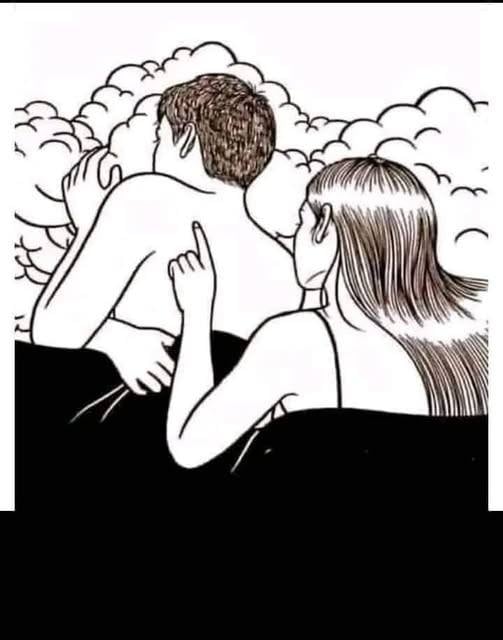
You wake up in the middle of the night and notice something small.
Your partner is lying with their back toward you.
Maybe you have always slept this way. Perhaps you usually fall asleep facing each other, but recently your partner has started turning away. Suddenly, a simple sleeping position feels like a message.
Are they upset?
Do they need more space?
Has something changed between you?
It is easy to attach emotional meaning to body language, especially in a close relationship. We naturally look for clues in the people we love. But when it comes to sleep, the explanation is often much simpler than we imagine.
A partner who sleeps facing away may simply be more comfortable in that position. They may prefer cooler air, need additional space, or naturally move during sleep.
At the same time, a noticeable change in sleeping habits can sometimes be worth discussing, particularly when it happens alongside other changes in communication or behavior.
The key is not to treat one sleeping position as a secret code.
Instead, look at the bigger picture.
Sleeping Positions Do Not Have One Universal Meaning
Human beings have different sleep preferences.
Some people sleep on their sides. Others prefer their backs or stomachs. Some move frequently during the night, while others remain in nearly the same position for hours.
Because sleep is primarily about physical rest, comfort often determines body position.
A person may turn away because their neck feels better that way. They may be trying to regulate body temperature. They may simply have developed the habit over many years.
This means that interpreting a partner’s sleeping position requires caution.
There is no reliable rule stating that facing away automatically means emotional distance.
In fact, couples can sleep in very different positions while having perfectly healthy relationships.
1. They May Simply Need More Physical Space
One of the simplest explanations is also one of the most overlooked.
People need space to sleep.
Even couples who are deeply affectionate during the day may prefer not to remain physically close throughout the entire night.
Sleeping back-to-back can provide a comfortable compromise.
Both partners remain close enough to know the other person is there, while each has enough room to stretch, adjust their position, or find a comfortable posture.
This can be especially appealing to people who sleep better without continuous physical contact.
The desire for personal space during sleep should not automatically be interpreted as rejection.
Sometimes it is simply good sleep hygiene.
2. Temperature Can Influence Sleeping Direction
Temperature is another important factor.
Some people naturally sleep warmer than others.
If one partner prefers a cooler environment, turning away from another person’s body may make it easier to regulate temperature.
Mattress materials, blankets, room temperature, and clothing can all influence comfort.
This is one reason couples sometimes develop different sleeping habits even when they have similar personalities.
A person who turns away may simply be trying to find the position in which they can fall asleep most easily.
In that situation, the sleeping direction has little to do with the emotional relationship.
3. Back-to-Back Sleeping Can Be Comfortable
Interestingly, sleeping back-to-back is not necessarily a sign of disconnection.
Some couples naturally develop this position because it combines closeness with independence.
They may touch lightly through their backs or legs while facing opposite directions.
This can allow both people to maintain a sense of connection without requiring face-to-face contact.
The important detail is the overall quality of the relationship.
If partners communicate well, enjoy spending time together, and feel emotionally secure, sleeping back-to-back may simply be their preferred nighttime routine.

4. A New Change May Be Worth Noticing
There is a difference between a long-standing habit and a sudden change.
If your partner has always slept facing away, there may be little reason to interpret the position emotionally.
But if they normally sleep close to you and suddenly begin turning away every night, you may reasonably wonder whether something has changed.
Even then, the sleeping position itself does not provide an answer.
Perhaps they are experiencing stress.
Perhaps they are uncomfortable physically.
Perhaps their sleep schedule has changed.
Perhaps an argument has affected their mood.
Or perhaps they simply discovered that another position helps them sleep better.
The useful response is curiosity rather than assumption.
5. Stress Can Change Sleep Habits
Stress affects many aspects of daily life, including sleep.
Work pressure, family responsibilities, financial concerns, major life changes, and emotional exhaustion can all influence how people rest.
Someone experiencing stress may move more during the night or prefer a position that feels physically comforting.
They may also unconsciously seek more personal space.
This does not necessarily mean they are unhappy with their partner.
Sometimes the person’s mind is simply occupied with problems that have little to do with the relationship.
Understanding this distinction can prevent unnecessary misunderstandings.
6. Physical Comfort May Be the Real Explanation
Physical discomfort is another possibility that is easy to overlook.
A partner might turn away because of shoulder discomfort, neck stiffness, back pain, congestion, sensitivity to light, or another physical issue.
Sleeping position can change when the body changes.
For example, someone who normally sleeps facing their partner might begin sleeping on the opposite side because a particular position feels more comfortable.
This is why asking a simple question can be more useful than analyzing body language.
“Are you comfortable?”
may reveal much more than trying to interpret the position from a distance.
7. What About Relationship Tension?
There are situations where sleep habits can occur alongside emotional tension.
Suppose a couple has recently experienced repeated disagreements. Communication has become shorter. Affection has decreased. One partner spends less time talking before bed and has also started facing away during sleep.
In that context, the sleeping position may feel significant.
But even then, it is better understood as one observation among many, rather than proof of a relationship problem.
The daytime behavior provides much more information.
Are conversations becoming more difficult?
Are problems being avoided?
Has affection changed?
Do both people still feel heard?
These questions are more meaningful than asking what direction someone faces while asleep.
8. Avoid Turning Sleep Into a Relationship Test
One common mistake is to treat sleeping positions like a psychological test.
A person sees their partner facing away and immediately concludes:
“They don’t love me anymore.”
That conclusion may create anxiety even when nothing is wrong.
The partner may have no idea that their sleeping position has caused concern.
They may simply be asleep.
This is why relationship experts generally encourage direct communication rather than mind-reading.
If something is bothering you, talk about it when both people are awake and calm.
A conversation can clarify what an assumption cannot.
9. How to Talk About It Without Creating Conflict
The way you raise the subject matters.
Instead of saying:
“Why are you always turning your back on me?”
which can sound accusatory, try a gentler approach.
You might say:
“I noticed we’ve been sleeping differently lately. Are you comfortable?”
This invites a conversation rather than a defense.
If there is an emotional issue, the partner may feel safer discussing it.
If there is no emotional issue, you may discover that the reason is surprisingly ordinary.
Perhaps the mattress feels different.
Perhaps the room is too warm.
Perhaps they have been experiencing neck discomfort.
Perhaps they simply sleep better facing the other direction.
The conversation can therefore solve two possible problems at once: unnecessary worry and genuine discomfort.
10. What Healthy Couples Usually Need More Than Perfect Sleep Positions
A strong relationship is not defined by whether two people sleep face-to-face.
It is built through communication, trust, respect, emotional support, shared experiences, and the ability to work through disagreements.
Couples may have completely different sleep preferences and still have a strong emotional connection.
One person may fall asleep immediately.
The other may need to read first.
One may prefer several blankets.
The other may sleep with almost none.
One may turn toward the wall.
The other may face the room.
None of these differences automatically defines the quality of the relationship.
What matters is how partners treat one another when they are awake.
When Should You Pay More Attention?
A sleeping position alone usually does not provide enough information to conclude that something is wrong.
However, a significant change in sleep behavior may be worth discussing if it appears together with other noticeable changes.
For example, you may want to talk if there is a broader pattern of avoiding conversation, persistent tension, reduced emotional connection, or difficulty resolving disagreements.
Even then, the goal should be understanding rather than accusation.
A relationship problem is rarely solved by interpreting one physical behavior.
It is more likely to improve when both people can speak honestly about what they are experiencing.
The Science of Sleep and Relationships
Sleep itself plays an important role in emotional well-being.
Poor sleep can affect mood, concentration, patience, and communication.
When people are tired, ordinary disagreements can sometimes feel more significant.
For couples, this creates an interesting cycle.
Relationship stress can interfere with sleep, while inadequate sleep can make communication more difficult.
That is another reason why couples should not automatically interpret nighttime behavior as a direct reflection of their relationship.
Sometimes the real issue is simply that both people are exhausted.
Improving the sleep environment may help more than analyzing body language.
A comfortable mattress, appropriate room temperature, reduced nighttime noise, and consistent sleep schedules can all contribute to better rest.

Final Thoughts: Sometimes a Back Is Just a Back
There is something deeply human about searching for meaning in small behaviors.
We watch how someone speaks.
We notice their expressions.
We remember whether they reached for our hand.
And sometimes, we notice which direction they face while sleeping.
These observations can feel meaningful because relationships make us attentive to subtle changes.
But not every behavior carries a hidden message.
A partner who sleeps facing away may be comfortable.
They may need space.
They may be warm.
They may have a physical reason.
They may simply have fallen asleep in that position without thinking about it.
And yes, in some situations, a change in sleeping habits can occur alongside emotional tension.
The important distinction is that one sleeping position cannot tell the whole story.
If you are worried, communication is usually more valuable than speculation.
Ask gently.
Listen carefully.
Consider the broader relationship rather than one nighttime habit.
After all, healthy relationships are not measured by which direction two people face while sleeping.
They are built during the hours when both partners are awake, talking, listening, laughing, supporting each other, and choosing to understand one another.
Sometimes, the most reassuring explanation is also the simplest one: your partner may just be trying to get comfortable and get a good night’s sleep.
Sources
National Sleep Foundation. Healthy Sleep Habits and Sleep Environment. (thensf.org)
Harvard Medical School, Division of Sleep Medicine. Sleep and Health Resources. (healthysleep.med.harvard.edu)
American Academy of Sleep Medicine. Healthy Sleep Information and Resources. (aasm.org)
Sleep Foundation. Sleeping Positions and Sleep Health. (sleepfoundation.org)
National Institutes of Health, National Heart, Lung, and Blood Institute. Sleep Deprivation and Sleep Health. (nhlbi.nih.gov)