

Woman Who Claimed She Gave Birth to 10 Babies Sparks Global Headlines—But Authorities Say It Was Not True
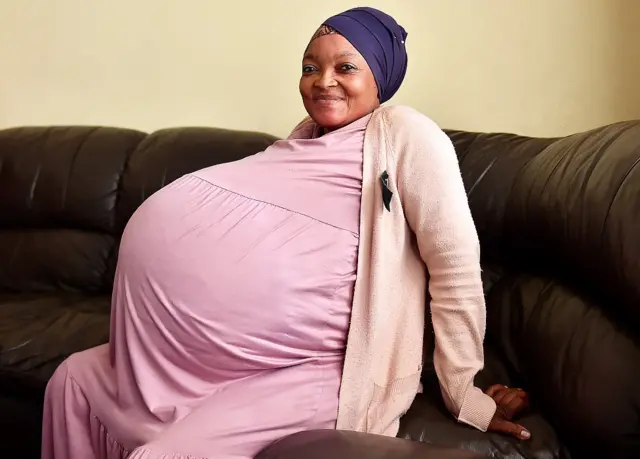
In June 2021, a story from South Africa captured global attention. A woman named Gosiame Thamara Sithole reportedly gave birth to ten babies at once—an event that, if confirmed, would have broken world records. The claim spread rapidly across social media and international news platforms, drawing fascination, disbelief, and widespread discussion.
But as officials began to investigate, the extraordinary story took an unexpected turn.
The initial report was published by Pretoria News, which stated that the 37-year-old mother had delivered her babies at Steve Biko Academic Hospital in Gauteng province. According to the article, Sithole and her partner had originally been told they were expecting eight babies, only to learn after delivery that the number was ten. The infants were quickly dubbed the “Tembisa 10,” referencing the township where the couple lived.
The report included quotes attributed to Sithole prior to the supposed birth. She was described as having experienced a difficult pregnancy but expressed hope that both she and her children would be healthy. The story contained enough specific details to appear credible, and it was picked up by several well-known media outlets around the world. For a brief period, it seemed like an extraordinary medical milestone.
However, questions soon emerged.
Medical professionals and members of the public began asking for confirmation. Giving birth to ten babies naturally would be exceptionally rare, and such a case would require significant medical coordination and documentation. As global attention intensified, authorities in Gauteng launched an investigation to verify the claims.
What they found raised serious doubts.
Officials reported that no public or private hospital in the province had records of such a birth. Further medical evaluations concluded that Sithole had not given birth in recent months. In fact, according to statements released by the Gauteng Provincial Government, medical practitioners determined that she had not been pregnant at all during the period in question.
“It has now been established by medical practitioners that Ms. Sithole did not give birth to any babies in recent times,” the provincial government stated. “It has also been established that she was not pregnant in recent times.”
The revelation left many people confused and searching for answers.
Why would someone claim to have delivered ten babies? Authorities did not provide a clear explanation, and the motivations behind the claim remain uncertain. Some observers speculated that financial donations and public attention may have played a role, as reports indicated that the family had received support following the announcement.
Meanwhile, the journalist who broke the original story, Piet Rampedi, initially defended his reporting. He maintained that he believed the information he received at the time was accurate. Rampedi stated that he had seen Sithole during her pregnancy and had no reason to doubt her account. According to him, he learned about the alleged birth through direct communication from her.
However, as scrutiny intensified, Rampedi later acknowledged that the story may not have been verified thoroughly enough before publication. In comments reported by local media, he admitted that the verification process could have been handled more carefully.
“Even though I stand by the fact that Sithole was pregnant, some aspects of the story could have been dealt with differently,” he said. “Could I have handled the story much better? Definitely. Especially the verification process.”
The situation sparked debate not only about the specific claim but also about journalistic responsibility in the age of viral news. In today’s digital landscape, extraordinary stories can travel worldwide within hours. The pressure to publish quickly can sometimes overshadow the need for comprehensive fact-checking.
Independent Media, the company behind Pretoria News, stood by its publication for a time, arguing that the story had been unfairly labeled as “fake news.” However, as official findings contradicted the original report, public confidence shifted.
Beyond the media controversy, the case also raised broader questions about misinformation and its consequences. Sensational claims can create emotional responses, inspire donations, and influence public opinion before facts are fully established. Once a story gains momentum online, correcting the narrative can be challenging—even when official statements clarify the truth.

In the aftermath, Sithole was reportedly offered assistance and support. While authorities confirmed that the birth did not occur, they did not release detailed information about her personal circumstances. Observers noted that cases involving disputed pregnancies can sometimes involve complex emotional or psychological factors, though no official diagnosis or explanation was publicly disclosed in this instance.
The “Tembisa 10” story remains one of the more unusual viral news episodes in recent years. For a brief time, it united people around what appeared to be an unprecedented medical event. When the claim was later disproven, it became a cautionary example of how quickly narratives can form—and unravel.
Ultimately, the case underscores the importance of verification, transparency, and responsible reporting. Extraordinary claims require careful confirmation, particularly when they involve medical milestones or public fundraising efforts.
Today, the story serves less as a tale of record-breaking birth and more as a reminder of the power—and risk—of viral information.
In a world where headlines can circle the globe in minutes, the search for truth often requires patience, scrutiny, and a willingness to revisit what we think we know.