

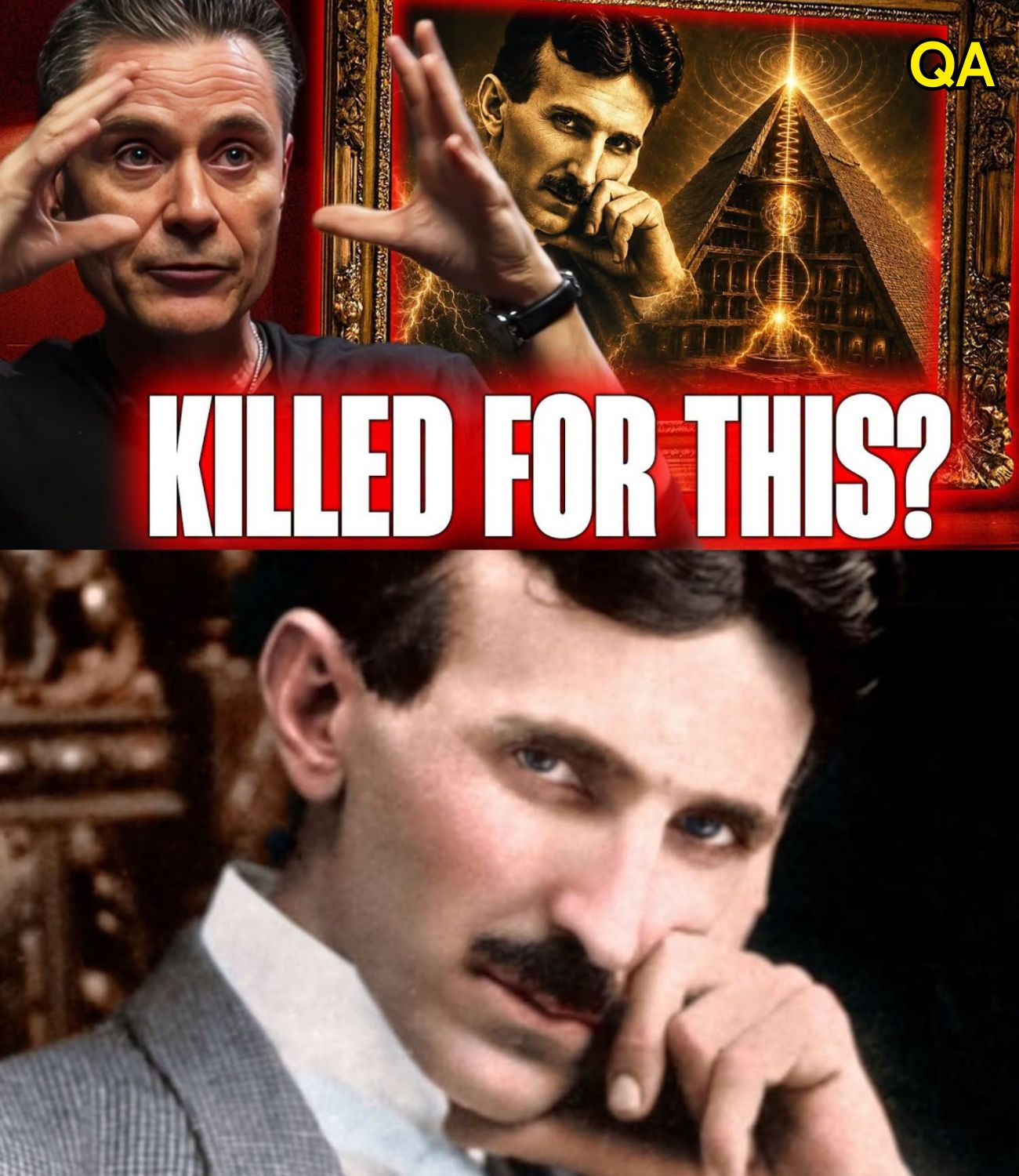
The tale begins in a hotel room, specifically Room 3327 of the New Yorker Hotel, where the late inventor Nikola Tesla had lived in his final days. Following his death in January 1943, during the height of World War II, the world was embroiled in conflict and the rumors surrounding Tesla’s work gained a sinister turn. Tesla had claimed to develop a mysterious weapon, one that newspapers sensationalized as a “death ray.” These claims spurred considerable intrigue among government officials, not due to Tesla’s wealth or power, but due to the potential implications his inventions could have in the war. Almost overnight, the old inventor’s trunks of papers vanished into the custody of the U.S. government, laying the foundation for an enduring legend that remains to this day.
Fast forward several decades, and we arrive in the Alaskan wilderness, where an unusual field of antennas rises outside Gakona—an official research site capable of sending high-frequency radio energy into the upper atmosphere as part of a program known as HAARP. As often occurs, the internet made connections between disparate stories, and thus, the mystique surrounding Tesla converged with HAARP, bridging two realms of speculation and intrigue.

The Night Tesla Became a Government Problem
Nikola Tesla’s demise in 1943 unfolded against a backdrop of global chaos, with the United States entrenched in a battle against the Axis powers. The fears of rapidly advancing weaponry haunted the government, thus fueling significant interest in Tesla’s papers. After all, he had intimated that he was working on a powerful beam weapon that could potentially serve as a defensive mechanism against enemy aircraft.
However, the question remains: did this invention exist? The line between fact and fiction blurred dangerously in wartime, as rumors could easily escalate into matters of national security. According to PBS’ documentary, Tesla: Master of Lightning, U.S. officials recognized the potential potency of Tesla’s papers. Fears loomed that this knowledge could fall into Axis or Soviet hands, prompting Tesla’s nephew, Sava Kosanović, to report missing documents and a notebook labeled “Government.” Within days of Tesla’s passing, representatives from the Office of Alien Property seized his belongings, catalyzing the legend that continues to underpin speculation about missing research.
Though some elements of the story are factual, such as the seizure of Tesla’s papers, the leap to suggesting that his work secretly powered a government laboratory in Alaska delves into murky waters where truth intertwines with speculation. The government did not simply archive Tesla’s trunks; they tasked Dr. John G. Trump, an MIT electrical engineer and expert in high-voltage technology, to examine Tesla’s papers. After a brief examination, Trump declared that Tesla’s later work was largely speculative and lacked “new, sound, workable principles or methods” regarding his wireless power or beam weapon concepts. This statement, while conclusive, didn’t quell the torrent of curiosity that surrounded Tesla’s legacy.
According to PBS, copies of Tesla’s documents connected to particle-beam weaponry ultimately found their way to Patterson Air Force Base for a project dubbed “Project Nick.” However, the lack of published details concerning this venture and the subsequent disappearance of related documents from public discourse gave rise to a new chapter in the Tesla tale. If Tesla’s work held no value, why pursue these papers? The official narrative attributes the seizure to wartime caution, while conspiracy theorists insist that something of great worth must have been uncovered, leaving us with one of the most enduring myths in modern science history.
Enter Alaska
In the decades following Tesla’s death, HAARP emerged as one of the world’s most misunderstood scientific installations. Located near Gakona, Alaska, the High-frequency Active Auroral Research Program aims to explore the ionosphere and better understand electromagnetic processes influenced by solar wind and the Earth’s magnetic field. Yet to many in conspiracy circles, HAARP was something more sinister—a weather weapon, a mind-control grid, or an “earthquake machine,” even labeled as a hidden device derived from Tesla’s lost research.
The unusual nature of HAARP, coupled with its military origins and its powerful radio-frequency transmissions, creates an environment ripe for conspiracy theories. Deep within the remote Alaskan landscape, where silence and solitude reign, the site took on an air of enigma, further fueled by its ties to the atmosphere—a space shrouded in mystery and misunderstood by the general public. Thus, the legend surrounding Tesla smoothly transitioned into the narrative of HAARP.

What HAARP Actually Does
The scientific facts about HAARP, however, are far less sensationalist than the rumors suggest. The University of Alaska Fairbanks outlines how researchers use the array to heat small regions of the ionosphere, allowing them to study the natural electromagnetic processes within it. With 180 high-frequency antennas spanning across 33 acres and capable of radiating 3.6 megawatts, HAARP serves as a powerful tool for researchers observing phenomena, including radio communication and navigation.
Despite its impressive capabilities, HAARP is not the mystical project many conspiracists envision. While it can temporarily excite a localized region of the ionosphere, producing results that enhance our understanding of numerous scientific facets, it pales in comparison to the seemingly boundless energy radiated by the sun. It is not a death ray nor a weather-control machine, and there is no evidence that it holds any hidden weapons within its structure. Nevertheless, the facility’s visual resemblance to something out of a sci-fi film continues to stoke rumors and intrigue.
The popular association between Tesla and HAARP can be traced to Tesla’s preoccupation with resonating frequencies, wireless transmission, and high-voltage energy. HAARP, utilizing high-frequency radio waves to interact with the ionosphere, piques the public’s imagination, creating a connection that feels intuitive yet lacks substantive evidence. The reality lies in the broad spectrum of Tesla’s work contrasted against the specifically modern framework built on decades of scientific progress not solely authored by him—plasma physics, atmospheric science, and military communication research generally built HAARP apart from Tesla’s legacy.
The “Missing Papers” Problem
The enduring speculation surrounding the lost documents and their rumored link to government interest has rendered the Tesla story irresistible to many. The FBI maintains a public archive of Tesla-related files that reveal the existence of records; however, they firmly reject the popular myth of the FBI possessing Tesla’s death ray plans. Instead, these possessions were momentarily seized by the Department of Justice’s Alien Property Custodian Office following Tesla’s passing and handled by individuals surrounding the matter, thereby further complicating public perception.
This distinction is crucial as legends gain traction based on who allegedly seized what and the circumstances behind it. While Tesla indeed had revolutionary ideas, his late attempts at a “death ray” were not the functional inventions some believe them to be. He called this concept “teleforce,” claiming it could project charged particles or concentrated energy via enormous destructive force. Newspapers ran wild with these visions, as military officials were acutely aware of the potential ramifications in wartime.
However, many scientists continue to challenge whether Tesla’s imaginings could ever translate into practical technologies. Tesla’s genius lay in many successful innovations—alternating current systems, high-voltage devices, remote control workings, and much more—yet not all his late works reached the heights he envisioned. Instead of portraying Tesla as a flawless inventor, history illustrates him as a brilliant creator who often dreamt beyond the practical bounds of his time.
Why Alaska Was the Perfect Place for the Myth
Had HAARP been established within a bustling metropolis, surrounded by noise and distraction, the legend might have faltered. However, Alaska’s remoteness lends itself perfectly to breeding myths. The landscape—featuring vast stretches of wilderness, silent nights, and mountains stretching towards the stars—creates a stage ripe for mystery, where the natural phenomena like northern lights blend seamlessly with technological exploration.
This scenic backdrop combined with Tesla—an inventor renowned for his dreams of transmitting energy through the air and his legacy of secrecy—forms an irresistible narrative mesh. The government’s apparent seizure of his papers only adds layers to a drama interwoven with the allure of unfinished stories and hidden knowledge.
The Weather Weapon Claim
Further complicating matters, many associated HAARP with weather control. Misconceptions arose, fueled by speculation that the facility’s interaction with the ionosphere enabled it to manipulate climatic conditions. However, expert analysis confirms that HAARP’s functions reach beyond traditional weather systems, engaging directly with the upper atmosphere where phenomena like auroras occur.
In reality, storms like hurricanes are not influenced by HAARP transmissions, but rather by various factors operating strictly within lower atmosphere conditions. It’s a disconnect that repeatedly draws the link back to Tesla’s narrative, creating a chasm between perception and scientific reality.
Final Thought: The Real Mystery Is Not Alaska
Ultimately, the greater puzzle lies in understanding why we cling so tightly to the notion that Tesla’s research found its resting place in an Alaskan lab. Perhaps it stems from the desire to believe in the unfinished story of an extraordinary inventor, a sense of disconnection with our technological advancements, and a hunger for transparency amid evolving secrecy. HAARP, with its eerie sight, suggests a hidden legacy—evoking reflections of science fiction colliding with reality.
The documented evidence does not substantiate a direct tie between Tesla’s missing research and HAARP; rather, it does affirm a complex narrative in which mystique flourishes and the human need to believe in something greater is unabashedly fulfilled. Between documentary facts and haunting legends, the allure of possibility reinforces our understanding that behind every trail of missing knowledge, the imagination continues to seek answers, shadowed by the silhouette of Nikola Tesla himself.
Sources: