
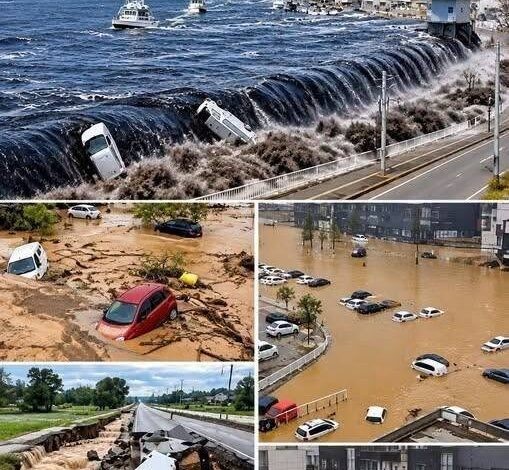
When the Ocean Turns Against the Shore How Powerful Undersea Earthquakes Trigger Devastating Tsunamis and Change Coastal Communities Forever
A powerful earthquake beneath the ocean can move an immense volume of seawater in a matter of seconds. The result may be a tsunami: a series of long ocean waves capable of reaching coastlines far from the original earthquake. Although tsunamis are relatively uncommon compared with ordinary coastal waves, their consequences can be severe because they can arrive rapidly, flood low-lying land, disrupt essential services, and reshape the lives of entire communities.
Understanding how tsunamis form, how official warning systems operate, and what people should do when natural warning signs appear is an important part of coastal safety. Scientific knowledge, reliable public communication, resilient infrastructure, and local preparedness all contribute to reducing risk.
How Undersea Earthquakes Create Tsunamis
Most tsunamis are caused by large earthquakes beneath the sea floor, particularly in areas where tectonic plates meet. Earth’s outer layer is divided into moving plates. Along some boundaries, one plate is forced beneath another in a process known as subduction. These zones can store enormous amounts of energy over time.
When stress is suddenly released, the sea floor may rise or fall. If this vertical movement displaces the water above it, the entire water column can begin to move outward. Unlike wind-driven waves, which mainly affect the ocean surface, tsunami waves involve water from the surface to the seabed. This is one reason they can carry so much energy across large distances.
Not every undersea earthquake produces a tsunami. The likelihood depends on several factors, including the earthquake’s magnitude, depth, location, fault movement, and whether the sea floor shifted vertically. Landslides under water, volcanic activity, and, in rare cases, impacts from space objects can also generate tsunami waves.
Why Tsunami Waves Behave Differently From Ordinary Waves
In deep water, a tsunami may be difficult to notice. Its wave height can be relatively small offshore, but its wavelength—the distance between wave crests—may extend for many kilometres. Tsunami waves can travel at speeds comparable to commercial aircraft in deep ocean conditions.
As a tsunami approaches shallow coastal water, it slows down. The energy that was distributed across a wide expanse of water becomes compressed, causing the water level to rise. The result is not always a single towering wall of water, as often portrayed in entertainment media. A tsunami may instead arrive as a rapidly rising flood, a powerful surge through a harbour, or multiple waves over several hours.
The first wave is not necessarily the largest. This fact is central to public safety guidance. People should not return to coastal areas after one wave has passed unless authorities have clearly announced that it is safe to do so. Changing tides, currents, debris, and damaged infrastructure can remain hazardous long after the initial arrival.
Natural Warning Signs That Should Never Be Ignored
Official alerts are valuable, but people near the coast may have to act before a formal warning reaches them. The United States National Oceanic and Atmospheric Administration and other disaster-management agencies emphasize several natural warning signs.
A strong or long-lasting earthquake is one of the clearest signs. If shaking makes it difficult to stand or lasts for an extended period, people in coastal areas should move to higher ground or farther inland as soon as it is safe to do so. They should not wait to confirm whether a tsunami has been issued.
Other warning signs may include an unusual roar from the ocean, similar to the sound of a train or aircraft, or a sudden and unusual retreat of the sea that exposes parts of the seabed. While a receding shoreline can attract attention, it may signal that a powerful surge is approaching. The appropriate response is to leave the shore immediately and follow local evacuation guidance.
The Importance of Tsunami Warning Systems
Modern tsunami warning systems combine seismic monitoring, ocean observations, communication networks, and emergency planning. Seismometers detect earthquakes and help scientists estimate their location, depth, and magnitude. Tide gauges and deep-ocean pressure sensors can then help confirm whether a tsunami has been generated and how it is moving.
In the Pacific region, international cooperation has helped create extensive monitoring and warning arrangements because the area contains many active plate boundaries. Similar regional systems operate in the Indian Ocean, the Caribbean, the Mediterranean, and other vulnerable areas. These networks share data across borders, reflecting the fact that tsunami risks do not stop at national boundaries.
Warnings may be delivered through sirens, emergency text alerts, television and radio broadcasts, mobile applications, social media accounts operated by public agencies, and local officials. However, technology is most effective when residents understand the messages and know where to go. A warning without accessible evacuation routes, clear signs, or community training may not provide enough protection.
Lessons From Major Tsunami Disasters
Several major events have shaped global understanding of tsunami preparedness. The Indian Ocean tsunami of December 2004 demonstrated the danger posed by a large offshore earthquake in a region with limited warning infrastructure at the time. The event affected communities across multiple countries and prompted a major expansion of regional monitoring, public education, and international disaster-risk cooperation.
In March 2011, a major earthquake off the coast of Japan generated a tsunami that caused widespread coastal flooding and major disruption. Japan’s experience highlighted both the value and the limits of advanced preparedness. Sea walls, warning systems, evacuation planning, and public drills can reduce risk, but exceptionally powerful events can still exceed design assumptions. The disaster also led to extensive discussions about land-use planning, infrastructure resilience, emergency communications, and long-term recovery.
These events have reinforced a central lesson: there is no single solution to tsunami risk. Effective protection requires overlapping measures, including early warnings, rapid evacuation, well-designed buildings, public education, coastal planning, and support for affected communities after an emergency.
How Tsunamis Change Coastal Communities
Coastal communities often depend on the sea for livelihoods, food, culture, tourism, and transport. A tsunami can interrupt fishing, damage ports, close businesses, affect schools and health services, and displace families. The consequences may continue long after floodwaters have receded.
Recovery is not only about rebuilding roads and homes. It can involve restoring local economies, preserving cultural heritage, addressing mental health needs, and helping residents make informed decisions about where and how to rebuild. Communities may also face difficult questions about whether certain highly exposed areas should be redeveloped, elevated, protected with engineered structures, or left as open coastal space.
International organizations increasingly stress the importance of “building back better.” This approach aims to make homes, public facilities, evacuation routes, and communication systems safer than they were before an emergency. It also recognizes that recovery plans should include local residents, especially people who may face additional barriers during evacuations, such as older adults, children, visitors, and people with disabilities.
Preparedness Steps for People Living Near the Coast
Preparedness starts well before an earthquake occurs. Residents and visitors in tsunami-prone areas should learn whether they are in an evacuation zone and identify more than one route to higher ground. Local government websites, emergency management offices, and posted evacuation maps are often useful starting points.
A household emergency plan should include a meeting point, contact information for relatives, and a plan for children, pets, and people who need assistance. Emergency supplies may include drinking water, essential medicines, a flashlight, batteries, a portable radio, identification documents, basic first-aid materials, and chargers or backup power options where practical.
When an official evacuation order is issued, people should leave promptly and follow instructions from local authorities. Walking may be safer than driving if roads are crowded or damaged. People should avoid beaches, harbours, river mouths, and low-lying areas until officials announce that the threat has passed.
The Role of Education and Community Drills
Public education can turn scientific information into lifesaving action. Schools, hotels, fishing communities, tourism operators, and employers in coastal regions can all play a role in helping people recognize warning signs and understand evacuation procedures.
Regular drills help residents practice decisions that may need to be made quickly during a real emergency. They can also reveal practical problems, such as unclear signs, inaccessible routes, insufficient lighting, or evacuation areas that are too small. For visitors unfamiliar with local geography, multilingual signs and simple instructions can be especially important.
UNESCO’s Intergovernmental Oceanographic Commission promotes tsunami awareness through initiatives such as World Tsunami Awareness Day and the Tsunami Ready recognition programme. These efforts encourage communities to improve hazard mapping, warning communication, evacuation planning, and public readiness.
Science, Climate, and Future Coastal Risk
Earthquakes themselves are driven by tectonic processes, not by climate change. However, rising sea levels can increase coastal flood exposure over time. Higher baseline sea levels may allow tsunami flooding to reach farther inland in some locations, depending on local geography and coastal conditions.
This makes long-term planning increasingly important. Coastal communities must consider several overlapping challenges, including erosion, storm surge, sea-level rise, and earthquake-related hazards. Investments in reliable warning systems, natural coastal buffers, elevated critical infrastructure, and well-maintained evacuation routes can support broader resilience.
Scientists continue to improve models that estimate tsunami travel times, wave heights, and likely inundation areas. Yet uncertainty remains a defining feature of natural hazards. The most practical response is not to expect perfect prediction, but to prepare communities to respond quickly when credible warnings or natural signs appear.
A Shared Responsibility for Safer Coasts
Tsunamis demonstrate the extraordinary power of the natural world, but they also show how preparedness can make a meaningful difference. Governments have responsibilities to invest in monitoring, public alerts, building standards, and inclusive emergency planning. Schools and local organizations can help make safety information familiar and practical. Individuals can learn evacuation routes, prepare supplies, and act without delay after strong coastal shaking.
For coastal communities, living near the ocean brings opportunities as well as risks. Respecting the science of tsunamis, listening to trusted authorities, and maintaining a culture of readiness can help protect lives and support a faster, more resilient recovery when emergencies occur.
Disclaimer: This content is intended for entertainment purposes only and is not based on real events.