



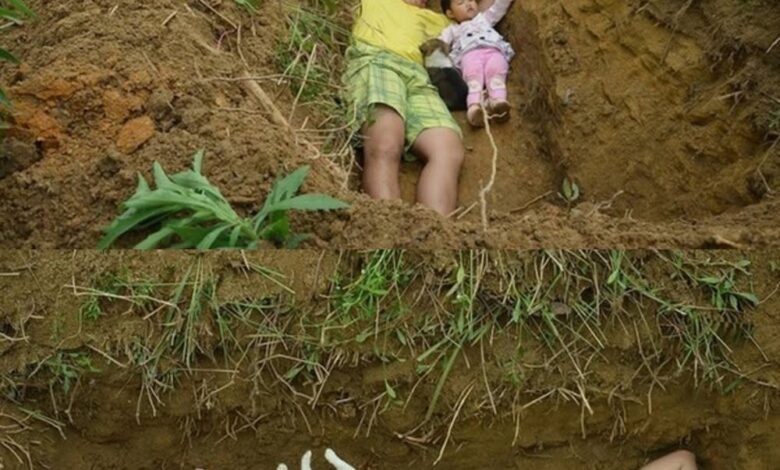
A Father’s Unimaginable Decision
Stories about parents caring for seriously ill children can evoke profound sadness because they reveal the pressure that illness, uncertainty, and financial hardship can place on a family. One widely circulated account from Sichuan Province, China, described a young father, Zhang Liyong, whose daughter Zhang Lei was reportedly living with a severe congenital blood disorder.
The story gained public attention after images appeared online showing the father beside a burial site he had prepared while fearing for his child’s future. The photographs prompted shock and sympathy across social media. However, the account should be approached carefully: many details were circulated through secondary reports and social platforms, and a complete independently verified record of the family’s later medical outcome is not publicly established.
What can be discussed responsibly is the wider reality reflected in such reports. Families facing serious childhood illness may encounter repeated hospital visits, complicated treatment decisions, lost income, emotional exhaustion, and substantial costs. Their experiences underscore why access to qualified medical care, social support, accurate health information, and transparent financial assistance matters.
Reported Family Circumstances in Sichuan
According to the original account, Zhang Liyong was a young laborer from a village near Neijiang in Sichuan Province. His daughter, Zhang Lei, was reportedly diagnosed during infancy with congenital anemia, a broad term for anemia associated with a condition present from birth. The reports stated that she needed ongoing medical attention and regular blood transfusions.
The family’s situation was described as financially difficult. Reports claimed that the parents had spent more than 140,000 yuan on medical treatment while the father earned approximately 2,500 yuan per month. Those figures cannot be independently confirmed here, but they illustrate a challenge faced by many households worldwide: even when treatment is available, the direct and indirect costs of care can create a severe burden.
For parents, the pressure of a child’s illness is rarely limited to a diagnosis. It can affect employment, transportation, housing, childcare for siblings, nutrition, sleep, and relationships. Frequent travel to hospitals may require families to miss work. Medical bills may be accompanied by expenses for medicines, tests, accommodation, and time away from home. In rural communities, distance from specialist services can add another layer of difficulty.
The reported images associated with this family were distressing because they seemed to show a father overwhelmed by fear. They should not be viewed as evidence of a medical solution or a model for other families. Rather, they point to the emotional crisis that can arise when caregivers believe they are running out of choices.
Understanding Congenital Anemia in Children
Congenital anemia is not one single diagnosis. It may refer to a range of inherited or early-life conditions that affect red blood cells, hemoglobin, bone marrow function, or the body’s ability to maintain healthy blood cells. Examples include thalassemia, sickle cell disease, hereditary spherocytosis, and rare bone marrow failure syndromes. Each condition has different causes, risks, and treatment pathways.
Red blood cells carry oxygen from the lungs to tissues throughout the body. When a child has anemia, the body may not have enough healthy red blood cells, or those cells may not work effectively. Symptoms can vary widely depending on the cause and severity. A child may experience tiredness, paleness, poor feeding, shortness of breath, delayed growth, or other complications. Only a qualified clinical team can diagnose the precise condition and recommend treatment.
Some forms of anemia are mild and can be monitored or treated with medicines and nutritional support. Severe inherited blood disorders may require repeated transfusions, medicines to reduce complications, specialist follow-up, or consideration of hematopoietic stem cell transplantation. The appropriate approach depends on the individual child’s diagnosis, overall health, available services, and family circumstances.
It is important to avoid assuming that all childhood anemia requires a transplant. Similarly, not every child who receives transfusions will be a candidate for the same procedure. Families need clear explanations from pediatric hematologists and other specialists about what is known, what remains uncertain, and what options may be appropriate.
Blood Transfusions and the Long-Term Burden of Care
For children with certain severe blood disorders, blood transfusions can be essential. They may help improve oxygen delivery, reduce symptoms, support growth, and prevent some complications. Yet transfusion programs require careful monitoring. Over time, repeated transfusions can lead to iron overload, which may require additional treatment known as iron chelation therapy. Patients also need ongoing testing for safety and effectiveness.
These medical needs can make a childhood condition feel like a full-time responsibility for parents. Caregivers may become highly familiar with hospital schedules, laboratory results, medications, insurance processes, and the signs that a child may need urgent assessment. Many parents also try to preserve a sense of normal childhood through play, school, friendships, and family routines.
The original account described Zhang Lei as spending time in the family yard, with a puppy and ducks, and accompanying her father during his free time. Whether every detail can be verified or not, the image reflects an important truth: a child with a serious illness is more than a patient. Children need affection, stimulation, comfort, and opportunities to enjoy ordinary life alongside medical care.
Health professionals often encourage families to ask hospitals about child-life support, social work services, psychological care, and school or developmental resources where these are available. Such support can help reduce isolation and make medical routines less frightening for children and their caregivers.
Stem Cell Transplantation: Hope, Limits, and Medical Guidance
The reports about the Sichuan family stated that doctors had discussed the possibility of a stem cell transplant if a suitable donor could be identified. Hematopoietic stem cell transplantation can be a potentially curative treatment for some serious inherited blood disorders and bone marrow diseases. However, it is a complex procedure with significant risks and is not appropriate for every patient.
Before a transplant can be considered, specialists assess the child’s diagnosis, disease severity, organ function, infection risks, prior treatment, and donor availability. Donor compatibility is evaluated through human leukocyte antigen, or HLA, testing. A sibling may have a chance of being a match, but shared parentage does not guarantee compatibility. Unrelated donor registries and cord blood programs may sometimes be considered, depending on local resources and the clinical situation.
A transplant can involve chemotherapy or other conditioning treatment, a hospital stay, infection prevention, close follow-up, and management of complications such as graft-versus-host disease. Families considering this option need balanced information that explains possible benefits as well as risks. It is not responsible to present transplantation as a certain cure or to suggest that a future sibling will necessarily be a suitable donor.
The reported family had reportedly hoped that another child might offer a donor possibility. That situation illustrates the deeply personal and difficult decisions families may face. Any decisions involving pregnancy, cord blood, donation, or transplantation should be guided by independent medical specialists, ethical standards, and the wellbeing of every child in the family.
When Medical Costs Become a Family Crisis
Childhood illness can expose the gap between medical possibility and medical access. A treatment may exist, but a family may struggle to pay for it, travel to the appropriate hospital, take time away from work, or navigate administrative systems. These challenges are not unique to China. The World Health Organization has repeatedly emphasized that health costs can cause financial hardship, especially for households with lower incomes or limited insurance coverage.
Financial strain also has emotional consequences. Parents may experience anxiety, guilt, grief, sleep disruption, and a sense of helplessness. They may feel pressure to keep earning money while also being physically present for their child’s appointments and daily care. These demands can be especially severe for young parents and families living far from specialist centers.
Practical support can make a meaningful difference. Depending on the country and healthcare system, families may be able to seek help through hospital social workers, public health insurance programs, charitable foundations, patient organizations, community groups, or verified fundraising platforms. Social workers can sometimes help families understand eligibility for assistance, identify accommodation near treatment centers, or connect with transportation and counseling services.
Financial assistance does not remove the pain of a serious diagnosis, but it can reduce the impossible choices that families may otherwise face. Stronger systems for pediatric care should recognize that a child’s treatment needs are inseparable from the wellbeing of the people providing care every day.
Why Compassion Must Be Paired With Responsible Action
Stories involving sick children often spread quickly online because they inspire an immediate desire to help. That response can be generous and humane, but it should also be careful. Images and personal accounts may lack complete context. Medical claims may be oversimplified. Donation appeals can be misrepresented or exploited by others.
People considering a donation should look for transparent documentation, reputable charitable partners, clear explanations of how funds will be used, and confirmation from reliable sources where possible. Families deserve support, but they also deserve privacy and dignity. Sharing distressing images repeatedly can turn real people into symbols rather than recognizing them as individuals with rights and personal boundaries.
Responsible support also means avoiding harmful myths. Exposure to frightening settings or rituals is not a recognized treatment for anemia or a substitute for clinical care. Children facing serious illness benefit from trusted caregivers, familiar routines, pain and symptom management, age-appropriate communication, and medical guidance tailored to their condition.
If a child has a life-limiting illness, pediatric palliative care may be offered alongside treatment. Palliative care focuses on comfort, symptom relief, communication, emotional support, and quality of life. It does not necessarily mean that disease-directed treatment has ended. Instead, it helps families make informed decisions while keeping the child’s wellbeing at the center.
Supporting Parents and Caregivers During Childhood Illness
Caregivers are often expected to be resilient, organized, and calm even when they are under extraordinary pressure. Yet parents of children with chronic or serious illnesses may need support in their own right. Counseling, peer support groups, practical respite, financial advice, and honest conversations with clinicians can reduce isolation.
Friends and relatives can help in small but valuable ways. They can provide meals, offer transportation, look after siblings, listen without judgment, or help organize verified practical support. Employers can contribute through flexible schedules and compassionate leave policies. Communities can help by supporting hospitals, blood donation systems, and reputable child-health organizations.
It is also important to speak about mental health without stigma. A parent who seems overwhelmed is not necessarily uncaring or weak. Severe stress can affect judgment and coping. If a caregiver appears to be in immediate distress or unable to keep a child safe, local emergency services, healthcare professionals, or crisis support services should be contacted promptly.
A Reminder to See the Child Beyond the Diagnosis
The account of Zhang Liyong and Zhang Lei became widely shared because it combined several fears that many people recognize: fear of losing a child, fear of not being able to afford care, and fear that love alone may not solve every problem. But the most respectful way to consider such a story is not to focus solely on a dramatic image.
The wider lesson is that childhood illness affects entire families. Behind every diagnosis may be parents trying to understand medical information, arrange appointments, earn an income, comfort a frightened child, and preserve moments of ordinary happiness. Behind every treatment cost may be difficult decisions that outsiders never see.
Compassion should therefore extend beyond sadness. It should include support for evidence-based healthcare, affordable access to treatment, ethical fundraising, caregiver mental health, and policies that prevent families from being left alone during a medical crisis.
While the later outcome of the reported Sichuan case remains unclear in publicly available accounts, its broader message remains relevant. Families facing serious childhood illness deserve accurate information, skilled medical care, practical help, and respect. A child is never only a diagnosis, and a parent should never have to confront overwhelming fear without support.
Sources
- World Health Organization: Anaemia
- World Health Organization: Palliative Care
- Centers for Disease Control and Prevention: Sickle Cell Disease
- Centers for Disease Control and Prevention: Thalassemia
- National Heart, Lung, and Blood Institute: Anemia
- NHS: Stem Cell and Bone Marrow Transplants
- Mayo Clinic: Bone Marrow Transplant
Disclaimer: This content is intended for entertainment purposes only and is not based on real events.