


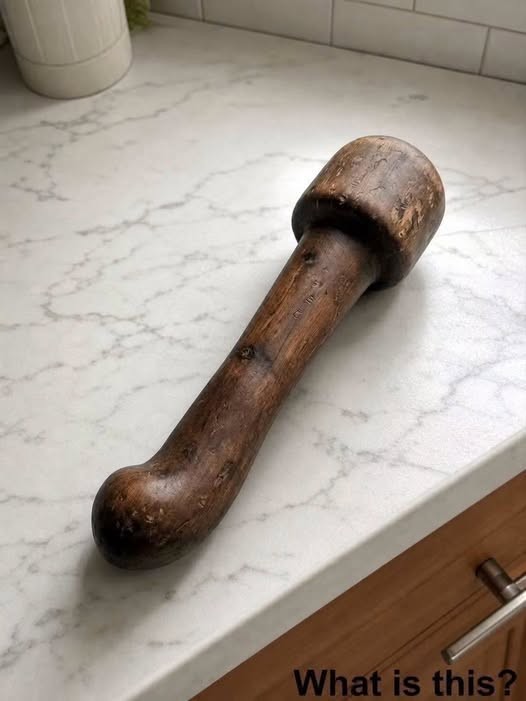
Antique Potato Masher or Primitive Pestle: A Traditional Wooden Kitchen Tool
At first glance, an old wooden kitchen object with a rounded base, a curved handle and a worn, simple shape can be difficult to identify. It may resemble a tool from a workshop, a small mallet or a piece of farm equipment rather than something used for preparing food. In many homes of the past, however, practical wooden implements such as this were essential parts of daily cooking.
One likely identification for this type of object is an antique potato masher or a pestle-like food crusher. It was designed to be held securely in the hand and pressed, twisted or pounded gently against cooked food. Although its appearance may seem unfamiliar in a kitchen shaped by electric mixers, blenders and food processors, its basic purpose remains recognizable: using manual pressure to change the texture of ingredients.
These traditional utensils offer a useful window into domestic life before household electrical appliances became widespread. They also show how thoughtful design, durable materials and repeated hand movements supported everyday meals for generations.
What Is an Antique Wooden Potato Masher?
A traditional wooden potato masher is a hand-operated utensil used to break down boiled or steamed potatoes after they have become tender. Unlike many modern mashers, which often have a perforated metal plate or a zigzag wire head, older examples could be made from one solid piece of wood. The handle was shaped for grip, while the wider or rounded working end was used to press into food inside a bowl, pot or other sturdy container.
The precise name can vary by region, household and design. Some tools were described simply as mashers, while others functioned more like a small pestle. A pestle is traditionally paired with a mortar, a bowl-shaped vessel used for crushing, grinding or blending ingredients. In domestic kitchens, though, the line between a potato masher and a pestle-like crusher was not always rigid. A solid wooden tool could be used for several food-preparation tasks, especially where households preferred versatile equipment over specialized utensils.
It is important to avoid identifying every old wooden object with certainty from its shape alone. Wear patterns, dimensions, the type of wood and information about where it was found can all help historians or museum curators determine its original use. Still, a rounded working end and a handle intended for downward force are consistent with many traditional mashers and food-crushing tools.
How Wooden Mashers Were Used in Traditional Cooking
Preparing mashed potatoes by hand was straightforward but required time and effort. Potatoes were first boiled, steamed or cooked in another way until soft. After draining them, the cook placed the potatoes in a bowl or cooking vessel and applied repeated downward pressure with the wooden masher. Turning or twisting the tool between presses helped break apart remaining lumps.
The resulting texture depended on several factors: the potato variety, how long the potatoes were cooked, whether they had cooled, and how much liquid or fat was added. Milk, cream, butter, broth or other ingredients were often mixed in according to local food traditions and household resources. The masher did not merely reduce food into smaller pieces; it helped create a softer consistency that could be served as a side dish or used as part of other recipes.
Hand mashing also gave cooks direct control over texture. Some families preferred a smooth mash, while others accepted or intentionally retained small pieces of potato. Modern food processors can be convenient, but overprocessing potatoes may produce an excessively sticky texture because of the starch released during vigorous mechanical mixing. For this reason, many cooks still choose a hand masher, ricer or fork when preparing mashed potatoes.
More Than a Potato Tool
Although potatoes are among the most likely foods associated with this kind of utensil, a wooden masher could be useful for other soft ingredients as well. Cooked root vegetables, including turnips, carrots, parsnips and squash, can be softened through pressing and crushing. Cooked beans may also be mashed for soups, spreads or traditional dishes. Soft fruits could be crushed for sauces, preserves or baking preparations.
In some kitchens, a robust wooden tool may have served a role similar to that of a pestle by crushing herbs, spices or other ingredients in a suitable bowl. However, the food being prepared matters. Hard, dry spices generally require a more durable grinding surface, often stone, ceramic or metal, while a wooden masher is best suited to moist, cooked or naturally soft foods.
This flexibility was valuable in households where kitchen storage was limited and utensils were expected to perform more than one job. Rather than owning a separate tool for every ingredient, families often relied on a smaller number of sturdy objects that could be used repeatedly throughout the year.
Why Wood Was a Common Kitchen Material
Wood was a practical and widely available material for household utensils. It could be carved by skilled craftspeople, produced locally and repaired or replaced more easily than complex manufactured equipment. Hardwoods in particular could withstand frequent use when properly maintained. Their natural warmth and comfortable feel also made them well suited to hand tools.
Before the expansion of mass-produced kitchenware, wooden spoons, paddles, bowls, rolling pins and mashers were familiar items in many regions. Their forms were shaped by function. A thicker handle helped prevent splitting and made repetitive work easier on the hand. A broad end increased the area used for pressing food. Smooth surfaces reduced the chance of splinters and made cleaning more manageable.
Wooden tools nevertheless required care. They needed to be washed promptly, dried thoroughly and kept in good condition to reduce cracking or retain food residue. Modern food-safety guidance emphasizes cleaning food-contact surfaces after use and avoiding cross-contamination, especially when handling raw animal products. An antique utensil intended for display should not automatically be used for food preparation without assessing its condition, finish and cleanliness.
Life Before Electric Kitchen Appliances
Traditional potato mashers belong to a period when cooking involved substantially more manual labor. Chopping, kneading, grinding, whisking, beating and mashing were physical tasks performed with knives, boards, bowls, spoons, mortars, pestles and other hand tools. The pace of meal preparation was often influenced by the availability of fuel, water, ingredients and help from family members.
The rise of household electricity transformed kitchens gradually rather than all at once. Electric mixers, blenders and food processors eventually reduced the time needed for many repetitive jobs, particularly in homes with reliable electrical service and the means to purchase appliances. Yet older manual tools did not disappear immediately. They remained affordable, dependable and useful, and many still have a place in contemporary kitchens.
Manual mashers have several enduring advantages. They do not require power, take up little space and have no motors or electronic parts to maintain. They can also be used during camping trips, in off-grid settings or whenever a simpler approach is preferred. Their continued presence in stores and home kitchens demonstrates that convenience does not always replace the usefulness of a well-designed hand tool.
Traditional Food Tools and Household Heritage
An old wooden masher can carry historical value beyond its original cooking function. It may represent a family’s food traditions, local woodworking practices or the practical habits of a particular generation. In some families, kitchen tools were passed down because they were durable and because they held memories of everyday meals, celebrations and shared work.
Museums and historical collections often preserve ordinary domestic objects for this reason. Large machinery and major political events may receive more attention, but household utensils can reveal how people organized work, prepared food and adapted to the materials available to them. A simple wooden masher can tell a story about self-sufficiency, craftsmanship and the central role of the kitchen in home life.
Interest in heritage cooking has also encouraged renewed appreciation for older utensils. People exploring traditional recipes may seek methods that rely on hand mixing, grinding or mashing. This does not mean older tools were always superior to modern equipment. Rather, it highlights that different tools produce different results and reflect different ways of cooking.
How to Identify and Care for a Vintage Wooden Masher
If you find a similar object in an attic, antique shop or family collection, begin by examining it carefully. Look for a broad or rounded working end, signs of repeated contact with a bowl or pot, and a handle shaped for a firm grip. Ask whether family members remember how it was used, and note any markings, maker’s stamps or provenance that may help establish its age or origin.
For valuable or uncertain objects, consultation with a local museum, historical society, antiques specialist or material-culture researcher may provide more reliable identification. Photographs alone can be misleading, since some woodworking, agricultural and laundry tools share similar forms.
For preservation, avoid harsh chemical treatments, excessive soaking and aggressive sanding, all of which may damage original surfaces or remove evidence of use. If the item is primarily decorative, gentle dusting and stable indoor storage are generally sensible approaches. If it is to be used with food, make sure it is structurally sound, free from flaking finishes and cleaned appropriately. When in doubt, keep an antique utensil for display and use a modern food-safe equivalent for cooking.
A Simple Tool With a Lasting Purpose
The mysterious wooden object is best understood as an antique potato masher or a primitive pestle-like kitchen tool. Its function was uncomplicated: to crush and soften food through the pressure of the cook’s hand. Yet that simple function made it useful for preparing potatoes, cooked vegetables, fruits and other soft ingredients long before electric appliances became common.
Its enduring appeal lies in that practicality. Made from solid wood, easy to handle and capable of lasting for years, it represents an era in which many meals depended on durable tools, patient preparation and physical skill. Modern kitchens may offer faster alternatives, but the principle behind this traditional utensil has not changed. Transforming ingredients often begins with the most basic action of all: pressing, crushing and mixing by hand.
Sources
- U.S. National Park Service: Historic Kitchen Tools and Domestic Life
- Smithsonian Institution: Collections and Research on American Material Culture
- USDA Food Safety and Inspection Service: Cleaning and Food Safety Basics
- U.S. Food and Drug Administration: Safe Food Handling
- Encyclopaedia Britannica: Mortar and Pestle
Disclaimer: This content is intended for entertainment purposes only and is not based on real events.