
Pretty Woman Bloopers and Behind-the-Scenes Secrets You Might Have Missed
Pretty Woman remains one of the most recognizable romantic comedies of the modern Hollywood era. Released in 1990 and directed by Garry Marshall, the film turned Julia Roberts into an international star and paired her with Richard Gere in a story that has remained a popular cultural reference for more than three decades. Its memorable fashion, Los Angeles locations, soundtrack, and dialogue have helped sustain its place in film history.
Like many well-loved studio films, however, Pretty Woman contains small continuity slips and production stories that are easy to miss during a first viewing. Some moments emerged from editing decisions, while others came from spontaneous performances or creative disagreements that ultimately shaped the final film. Looking more closely at these details reveals how a movie can evolve considerably between an early screenplay and its theatrical release.
Pretty Woman Began as a Very Different Story
The version of Pretty Woman audiences know was not the story initially imagined by screenwriter J. F. Lawton. His original screenplay was titled 3,000, referring to the amount of money Edward Lewis agrees to pay Vivian Ward for a week of companionship. The early script was developed in the late 1980s and took a much more pessimistic approach to its characters and their unequal economic circumstances.
Lawton’s original concept focused more directly on class divisions, financial insecurity, and the impersonal atmosphere of Los Angeles. In that earlier version, the story did not end with a grand romantic reconciliation. Edward leaves Vivian behind, creating a conclusion far removed from the fairy-tale-inspired ending that became central to the finished movie.
The screenplay changed significantly after Disney’s Touchstone Pictures became involved. Garry Marshall, who had already established himself as a skilled director of warm, audience-friendly comedies, helped steer the material toward a more hopeful romantic tone. The finished film retained the premise of two people from sharply different worlds meeting under unusual circumstances, but it emphasized emotional growth and mutual connection rather than cynicism.
That change is especially visible in the final sequence. Edward arrives in a limousine, climbs the fire escape to Vivian’s apartment, and tells her that she has “rescued him right back.” The scene consciously echoes the language of fairy tales while giving Vivian agency in the relationship. Its optimistic conclusion became one of the defining elements of the film’s legacy, even if it represented a major departure from the earliest screenplay.
The Casting of Edward Lewis Took Time
Richard Gere is now closely associated with Edward Lewis, the wealthy corporate raider whose relationship with Vivian changes his priorities. Yet Gere was not the only actor considered during development. According to interviews discussed by entertainment outlets, Al Pacino read for the role before the project reached its final form. Pacino later said that he read scenes with Julia Roberts and was impressed by her ability.
The search for the right lead reflected a common challenge in romantic comedy casting: the actor needed to convey authority and reserve while also making Edward’s emotional transformation believable. Gere brought a calm, polished presence to the role, and his chemistry with Roberts became central to the film’s appeal.
Gere has recalled that he was initially undecided about accepting the part. During a meeting connected to the project, Roberts reportedly slid him a note that read, “Please say yes.” Gere shared the story during a 25th-anniversary reunion associated with the film. Whether viewed as a charming anecdote or a sign of the cast’s early rapport, the moment has become part of the movie’s frequently retold production history.
Roberts was only in her early twenties when Pretty Woman was released, but her performance quickly established her as one of Hollywood’s most sought-after actors. She received an Academy Award nomination for Best Actress for the role, recognition that underscored the impact of her portrayal. Vivian’s humor, vulnerability, confidence, and evolving sense of self gave the film emotional energy beyond its glamorous settings.
The Famous Breakfast Continuity Error
One of the best-known Pretty Woman bloopers appears during a breakfast conversation in Edward’s hotel suite. Vivian is eating while Edward explains aspects of his business career. In one shot, she is holding a croissant. After the camera cuts away and returns to her, the croissant has become a pancake.
The moment is a classic continuity error: a visual inconsistency created when separate takes are edited together to appear as one uninterrupted scene. Continuity staff normally track details such as food, clothing, jewelry, hand positions, and props to make sure they remain consistent from shot to shot. Even with careful planning, small changes can slip through, particularly when a scene includes multiple camera angles and several takes filmed over a long production day.
For most viewers, the dialogue and the chemistry between Roberts and Gere make the change easy to overlook. Once noticed, though, it becomes one of the film’s most replayed details. It also offers a simple reminder that movies are assembled from many individual pieces of footage, not captured as a single continuous event.
Continuity mistakes are common across cinema and rarely affect the emotional meaning of a scene. In this case, the breakfast switch has become an affectionate piece of trivia rather than a serious flaw. It reflects the practical reality of filmmaking: editing is designed to preserve pacing, performance, and story, even when a minor prop detail does not match perfectly.
Marilyn Vance’s Costumes Helped Tell Vivian’s Story
The fashion in Pretty Woman remains a major part of its visual identity. Costume designer Marilyn Vance created looks that helped mark Vivian’s movement through different social settings while preserving her personality and confidence. Her wardrobe does more than signal a makeover; it supports the film’s larger contrast between public appearance, wealth, and personal identity.
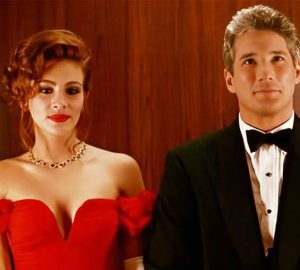
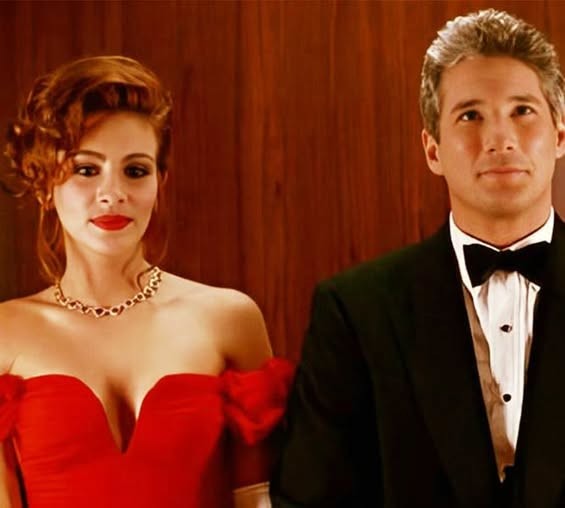
The red opera gown is perhaps the most celebrated costume in the film. Its off-the-shoulder design, paired with long white gloves, makes Vivian immediately stand out at the opera. Reports about the production have long noted that there were discussions about using black instead. Vance favored red, and the final choice gave the outfit a bold visual presence against the formal setting.
Red was a strategic choice for the screen. It draws attention while also allowing Vivian to appear glamorous and self-assured in a space that initially feels unfamiliar to her. The dress became so closely linked with the movie that it has been referenced in fashion retrospectives and popular culture for years.
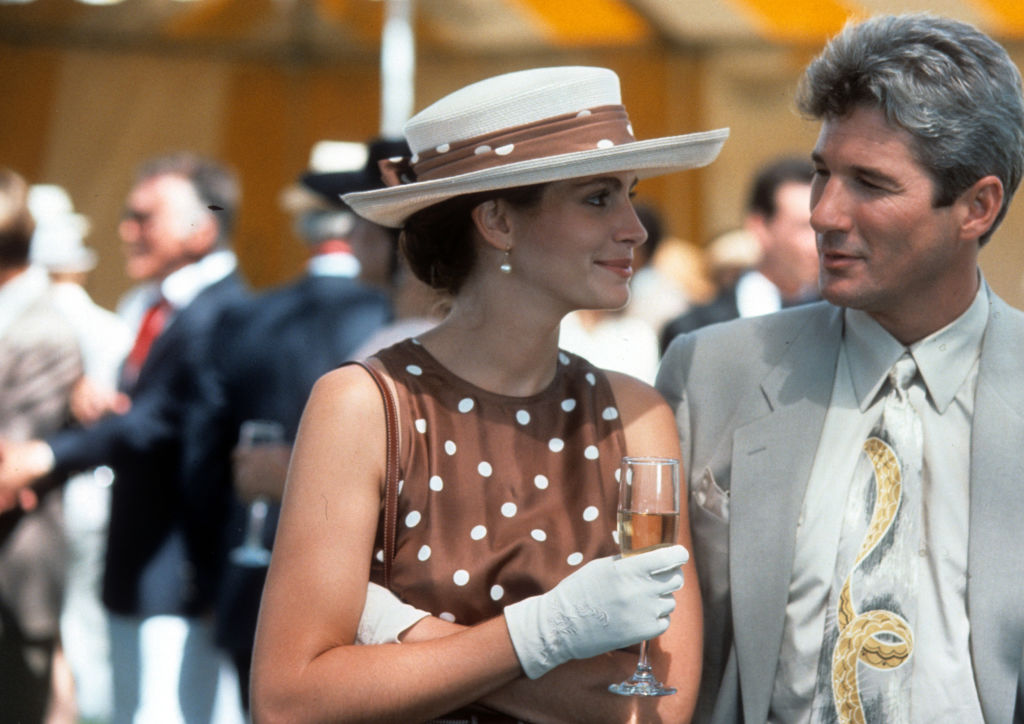
Other outfits serve different narrative purposes. The brown-and-white polka-dot dress worn at the polo match is more restrained and daytime appropriate, reflecting the setting where Vivian meets people connected to Edward’s business world. Her clothing in these sequences demonstrates how costume design can communicate character development without changing the character into someone unrecognizable.
Vance’s work is often remembered because the costumes were not simply decorative. They helped audiences understand how Vivian was being seen by others and how she was beginning to see herself. The film’s wardrobe remains an example of how costume design can influence storytelling, character, and the enduring image of a movie.

The Jewelry Box Moment Was a Spontaneous Laugh
Another of the film’s most beloved scenes happens shortly before Edward and Vivian leave for the opera. Edward presents Vivian with a necklace in a jewelry box. As she reaches toward it, he quickly closes the lid, surprising her and prompting an immediate laugh from Roberts.
Garry Marshall explained in interviews that the moment was intended as a playful on-set joke and was initially filmed for the gag reel. The reaction from Roberts was spontaneous, and Marshall chose to use it in the final movie. The jewelry box was reportedly soft enough to avoid causing harm, allowing the improvisation to remain lighthearted.
The decision to keep the take added an unusually natural beat to a highly polished scene. Until that point, the sequence is filled with formal details: an elegant dress, a sophisticated hotel suite, valuable jewelry, and preparations for a night at the opera. Roberts’s laughter interrupts the formality and makes the interaction feel more relaxed and personal.
Spontaneous moments can be valuable in filmmaking because they bring a sense of unpredictability to a scripted scene. Directors do not always retain improvised material, but when it supports character relationships and fits the overall tone, it can become more memorable than carefully planned dialogue. In Pretty Woman, the jewelry box scene is a small example of a genuine reaction becoming part of the film’s emotional texture.
Richard Gere Improvised at the Piano
The late-night piano scene gives audiences a quieter view of Edward Lewis. Rather than conducting business meetings or directing employees, he sits alone at a piano and plays. Vivian watches him, seeing a side of him that does not fit the controlled, business-focused image he presents during much of the film.
Gere has said that the scene grew from a conversation with Marshall about what someone might do while unable to sleep in a hotel. Gere mentioned that he sometimes enjoyed finding a piano in a hotel ballroom or bar and playing. Marshall asked him to bring that idea to the character, and Gere performed an improvised piece for the scene.
The sequence works because it is understated. Edward does not explain his emotions through a long speech. Instead, the music gives Vivian and the audience a brief glimpse of his private world. It suggests that beneath his carefully managed public life, he has interests and feelings that he rarely shares.
At a Venice Film Festival masterclass, Gere discussed the scene as an important moment in Vivian’s understanding of Edward. Earlier in the story, she sees him primarily as a powerful executive whose decisions affect other people’s lives. The piano scene complicates that impression by showing him in a vulnerable, solitary moment.
Why Pretty Woman Still Inspires Discussion
More than 30 years after its release, Pretty Woman continues to attract viewers because it can be discussed from several perspectives. Many audiences appreciate its charm, humor, fashion, and central performances. At the same time, critics and scholars have considered its portrayal of wealth, gender expectations, class mobility, and romantic fantasy.
Its staying power also reflects the strength of its filmmaking craft. Roberts and Gere created a screen partnership that audiences found compelling, while Marshall balanced comedy with sentimental drama. The score, costumes, locations, and soundtrack all contributed to a distinct early-1990s Hollywood style.
The bloopers and behind-the-scenes stories do not diminish the movie’s appeal. Instead, they show how much of filmmaking depends on collaboration, experimentation, editing, and chance. A changed breakfast prop, an improvised laugh, a costume color decision, and a piano performance can all become small but lasting parts of a film’s identity.
For returning viewers, spotting these details can add a new layer to a familiar favorite. For first-time audiences, they provide useful context for understanding how Pretty Woman developed from a darker script into one of the era’s defining romantic comedies.
Sources
Disclaimer: This content is intended for entertainment purposes only and is not based on real events.