

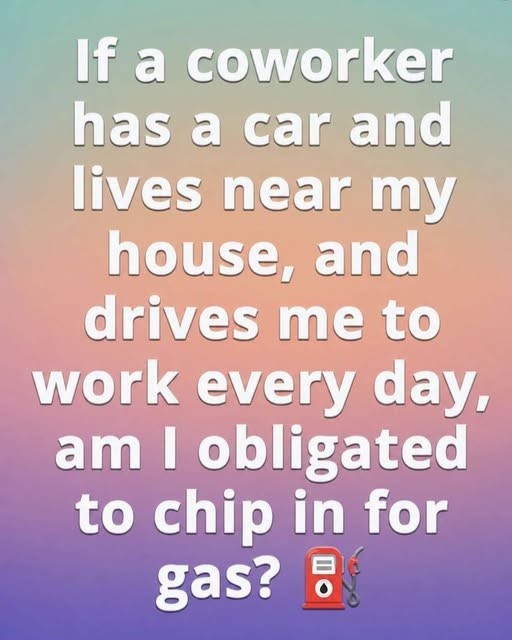
Getting a free ride to work every day can feel like a simple favor between coworkers. Perhaps your colleague already drives past your neighborhood, and picking you up adds only a few minutes to their commute.
But even when the arrangement seems convenient, there can be costs that aren’t immediately obvious.
Fuel, vehicle maintenance, time, scheduling, and occasional detours all add up. More importantly, a daily ride can gradually become an expectation rather than a favor if neither person talks about it.
A Free Ride Is Still an Effort

Imagine your coworker leaves home every morning, picks you up, and drives both of you to work.
At first, they might genuinely be happy to help. You might offer to contribute, but they politely decline.
After a few weeks, however, the situation may start to feel different.
They are still paying for fuel. They are still responsible for the vehicle. And they may occasionally adjust their departure time to make sure you’re ready.
That doesn’t automatically mean they expect payment. But it does mean their effort deserves recognition.
A convenient arrangement can remain positive when both people understand that the ride is a favor rather than an obligation.
Why Staying Silent Can Become Awkward

If you’ve never discussed the arrangement, it can be easy to assume everything is fine.
Your coworker hasn’t complained, so you might think they don’t mind.
But people sometimes avoid raising small frustrations because they don’t want to create an uncomfortable situation at work.
Over time, an arrangement that began as a generous favor could potentially create resentment if one person feels that their effort is being taken for granted.
That is why a simple conversation can be valuable.
You don’t need to make it formal or uncomfortable. Something as simple as, “I really appreciate you driving me every day. Is there anything I can contribute toward fuel?” can show that you recognize their effort.
Should You Contribute Toward Fuel?

There is no universal rule that says you must pay your coworker.
The appropriate approach depends on the circumstances.
If your coworker drives past your home anyway and has specifically offered to pick you up, they may genuinely consider it no trouble.
On the other hand, if they regularly make a special trip to collect you, your contribution becomes more reasonable.
You could suggest contributing a small amount toward fuel each week or month.
The goal isn’t necessarily to calculate every mile or divide every expense precisely. Instead, it’s about acknowledging that transportation has a cost.
What If They Refuse Money?
Your coworker might respond, “Don’t worry about it.”
If they genuinely don’t want money, there are other ways to show appreciation.
You could occasionally buy them coffee or breakfast, give them a fuel gift card, or treat them to lunch.
You might also return the favor in another practical way when the opportunity arises.
For example, perhaps you can help with an errand, bring them something they need, or occasionally take over another small responsibility.
The important thing is that appreciation doesn’t always have to take the form of cash.
Communication Matters More Than the Amount
One of the biggest mistakes is focusing too much on finding the “correct” amount to pay.
The more important issue is communication.
If you’re receiving a daily ride, acknowledging the favor shows that you understand the effort involved.
You could say:
“I really appreciate you driving me. I don’t want to take advantage of your kindness, so I’d like to contribute toward fuel.”
That sentence does several things at once. It expresses gratitude, recognizes the cost involved, and gives your coworker an opportunity to explain what they are comfortable with.
They may accept your offer.
They may suggest a different arrangement.
Or they may tell you that they are perfectly happy to continue without compensation.
Any of those outcomes is better than silently assuming.
Consider the Time Involved
Fuel isn’t the only expense.
Time can be even more valuable.
If your coworker has to wait for you every morning, leave home earlier, or take a longer route, those small inconveniences can accumulate.
A ride that adds five minutes to a commute once might not matter. Five extra minutes every weekday for months is a different story.
This is why it is worth considering the entire arrangement rather than simply asking how much gasoline is being used.
Don’t Turn a Favor Into an Obligation

There is another side to the situation as well.
If your coworker voluntarily gives you a ride, contributing toward expenses does not mean you are purchasing an unlimited transportation service.
You should still be punctual, communicate clearly when your schedule changes, and avoid assuming that the arrangement will continue forever.
If you don’t need a ride on a particular day, let them know as early as possible.
Likewise, if you expect to be late, communicate rather than leaving your coworker waiting.
Good manners can be just as valuable as financial contributions.
What Makes a Fair Arrangement?
A healthy carpool arrangement usually has a few simple characteristics.
Both people understand what is expected. Pick-up times are reasonably consistent. Changes are communicated in advance. The driver doesn’t feel obligated to provide transportation, and the passenger doesn’t treat the ride as an automatic entitlement.
Financial contributions can be discussed openly, but they aren’t necessarily the only solution.
In some situations, alternating who drives may be practical. In others, one person may provide transportation while the other regularly pays for coffee, meals, parking, or fuel.
There is no single formula that works for every coworker relationship.
A Small Gesture Can Prevent a Bigger Problem
The easiest time to discuss appreciation is before anyone becomes frustrated.
If you’ve been receiving rides for weeks or months, don’t wait until your coworker finally complains.
Instead, acknowledge their generosity now.
A simple coffee, fuel contribution, or sincere thank-you can communicate something important: you notice the effort they’re making.
That recognition can help keep a convenient arrangement from becoming an uncomfortable expectation.
The Bottom Line
Getting a ride to work from a coworker can be a wonderful example of people helping one another. But convenience shouldn’t make us forget the effort behind the favor.
If someone regularly drives you to work, consider offering to contribute toward fuel or finding another meaningful way to show appreciation. If they decline, respect their decision while continuing to express gratitude.
Ultimately, the exact amount matters less than the attitude behind the arrangement.
A ride may seem like a small favor, but recognizing someone’s time, fuel, and effort can make the difference between a relationship that feels one-sided and one that remains comfortable for everyone.