

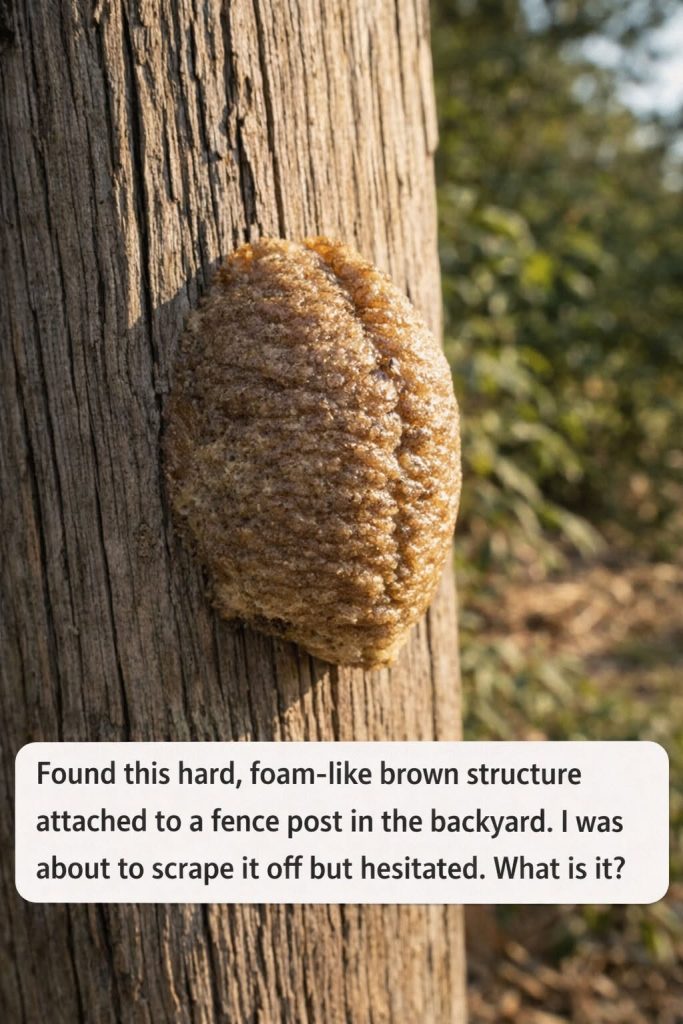
Imagine stepping into your backyard one morning and noticing a small, brown, foam-like object attached to your fence, a tree branch, or a garden shrub. At first glance, it might look unusual, and many homeowners wonder whether it is a fungus, an insect nest, or something that should be removed immediately.
In reality, this mysterious structure is often something far more fascinating. In many cases, it is an ootheca, the protective egg case of a praying mantis. Far from being harmful, it can be a sign that your garden provides a healthy habitat for beneficial wildlife.
Understanding what an ootheca is, how it develops, and why it plays an important role in nature can help gardeners make informed decisions while supporting local biodiversity.
What Is an Ootheca?
An ootheca is a protective egg case produced by female praying mantises toward the end of summer or during autumn.
After mating, the female secretes a frothy substance around her eggs. This material quickly hardens into a durable, foam-like casing that protects the developing insects from cold temperatures, changing weather, and many natural predators.
Although the egg case is usually only a few centimeters long, it may contain dozens or even hundreds of developing mantises waiting for spring.
The tough outer covering acts as a natural shelter, helping the eggs survive throughout the winter until environmental conditions become favorable for hatching.

Why Does It Look Like Foam?
The distinctive appearance often causes confusion.
When first produced, the material resembles soft foam. Within a short period, exposure to air causes it to harden into a lightweight but durable structure with a textured surface.
Its color generally ranges from light tan to dark brown, allowing it to blend naturally with tree bark, wooden fences, and shrubs.
This camouflage provides additional protection by making the egg case less noticeable to predators.
Where Are Oothecae Commonly Found?
Praying mantis egg cases can appear in many outdoor locations, including:
- Wooden fences
- Tree branches
- Garden shrubs
- Flower stems
- Deck railings
- Outdoor furniture
- Garden stakes
- Bushes and hedges
Because female mantises select sheltered locations, homeowners often discover them while pruning plants or preparing gardens for spring.
What Happens in Spring?
As temperatures gradually increase, the tiny mantises complete their development inside the egg case.
When conditions become suitable, numerous young mantises emerge through small openings in the protective casing.
The newly hatched insects quickly disperse into nearby vegetation, where they begin searching for tiny insects as food.
Although many hatchlings do not survive to adulthood due to natural environmental factors, enough typically remain to contribute to the local ecosystem.
Why Praying Mantises Are Considered Beneficial
Praying mantises are widely recognized as beneficial insects in many gardens.
They feed on a variety of small insects, including:
- Aphids
- Caterpillars
- Flies
- Leafhoppers
- Beetles
- Some mosquitoes
- Other soft-bodied garden insects
By naturally reducing certain insect populations, praying mantises may help gardeners maintain a healthier outdoor environment without relying solely on chemical pest control methods.
Because they are generalist predators, they may also consume other insects found in the garden, making them one part of a balanced ecosystem rather than a targeted solution for pest management.
Should You Remove an Ootheca?
In most situations, experts recommend leaving the egg case undisturbed.
If the ootheca is attached to a safe outdoor location where it will not be damaged, allowing it to remain in place gives the developing mantises the opportunity to hatch naturally.
If the object is located where construction or maintenance is necessary, it may sometimes be carefully relocated to a nearby shrub or protected branch before spring arrives.
Handling should be kept to a minimum to reduce the risk of damaging the protective casing.
How to Recognize a Praying Mantis Egg Case
Several characteristics help distinguish an ootheca from other natural objects.
It is typically:
- Light brown or tan
- Oval or elongated in shape
- Firm but lightweight
- Textured with a foamy appearance
- Attached securely to a solid surface
Unlike many insect nests, an ootheca has no visible openings or ongoing insect activity during winter.
The Science Behind the Protective Shell
From a biological perspective, the ootheca is an impressive example of natural adaptation.
The hardened outer layer helps:
- Reduce moisture loss
- Protect developing eggs from temperature fluctuations
- Shield against rain and snow
- Discourage some predators
- Provide structural stability throughout winter
This specialized design increases the likelihood that developing mantises will survive until spring.
Scientists continue studying insect reproductive strategies like the ootheca to better understand evolutionary adaptations across different species.
Cultural Interest in the Praying Mantis
Throughout history, praying mantises have appeared in the folklore and traditions of many cultures.
Their distinctive posture has inspired stories symbolizing patience, focus, stillness, and observation.
In some traditions, spotting a praying mantis is considered a positive sign associated with harmony and balance in nature.
While these interpretations belong to cultural beliefs rather than scientific evidence, they illustrate humanity’s long-standing fascination with the natural world.
Supporting Garden Biodiversity
Healthy gardens often contain a wide variety of insects, birds, and beneficial organisms.
Maintaining biodiversity can help create balanced ecosystems where many species contribute to natural ecological processes.
Gardeners can encourage beneficial wildlife by:
- Planting diverse flowering plants
- Reducing unnecessary pesticide use
- Providing native vegetation
- Leaving some natural habitat undisturbed
- Supporting pollinators and beneficial insects
A praying mantis ootheca is often one small indicator of this ecological diversity.
Common Misconceptions
Because the egg case looks unusual, several misconceptions frequently arise.
Some people believe it is:
- A fungal growth
- A wasp nest
- A harmful insect infestation
- A plant disease
In reality, an ootheca is simply a protective egg case produced by a praying mantis and is generally considered a normal part of many outdoor environments.
Recognizing it correctly helps prevent unnecessary removal.
Conclusion
Discovering a strange foam-like object attached to a fence or garden plant can initially be surprising, but in many cases it is actually the remarkable egg case of a praying mantis. Designed to protect dozens or even hundreds of developing insects throughout the winter, the ootheca represents one of nature’s many ingenious survival strategies.
From a scientific perspective, it demonstrates how insects have evolved specialized reproductive adaptations to protect future generations. From a cultural perspective, the praying mantis has long inspired curiosity and symbolism in communities around the world.
Ultimately, taking a closer look before removing unfamiliar natural objects reminds us that even the smallest discoveries can reveal fascinating stories about the living world. Curiosity, combined with accurate knowledge, allows us to better appreciate the remarkable diversity that exists right in our own backyards.
Sources
- Smithsonian Institution
- University of Kentucky Entomology
- University of California Integrated Pest Management (UC IPM)
- Penn State Extension
- National Wildlife Federation
- Xerces Society for Invertebrate Conservation
- Encyclopaedia Britannica
- Cornell University Department of Entomology
- National Geographic
- U.S. Forest Service