



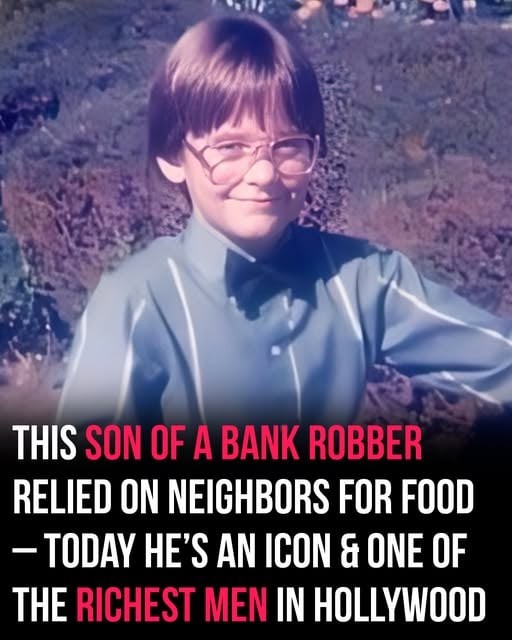
A bank robber father. Food stamps. Nights on relatives’ couches. Before the red carpet and millions, Tobey Maguire’s life was closer to a tragedy than a fairy tale. He could have vanished into addiction, poverty, or prison like so many others. Instead, one $100 bribe from his mother changed everything. His escape from alco…
Tobey Maguire’s story begins in chaos: teenage parents, a father who robbed a bank with a note, and a childhood spent drifting between couches, shelters, and food stamps. Feeling alone and unsafe, he learned early that no one was coming to rescue him. When his mother offered him $100 to take a drama class instead of home economics, he grabbed it, not knowing it would alter his life forever. Acting became both an escape and a weapon, a way to turn all that fear and instability into something powerful.

He dropped out of high school, fought his way through bit parts, and got sober at 19, long before fame could finish him. Then came The Ice Storm, Pleasantville, The Cider House Rules—and finally Spider-Man, which transformed a poor kid into a global icon and multimillionaire. Even after a high-profile divorce, he chose kindness, opening his home to his ex-wife and her fiancé during the wildfires. From lonely, frightened boy to disciplined actor, producer, father, and poker shark, Maguire’s life is less a superhero fantasy than proof that the hardest origins can forge the strongest heroes

A Childhood Defined by Instability and Survival
To understand the quiet intensity that Tobey Maguire brings to the screen, one must look at the fractured environment that shaped him. Born in Santa Monica, California, in 1975 to parents who were barely out of their teens, Maguire never experienced the cushioned suburban upbringing common to many young Hollywood stars. His parents separated when he was two years old, triggering a nomadic childhood spent moving constantly across California, Oregon, and Washington.
Money was perpetually scarce, and survival often depended on government assistance and the temporary generosity of extended family. In 1993, when Maguire was trying to establish himself as a young actor, his father, Vincent Maguire, walked into a California bank without a weapon, handed a teller a note demanding cash, and walked out—an act born of financial desperation that resulted in a two-year prison sentence. Rather than abandoning his father, Tobey stood by him, visiting him behind bars and carrying the quiet weight of public shame while trying to audition for commercial roles.
Growing up in survival mode forces a child to become hyper-observant. Without a stable home base, Maguire learned how to read rooms, adapt quickly to shifting social dynamics, and hide his vulnerabilities behind a calm, unreadable exterior—skills that would later become his greatest assets on camera.
Choosing Sobriety Before the Spotlight
In the late 1980s and early 1990s, young actors navigating the Hollywood audition circuit were surrounded by excess, nightlife, and substance abuse. Having grown up around instability and emotional pain, Maguire found himself turning to alcohol as a teenager to numb the anxiety of his upbringing.
However, at just 19 years old—years before landing a single major leading role—Maguire recognized that he was walking down a destructive path. With remarkable self-awareness, he joined Alcoholics Anonymous and committed to complete sobriety. That decision proved foundational. While many of his peers from that era saw their careers derailed by addiction once money and fame arrived, Maguire entered his twenties with total mental clarity, emotional discipline, and an uncompromising work ethic.
The Art of Quiet Vulnerability on Screen
When Maguire began landing critical acclaim in the late 1990s, directors quickly noticed that he possessed a rare screen presence. Unlike traditional leading men who relied on swagger or booming charisma, Maguire specialized in stillness, restraint, and bruised innocence.
When Sam Raimi cast him as Peter Parker in Spider-Man, some studio executives questioned whether a soft-spoken indie actor could carry a massive summer tentpole. Yet Maguire’s personal history made him the ideal vessel for the character. He understood what it felt like to be an outsider, to worry about rent money, to carry heavy secrets, and to feel responsible for protecting the people around him. His portrayal turned Spider-Man into a cultural phenomenon, grossing over $825 million worldwide and paving the way for the modern superhero film era.

Reinvention, High-Stakes Strategy, and Quiet Grace
Fame and fortune rarely erase early survival instincts; instead, they often reshape how a person navigates the world. Following the Spider-Man trilogy, Maguire stepped back from constant acting to focus on producing through his company, Material Pictures, and raising his two children with jewelry designer Jennifer Meyer.
Away from film sets, Maguire also became notorious in Los Angeles for his analytical mind at high-stakes private poker games—a pastime that mirrored his childhood mastery of reading people, calculating risk, and keeping his emotions tightly concealed. Even when tabloid headlines scrutinized his Hollywood social circle or his competitive nature at the card table, Maguire largely refused to play the celebrity PR game, keeping his private life fiercely guarded.
Perhaps the clearest measure of his character emerged long after the cameras stopped rolling. Following his 2016 separation from Jennifer Meyer, the two maintained an unusually close, supportive co-parenting bond. When devastating wildfires swept through Los Angeles, threatening homes and displacing thousands, Maguire immediately opened his doors to Meyer and her new fiancé, ensuring his family remained safe and united under one roof. For a man who spent his childhood sleeping on strangers’ couches without a safe place to call home, providing shelter and stability for others was the ultimate full-circle moment.