


When people look at a modern skyscraper, they usually notice the glass, the distinctive shape, or the impressive skyline it creates.
Very few people stop to think about the building’s outer skin.
Yet behind those windows, panels, insulation layers, and decorative surfaces is an intricate engineering system designed to protect the people inside from wind, rain, sunlight, noise, and changing temperatures.
A building facade is far more than an architectural finishing touch.
It can account for roughly 15% to 25% of a building’s construction cost and plays an important role in energy efficiency. In Europe, buildings account for a substantial share of energy consumption, while the proportion can be even higher in densely developed regions such as Hong Kong. As architects and engineers have searched for better ways to reduce energy use, facade systems have become increasingly sophisticated.
But greater energy efficiency can introduce new engineering questions.
What happens when insulation materials, composite panels, ventilation spaces, adhesives, solar technologies, and other components interact under extreme heat?
That question has become an important focus of modern fire engineering.
A special issue of Fire Technology, edited by Eric Guillaume, brings together research examining facade flammability, testing methods, computer modeling, building design, firefighting practices, and regulations. The collection illustrates just how complex the science behind facade safety has become.
The Building’s Outer Skin Has Many Jobs
A facade has to perform several functions at once.
It protects interior spaces from weather. It can reduce heat entering or leaving the building. It helps manage natural light and sound. It contributes to the appearance of a structure and can influence the amount of energy needed to maintain comfortable indoor temperatures.
In other words, the facade is part architecture and part engineering.
Modern buildings often use multiple layers to achieve these objectives.
There may be an exterior cladding material, an insulating layer, structural components, adhesives, air spaces, windows, protective barriers, and other systems working together.
Each component may perform well when tested individually.
The challenge is understanding what happens when all those components become part of one large system.
This is one of the central questions explored by researchers studying facade fire behavior.
Why Energy Efficiency Creates New Questions
Improving insulation can help buildings consume less energy.
That is an important goal as cities become more densely populated and governments, architects, and engineers look for ways to reduce energy consumption.
However, insulation materials can behave differently when exposed to high temperatures.
A material that performs well for thermal efficiency may require additional consideration from a fire-safety perspective.
This does not mean energy-efficient facades are inherently unsafe.
Rather, it demonstrates why modern building design must consider multiple objectives simultaneously.
A facade needs to conserve energy while also meeting appropriate fire-safety requirements.
Researchers therefore examine not only individual materials but also how entire facade systems behave under different conditions.
The Hidden Complexity of Composite Panels
One area of research involves aluminum composite panels and sandwich facade panels.
These systems may contain an exterior metal layer surrounding an internal core.
At first glance, the outer metal surface can appear to provide substantial protection.
But researchers have found that the connection between the exterior layer and the internal core can significantly influence how a panel behaves under fire conditions.
One study from The Hong Kong Polytechnic University examined how failure of that connection could expose the internal material to heat.
This highlights an important principle in engineering:
The performance of a system cannot always be predicted by examining its individual components separately.
A material may receive a certain classification when tested on its own, but its behavior can change when it becomes part of a larger assembly.
That is why full-scale testing is so important.
Adhesives Can Play an Unexpected Role
Another study in the special issue examined adhesive layers used inside insulated facade panels.
Adhesives may seem like a relatively minor part of a building system.
In reality, they can influence how different layers interact.
Researchers from Wuhan University of Technology and BRANZ investigated an intumescent flame-retardant epoxy resin adhesive.
Their findings suggested that this type of adhesive could delay ignition of the internal core and, under certain test conditions, contribute to self-extinguishing behavior.
This is an example of how seemingly small engineering decisions can have meaningful consequences.
A safer facade may depend not only on choosing the right visible exterior material but also on understanding the invisible layers behind it.
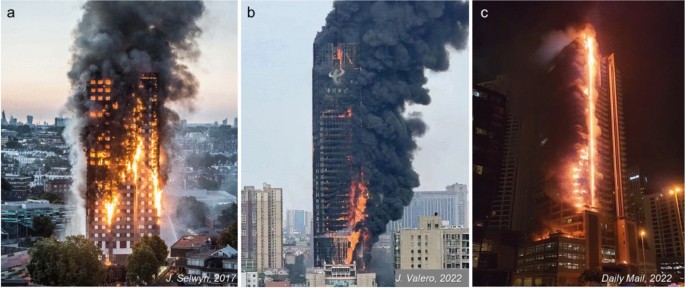
The Chimney Effect and Facade Design
One of the most fascinating physical phenomena examined in facade research is the chimney effect.
When heated air rises through a vertical or partially enclosed space, airflow can become stronger.
In certain facade configurations, this can influence how heat and flames move upward.
Researchers from the University of Science and Technology of China examined flame behavior between combustible facade materials and nearby surfaces, including the influence of separation distance and chimney effects.
Another full-scale study involving a 12-story structure examined a facade system using expanded polystyrene insulation and plaster.
The researchers found that the shape of the building facade could influence the behavior of the fire plume, with a U-shaped configuration creating conditions associated with a stronger chimney effect.
This demonstrates why building geometry matters.
A facade that looks relatively simple from street level can contain spaces and channels that behave very differently when exposed to high temperatures.
Why Small Tests Are Not Always Enough
One of the biggest challenges in fire engineering is scale.
A material may perform one way in a small laboratory test and behave differently when incorporated into a large building system.
This is because heat transfer, airflow, material interactions, and structural geometry can change dramatically as the scale increases.
Researchers from China University of Mining and Technology and the Building Research Institute in Japan examined the performance of expanded polystyrene facade systems at different testing scales.
Their work highlighted nonlinear changes when laboratory observations were compared with larger-scale experiments.
This is an important lesson for engineers.
A small sample can provide valuable information, but it cannot always tell the complete story of how an entire facade system will behave.
That is why researchers use multiple testing levels, ranging from material-scale experiments to larger intermediate tests and, when appropriate, full-scale building experiments.
Wooden Facades Require Careful Design
Wood is another material receiving increasing attention in modern architecture.
Wooden facades can provide an attractive natural appearance and may support certain sustainability goals.
But their fire performance depends on much more than the material itself.
Researchers from the Technical University of Munich examined wooden facade systems under full-scale testing standards.
Their work identified several important factors, including the type of wood cladding and supporting structure, the depth of the ventilation cavity behind the facade, and the fire performance of the exterior wall layer.
This illustrates another key principle of facade engineering.
There is rarely a single factor that determines safety.
Material choice, construction details, ventilation spaces, protective barriers, and installation quality can all interact.

The Importance of Fire Barriers
Fire barriers, sometimes called fire stops, are another important part of facade design.
Their purpose is to limit the movement of heat and flames through concealed spaces within a building system.
Researchers from the Indian Institute of Technology Gandhinagar examined different facade materials on a full-scale three-story structure under compartment-fire conditions.
Their work highlighted the importance of the area between floors and the way protective barriers are installed.
This is a valuable reminder that even a high-quality safety component can only perform as intended when it is correctly designed and installed.
Engineering drawings are important.
But construction quality matters too.
Wind Can Change the Picture
Buildings do not exist in a laboratory.
Real structures experience wind, changing temperatures, rain, sunlight, and many other environmental conditions.
Wind can be particularly important when researchers study facade fire behavior.
A study from Efectis used numerical simulations to examine full-scale facade tests and found that changes in heat release could influence heat exposure at the facade.
The research also examined how wind can alter flame shapes and patterns.
This matters because a facade’s behavior cannot always be predicted from a single idealized scenario.
Real buildings exist in complex environments.
A high-rise structure surrounded by other buildings may experience very different airflow from an isolated test structure.
That is why modern fire engineering increasingly combines laboratory experiments, full-scale testing, computer simulations, and real-world observations.
New Technology Is Helping Researchers See Fire Differently
Understanding large-scale fire behavior can be difficult.
Traditional measurement equipment can provide valuable data, but researchers are also exploring new technologies.
One study from Imperial College London and Poland’s Instytut Techniki Budowlanej introduced an approach called Visual Fire Power.
The technique uses two cameras to estimate fire heat release by analyzing the visible volume of the fire over time.
The concept is particularly interesting because cameras can observe large-scale experiments from a distance.
If refined and validated further, visual measurement techniques could provide researchers with additional tools for understanding complex fire behavior.
This reflects a broader trend in engineering.
Advanced sensors, imaging technology, numerical models, and artificial intelligence are increasingly being combined with traditional experiments.
Solar Panels Add Another Layer of Complexity
Modern buildings are also becoming more energy-conscious through the use of photovoltaic panels.
Solar technology can help buildings generate renewable electricity, but integrating photovoltaic systems into facades introduces additional fire-safety considerations.
Researchers from Universiti Putra Malaysia reviewed firefighting practices involving photovoltaic systems and identified areas where building regulations and emergency procedures may need further development.
This is another example of the challenge facing modern architecture.
Buildings are evolving quickly.
New technologies can improve energy performance, sustainability, and functionality, but safety standards must evolve alongside them.
Why Regulations Matter
Scientific research is only part of the solution.
The findings need to reach architects, engineers, construction companies, regulators, building owners, and emergency services.
Building codes and standards help translate scientific knowledge into practical requirements.
But regulations must keep pace with new materials and construction methods.
A facade system designed decades ago may be very different from one installed on a contemporary high-rise.
As materials become more complex, regulations need reliable testing methods that reflect real-world conditions.
This is why researchers continue to call for stronger connections between scientific studies and practical building standards.
The Challenge of Existing Buildings
New buildings can incorporate safety considerations from the beginning.
Existing structures are more complicated.
A building may have been designed under older regulations and later renovated with new insulation, cladding, windows, or energy-saving technologies.
Improving its fire performance can therefore require careful investigation.
Engineers may need to understand what materials are present, how they are connected, where concealed cavities exist, and whether protective barriers remain effective.
The challenge is not simply replacing one material.
It is understanding the entire system.
This is where cost-benefit analysis becomes important.
Building owners and policymakers must balance safety improvements with practical financial considerations while ensuring that essential safety measures are not overlooked.
What Future Facade Research Needs to Explore
The special issue emphasizes that facade fire safety remains a multidisciplinary challenge.
Researchers identify several areas that deserve continued attention.
These include better experiments and computer models, improved detection and suppression strategies, stronger smoke-management approaches, evacuation planning, performance-based facade design, and more detailed investigation of previous facade incidents.
Another important area is education.
Lessons from real-world building incidents need to become part of the training of fire engineers, emergency personnel, architects, and other professionals.
The goal is not simply to understand what happened in the past.
It is to use those lessons to make future buildings safer.
A Safer Future Begins Behind the Glass
When people walk past a skyscraper, they usually see an impressive architectural surface.
They rarely see the engineering decisions hidden behind it.
They do not see the insulation.
They may not notice the adhesives.
They cannot see the ventilation cavities or protective barriers.
They probably do not think about how wind could influence airflow around the structure.
Yet all of these details can matter.
The science of facade fire safety reminds us that modern buildings are complex systems. Improving one characteristic, such as energy efficiency, cannot be considered separately from other requirements.
Safety, sustainability, architecture, cost, construction, and emergency response all have to work together.
That is why the work of fire scientists and engineers is so important.
Final Reflection: Looking Beyond the Surface
A building facade is often judged by what we can see.
Its color.
Its windows.
Its shape.
Its materials.
But the most important qualities of a facade may be the ones hidden beneath the surface.
The research collected in Fire Technology offers a fascinating glimpse into the science behind those invisible decisions.
It shows that safer buildings require more than choosing materials that perform well in isolation. Engineers must understand how complete facade systems behave, how different components interact, how building geometry affects airflow, how wind changes conditions, and how safety measures perform at realistic scales.
Modern architecture is constantly evolving.
As cities become taller, denser, and more energy-efficient, facade engineering will become even more important.
The lesson is simple but powerful: a beautiful building is not complete until it is also a safe building.
Behind every window and every panel is an engineering story that most people never see.
Understanding that hidden story may be one of the best ways to build a safer future.
Sources
Springer Nature / Fire Technology — Eric Guillaume, “Special Issue on Facade Flammability and Fire Engineering,” Fire Technology.
Read the original Springer article
Fire Technology — Research journal covering fire science, engineering, materials, building safety, and related technologies.
Hong Kong Polytechnic University — Research into facade panel behavior and the interaction between exterior layers and internal cores.
Technical University of Munich — Research concerning wooden facade systems, ventilation cavities, and fire performance.
Imperial College London — Research into camera-based approaches for measuring large-scale fire characteristics.
Efectis — Research and testing organization specializing in fire safety, including full-scale facade testing and numerical simulation.